
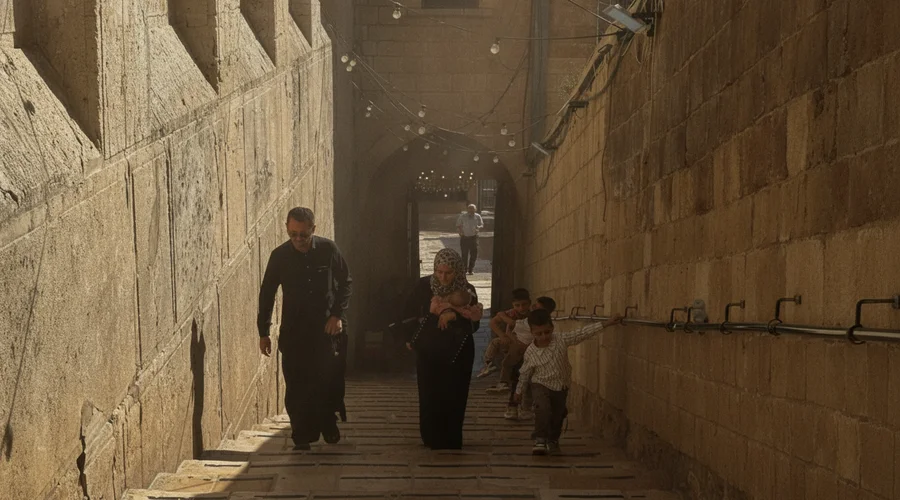
Israel Takes Over Planning Authority for Ibrahimi Mosque
In a significant development, Israel has declared its assumption of planning and construction authority over the Ibrahimi Mosque area in Hebron, located in the occupied West Bank. This decision, announced by Finance Minister Bezalel Smotrich, effectively nullifies certain provisions of the 1997 Hebron Agreement, which had previously granted these powers to the Palestinian municipal council of Hebron within the H2 zone. The move has been met with strong reactions, with observers describing it as a potentially 'dangerous' escalation in an already volatile region.
The Ibrahimi Mosque: A Site of Shared Significance
The Ibrahimi Mosque, also known as the Cave of the Patriarchs, holds profound religious importance for all three Abrahamic faiths. It is believed to be the burial site of Abraham, Isaac, Jacob, and their wives. While Jews and Christians refer to it as the Tomb or Cave of the Patriarchs, Muslims revere Abraham and established the Ibrahimi Mosque, or Sanctuary of Abraham, in the 14th century, building upon first-century BC Roman walls. Historically, this site has been a flashpoint for conflict, notably in 1994 when an American-Israeli settler killed 29 Muslim worshippers and injured many more during prayers.
Details of the Israeli Announcement
Minister Smotrich, a figure from Israel's far-right political spectrum, confirmed the transfer of planning and construction powers for the religious site and surrounding Jewish settlements to Israeli authorities. This decision, which he termed a 'historic step,' is aimed at deepening 'Israeli sovereignty' in the West Bank, a territory Palestinians envision as the core of their future independent state. The move follows an earlier approval by Israeli Prime Minister Benjamin Netanyahu's security cabinet to facilitate land acquisition for settlers in the West Bank and enhance Israeli enforcement powers in the area. Smotrich has openly advocated for the expansion of Israeli settlements and the elimination of Palestinian statehood, a stance that has coincided with an increase in settler violence against Palestinians.
Previous Control Under the Hebron Agreement
The 1997 Hebron Agreement, signed by then-Israeli Prime Minister Benjamin Netanyahu and PLO Chairman Yasser Arafat, divided Hebron into two zones: H1, under Palestinian control (approximately 80% of the city), and H2, under Israeli control (the remaining 20%). The H2 zone encompasses the Jewish Tomb of the Patriarchs, the adjacent Ibrahimi Mosque, and the Old City. Crucially, the agreement stipulated that the Palestinian Authority (PA) would oversee planning and construction for the entire city, including the Ibrahimi Mosque. Hebron's Old City is recognized as a Palestinian World Heritage site by UNESCO. Despite Palestinian oversight in planning, Israel has gradually asserted more control over the Ibrahimi Mosque since 1994, leading to restrictions on access, partitioning of prayer spaces, and granting prayer rights to Jewish settlers.
Fathi Nimer, a Palestine Policy Fellow at Al-Shabaka, commented on the existing situation, stating, "When it comes to the Ibrahimi Mosque, it was already de facto under the control of the Israelis in more ways than another. Access to it is heavily restricted and regulated, there’s periodic closures, and I don’t see how this will change that, really." He added that the latest move removes one less provision concerning construction regulation, which he believes Israel did not adhere to strictly in the first place.
Implications for the Hebron Agreement and Oslo Accords
While Israel's Ministry of Foreign Affairs attempted to mitigate international criticism by clarifying that the 1997 Hebron Agreement was not entirely canceled, the transfer of planning powers specifically for Jewish settler areas and holy sites, including the Ibrahimi Mosque, was confirmed. Nimer explained that Smotrich's action targets the part of the accord related to coordination with the Hebron municipality on construction permits, modifications to places of worship, or settlement expansion. This decision is seen as part of a broader effort to dismantle official negotiations and coordination mechanisms established by the Oslo Accords.
The Oslo Accords, signed in 1993 and 1995, aimed to pave the way for Palestinian self-determination and led to the creation of the Palestinian Authority and the division of the West Bank into Areas A, B, and C, each with varying levels of PA control. Nimer suggests that Smotrich's latest move eliminates any recourse for the Hebron municipality to challenge settler plans in Israeli courts, effectively treating the area like the rest of Area C, where Israel unilaterally decides on construction and expansion. He views this as an attempt by Israeli ministers to "undo as much of Oslo as possible," even if many of its provisions were not fully adhered to previously.
Reactions from Palestinian and International Bodies
The office of Palestinian President Mahmoud Abbas condemned the seizure of powers as an "infringement upon the political and legal status of Hebron" and a violation of international law. Hebron's Palestinian mayor, Yousef Al-Jabari, labeled Smotrich's announcement a "racist decision aimed at stripping the Hebron municipality of its powers."
Internationally, Israel's settlements in the West Bank are largely considered illegal under international law, particularly the Fourth Geneva Convention concerning occupied territories. Many observers view the expansion of these settlements as a primary impediment to Israeli-Palestinian peace and the establishment of a Palestinian state. The Council on American-Islamic Relations (CAIR) strongly condemned the move, stating it represents "another attempt to consolidate its illegal occupation of Palestinian land, undermine Palestinian self-governance, and alter the historic status of one of Islam’s holiest sites." Chris Doyle, director of the Council for Arab-British Understanding, reiterated the danger of altering existing arrangements in Hebron in favor of intensifying the Israeli occupation, advocating for the withdrawal of settlements and full Palestinian control over the city, with appropriate arrangements for holy sites.
Historical Precedents at Other Holy Sites
This development in Hebron is not an isolated incident. Similar shifts in control, access, or legal status have been observed at other Palestinian or Islamic holy sites. For instance, at the Al-Aqsa Mosque in Jerusalem, Israeli authorities frequently employ expulsion orders, conduct searches, detain individuals, and impose restrictions on Muslim worshippers, often under the guise of 'security measures.' Furthermore, settler organizations, often with state support, actively work to gain control of properties within and around Jerusalem's Old City, including areas near holy sites, indicating a broader pattern of asserting Israeli control over significant religious and historical locations.
Source: Israel takes control of Hebron’s Ibrahimi Mosque: What this means
Related Articles
 world
world
Global Water Crisis: Satellite Imagery Reveals Ten Disappearing Freshwater Sources
 world
world
Escalating Tensions: Israeli Actions in Lebanon Jeopardize US-Iran Agreement
 world
world
G7 Leaders Pledge Enhanced Support for Ukraine and Stricter Sanctions on Russia
 world
world