
International Community Responds to West Bank Developments
Recent weeks have seen significant actions from the international community regarding the Israeli-Palestinian conflict, particularly concerning developments in the West Bank. France, along with several other Western nations, has moved to sanction Israeli settlers and organizations, while a prominent human rights group has leveled serious accusations against Israel's policies in the territory. These actions come amidst a backdrop of continued Israeli expansion of settlements and military presence.
Sanctions and Accusations Mount Against Israeli Policies
On June 9, France announced a ban on Israeli Finance Minister Bezalel Smotrich from entering the country, citing his advocacy for West Bank annexation and the resettlement of Gaza. The ban also extended to four leaders of settler organizations and 21 individual settlers. French Foreign Minister Jean-Noel Barrot highlighted Smotrich's promotion of policies that could lead to the economic collapse of the Palestinian Authority.
Concurrently, France, the United Kingdom, Canada, and Norway, in coordination with Australia and New Zealand, collectively imposed sanctions on networks involved in financing settler violence. These measures reflect a growing international concern over the activities of certain settler groups.
Adding to the international pressure, on June 10, Amnesty International issued a report accusing Israel of engaging in a years-long, state-sponsored campaign of ethnic cleansing in the West Bank. The human rights organization claimed this campaign is designed to accelerate the annexation of Palestinian land. The Israeli military has rejected these accusations. On the same day, UN Secretary-General Antonio Guterres addressed the UN Security Council, warning of a "presumption of impunity" in the occupied territories. He cited an average of six settler attacks per day, displacement levels not seen since 1967, and an attempted annexation that he stated would possess "no legal validity."
Israel Advances Settlement Funding and Military Presence
Despite the mounting international censure, Israel has proceeded with plans to expand its presence in the West Bank. According to the Israeli anti-settlement group Peace Now, the Israeli cabinet approved a plan to fund 69 settlements with a budget of $388 million, reportedly bypassing standard planning procedures. Peace Now also indicated that since late 2022, the government has approved or legalized 103 settlements, 51 of which are entirely new. Many of these newly funded sites are situated in strategically sensitive areas, such as the South Hebron Hills and the Jordan Valley.
This political endorsement for the settler movement is unfolding as the territorial divisions established by the Oslo Accords, which nominally designate Areas A and B of the West Bank under partial or full Palestinian control, are experiencing unprecedented erosion by Israeli authorities. On June 11, it was reported by Haaretz that the Israeli military announced the establishment of a permanent post within the Jenin refugee camp. This marks the first standing military presence within Area A since the Oslo Accords, an area intended to be under full Palestinian civil and security control. The military stated that the post would "regulate the deployment of forces."
Escalating Outpost Campaigns and Nightly Raids
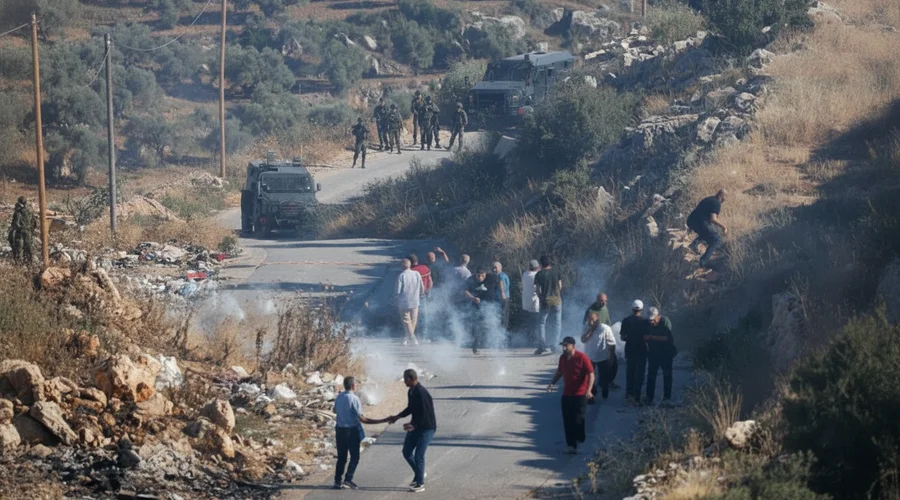
The drive to establish new outposts deeper into Palestinian-administered land has been particularly visible northwest of Ramallah. In Deir Abu Mash’al, residents have reportedly spent six consecutive days attempting to prevent settlers from establishing an illegal outpost on al-Qarana hill. After villagers repeatedly dismantled a settler tent, a second one was erected on June 15. Reports from Wafa news agency and local activists indicate that settlers attacked residents and a council member, injuring four Palestinians, one critically, while Israeli forces reportedly used tear gas and live ammunition.
Settlers have also expanded outposts in other areas, including bringing mobile units to Karmeilo, east of al-Taybeh, and unloading caravans at the Gharaba outpost northwest of Sinjil. Hundreds of dunums of land were reportedly seized across the Jalud, Qaryut, and Khirbet Sarra plains south of Nablus, where local activists claim police prevented landowners from accessing their property while allowing settlers to remain undisturbed. Online settler chat groups reportedly circulated a manifesto boasting of "endless tours through Areas A and B" and "new outposts growing like mushrooms after rain." Nightly raids continued, with reports of Palestinian land being set on fire. On June 14, masked and armed settlers reportedly attacked Deir Dibwan and neighboring Burqa east of Ramallah, torching vehicles and partially burning a home, as well as setting fire to mosque entrances before residents extinguished them. Settlers also reportedly assaulted residents and burned wheat fields near Nablus.
Impact on Bedouin Communities and Water Resources
Bedouin and herding communities in the West Bank continue to face significant challenges, including harassment, water sabotage, and demolition orders, which activists argue are aimed at displacing families from their land. Documentation from local activists indicates that Israeli authorities issued demolition and stop-work orders against 13 structures in al-Deirat and six in Khallet al-Hamous near Yatta. Homes of the al-Zawahra family at Mikhmas and others east of Yatta were reportedly demolished, and a poultry slaughterhouse supporting 50 people in Ras Karkar was razed.
On June 15, in the Ighziwah and Ma’in areas east of Yatta, forces reportedly demolished two family homes housing 25 individuals, two agricultural sheds, a perimeter wall, a 130-cubic-meter water well, and uprooted 20 trees belonging to the Rab’i and Jabarin families. The targeting of water resources has also been a recurring issue. Reports from Wafa and local activists state that settlers severed pipelines supplying two communities at Khan al-Ahmar, contaminated wells near Sa’ir, burned a well supplying Udala, stole pipes near a Bethlehem reservoir, and, with Israeli forces, seized five water tankers in Idhna. Nayef Khalaife also told Al Jazeera that settlers invaded his family home on June 12, emptying water tanks and damaging infrastructure. The UN Office for the Coordination of Humanitarian Affairs (OCHA) reported that since January, over 100 incidents have damaged or destroyed more than 190 water and sanitation structures across the West Bank, cutting off at least 10 Masafer Yatta communities from the network.
Gaza Continues to Face Humanitarian Crisis Amidst Ongoing Conflict
In Gaza, despite a nominal ceasefire, daily Israeli strikes, shelling, and gunfire have continued to result in Palestinian casualties. The Gaza Health Ministry's post-ceasefire toll has surpassed 990, bringing the cumulative toll since October 2023 to over 73,000. On June 14, an Israeli strike on a warehouse near the Yemen al-Sa’eed Hospital in Jabalia reportedly killed at least four people. The following day, attacks in Nuseirat, al-Zawayda, and Gaza City’s Tuffah neighborhood reportedly killed several civilians, including a four-year-old girl, and a detained child was reported killed after being seized with his father.
Along the constantly shifting "Yellow Line," which delineates Israel's military control within Gaza, forces have reportedly advanced under heavy fire into Tuffah and towards the al-Sanafour roundabout, utilizing engineering units and bulldozers. This advancement has triggered a fresh wave of displacement from eastern Gaza City. Zaki al-Qara, 30, was reportedly shot dead on June 14 near the Bani Suheila roundabout. A three-year-old boy, Rayan Abu al-Ajeen, was reportedly shot and killed on his family farm near the line in Deir el-Balah. Meanwhile, Israeli officials have reportedly approved plans for a possible return to large-scale fighting, citing intelligence that Hamas has rebuilt parts of its infrastructure.
The humanitarian situation in Gaza continues to deteriorate, with aid entry severely restricted. OCHA reported that more than 70 percent of Gaza's population relies on water trucks, and funding shortfalls are jeopardizing the supply. Fuel entering the Strip has plummeted to barely a million liters for the week, and daily cooked-meal production has halved since March. Gaza's health ministry stated that Israel is blocking at least 16,500 patients from leaving for treatment, including Dr. Hussam Abu Safiya, who appeared by video link at an Israeli Supreme Court hearing, with his lawyers presenting what they described as signs of torture following over 500 days in detention.
Source: Palestine weekly wrap: World sanctions settlers, Israel funds settlements
Related Articles
 world
world
Global Water Crisis: Satellite Imagery Reveals Ten Disappearing Freshwater Sources
 world
world
Escalating Tensions: Israeli Actions in Lebanon Jeopardize US-Iran Agreement
 world
world
G7 Leaders Pledge Enhanced Support for Ukraine and Stricter Sanctions on Russia
 world
world