
Anti-G7 Demonstrations Turn Violent in Geneva
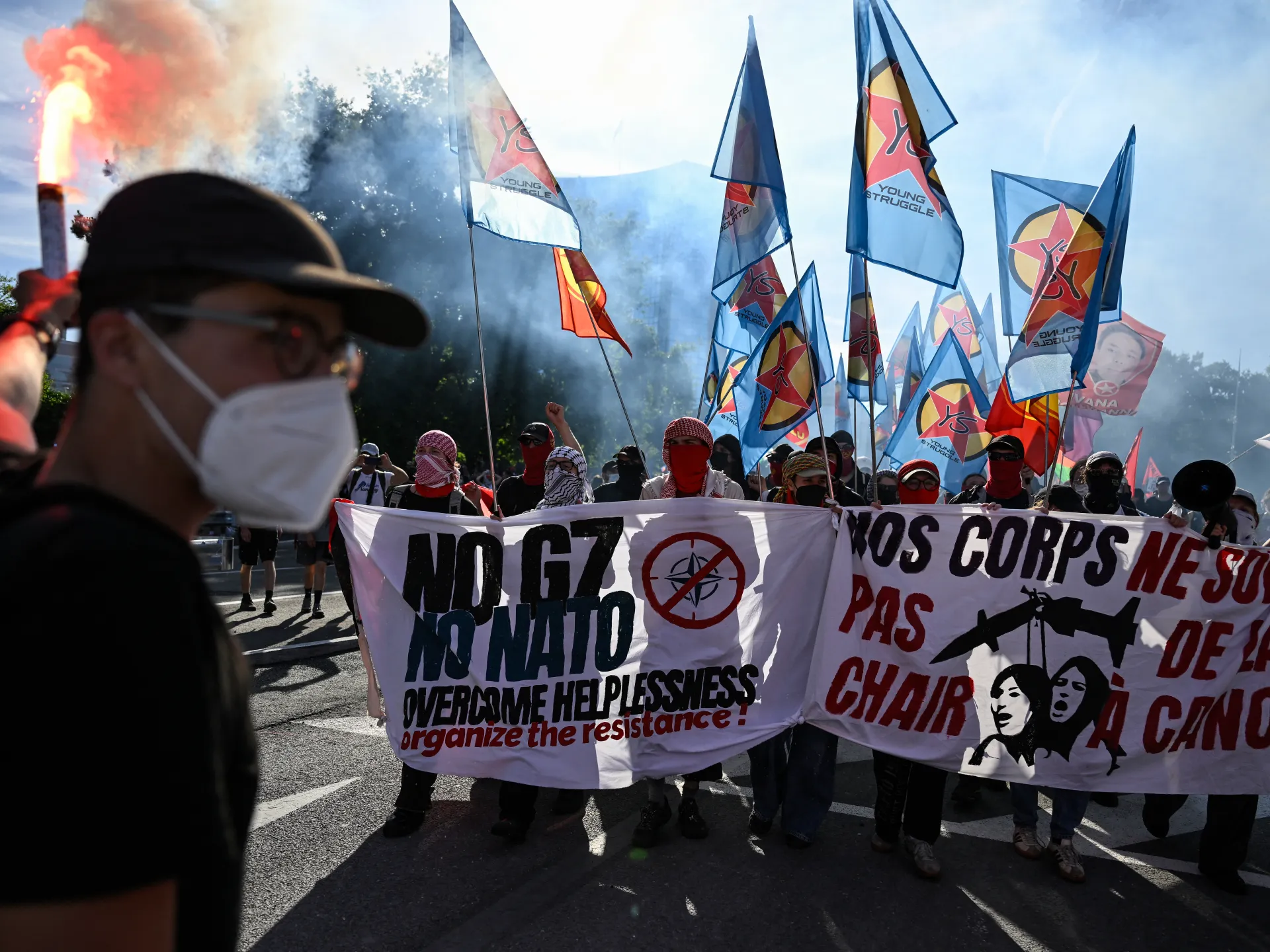
A protest against the upcoming G7 summit, held in Geneva, Switzerland, on June 14, 2026, saw a significant turnout before escalating into violent confrontations. While a large portion of the approximately 20,000 demonstrators marched peacefully, segments of the protest veered into destructive behavior, prompting a forceful response from law enforcement. The G7 summit, bringing together leaders from the world's most affluent democracies, was scheduled to commence the following day across Lake Geneva in Evian, France.
Swiss authorities had initially authorized a specific march route, intentionally situated away from Geneva's upscale commercial district, in an effort to prevent a recurrence of the extensive unrest observed during the 2003 G8 summit in the city. For the most part, participants proceeded calmly under bright sunshine, displaying Palestinian flags and banners advocating for climate action. Chants against capitalism and Western military alliances resonated through the streets, with placards bearing slogans such as, “No to the G7 and all imperialist alliances” and “Abort the G7.”
Escalation and Property Damage
The atmosphere shifted when distinct groups of protesters, often clad in black, diverged from the main procession. These individuals reportedly dismantled barriers, vandalized affluent residential buildings, and ignited vehicles. Among the damaged property was a Tesla car, which was set ablaze and spray-painted with the phrase “Eat the Rich.” Additionally, structures located near the European headquarters of the United Nations sustained damage. According to police reports, around 600 activists, identified as “Black Bloc” members, were involved in these acts of violence.
In response to the escalating disorder, Geneva police deployed tear gas and water cannons to disperse the stone-throwing individuals. The confrontations persisted into the evening, marked by incidents including car fires and the smashing of bank windows along the protest route. The “No G7” coalition, comprising over 60 associations, unions, and left-wing organizations, had organized the demonstration. This broad coalition included advocates for Palestinian rights, feminist groups, and environmental activists, all united in their opposition to the G7 summit, which they denounced as a symbol of “fascism and imperialism.”
Summit Context and Global Tensions
The 2026 G7 summit, scheduled from June 15-17 in Evian-les-Bains, France, was anticipated to address critical international issues. A primary focus was expected to be on efforts to de-escalate the conflict between the United States and Israel against Iran, which had commenced in February. The ongoing war in Ukraine was also slated to be a dominant topic of discussion among the participating leaders. French President Emmanuel Macron arrived in Evian on Sunday to host his counterparts, including US President Donald Trump, as thousands of Swiss and French security personnel were strategically positioned around the lake region to ensure security for the event.
The G7 summit brings together the leaders of Canada, France, Germany, Italy, Japan, the United Kingdom, and the United States. In addition to these core members, the European Union's foreign policy chief and ministers from Brazil, the United Arab Emirates, and Turkiye were also expected to participate, underscoring the broad international engagement anticipated at the meeting. The violent turn of the protests in Geneva highlighted the significant public opposition and deep-seated grievances held by various groups against the policies and influence of the G7 nations, setting a tense backdrop for the high-level international gathering.
Source: Original Article
Related Articles
 world
world
Global Water Crisis: Satellite Imagery Reveals Ten Disappearing Freshwater Sources
 world
world
Escalating Tensions: Israeli Actions in Lebanon Jeopardize US-Iran Agreement
 world
world
G7 Leaders Pledge Enhanced Support for Ukraine and Stricter Sanctions on Russia
 world
world