
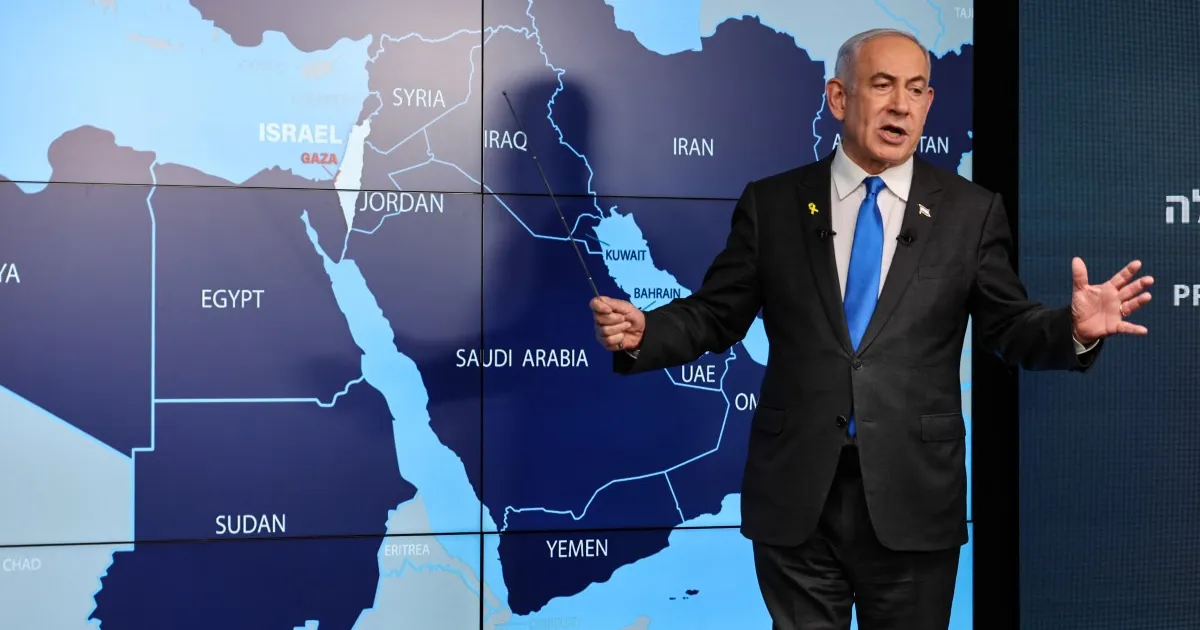
The 'Greater Israel' Concept: Origins and Interpretations
The notion of 'Greater Israel' refers not to the established State of Israel but to a more expansive ideological vision, often cited as a significant factor in various Middle Eastern conflicts. This concept, broadly understood, proposes that Israel should encompass the entirety of historic Palestine, stretching from the Jordan River to the Mediterranean Sea, and potentially include territories in neighboring countries. Historical and religious texts are sometimes invoked to support this interpretation, with some proponents suggesting a reach from the Nile to the Euphrates.
The doctrine of 'Greater Israel' appears to draw support from two distinct, yet sometimes overlapping, ideological perspectives. One perspective originates from secular hardliners who argue that extensive territorial control is essential for Israel's security, even if it entails governing large Palestinian populations. This view prioritizes strategic depth and territorial dominance as paramount for national defense. The other perspective is rooted in religious beliefs, asserting that the land was divinely granted exclusively to the Jewish people, thereby negating the legitimacy of Palestinian claims to the territory. Adherents to this view, such as certain Israeli political figures, have publicly stated their attachment to this broader vision, sometimes dismissing the very existence of a distinct Palestinian identity.
Recent Regional Developments and the 'Greater Israel' Narrative
Recent events in the Middle East have brought renewed attention to the 'Greater Israel' concept. A framework agreement reached between the United States and Iran on June 14, aimed at de-escalating their conflict, signaled a potential shift in regional dynamics. This agreement sought to reopen the Strait of Hormuz, halt bombardments in Lebanon, and, crucially, end hostilities that had reportedly claimed thousands of lives and threatened the global economy. While a fragile truce, it was seen by some as a significant step towards peace.
However, proponents of the 'Greater Israel' ideology have reportedly viewed such peace initiatives as detrimental to their vision. The cessation of hostilities with Iran, for example, has been interpreted by some as a setback for the expansionist agenda. Critics of the 'Greater Israel' concept argue that it has fueled a cycle of conflict, pointing to past wars in Iraq, Gaza, Lebanon, and Syria as manifestations of this underlying doctrine. They contend that this ideology promotes a sense of paranoia and megalomania, intertwining religious zeal with a program for territorial expansion.
The Role of International Relations and US Policy
For decades, the 'Greater Israel' doctrine has reportedly influenced Israel's foreign and military policies, maintaining its relevance through strategic alliances, particularly with the United States. This influence is often attributed to the support of certain American constituencies, including Jewish Zionists who maintain strong ties with Israel and Christian Zionists who interpret geopolitical events through the lens of biblical prophecy. Critics suggest that this alignment has, at times, led the US into costly and protracted conflicts in the region, with outcomes often diverging significantly from initial expectations.
Past interventions, such as the effort to destabilize the Syrian government, illustrate the potential for such policies to result in prolonged conflict and devastation, rather than swift, decisive victories. The recent US-Iran agreement is seen by some as an attempt by the US administration to disengage from what it perceives as an unproductive and costly regional entanglement. This pivot towards de-escalation has, in turn, intensified friction between certain Israeli political factions and the US, as a peaceful resolution with Iran is viewed as undermining the 'Greater Israel' agenda.
Consequences and the Path to Peace
The ongoing pursuit of the 'Greater Israel' vision is argued by some to be counterproductive to Israel's long-term security and international standing. Recent global opinion surveys suggest a decline in international favorability towards Israel, even among its traditional allies. This erosion of global support is seen as a direct consequence of policies perceived as expansionist or harmful to regional stability.
For sustainable peace in West Asia, critics assert that a fundamental shift away from the 'Greater Israel' doctrine is necessary. This would involve not only ending conflicts, such as those in Gaza and the West Bank, but also pursuing the establishment of a Palestinian state alongside Israel, based on the 1967 borders. Such a two-state solution, with genuine security guarantees for both entities and a robust regional framework, including Israel's withdrawal from territories in Lebanon and Syria, is presented as the most viable path forward. The recent Iran ceasefire, achieved through mediation rather than military force, is cited as an example of how diplomatic solutions can prevail when there is a political will for peace over conflict. Ultimately, the future of the region, and Israel's place within it, may depend on a re-evaluation of current doctrines and a commitment to a more inclusive and equitable peace.
Related Articles
 world
world
US Vice President Vance Arrives in Switzerland for Critical US-Iran Peace Negotiations Amid Regional Tensions
 world
world
High-Stakes Diplomatic Efforts Underway Between US and Iran in Switzerland
 world
world
US and Iran Engage in High-Level Talks in Switzerland Amidst Regional Tensions
 world
world