
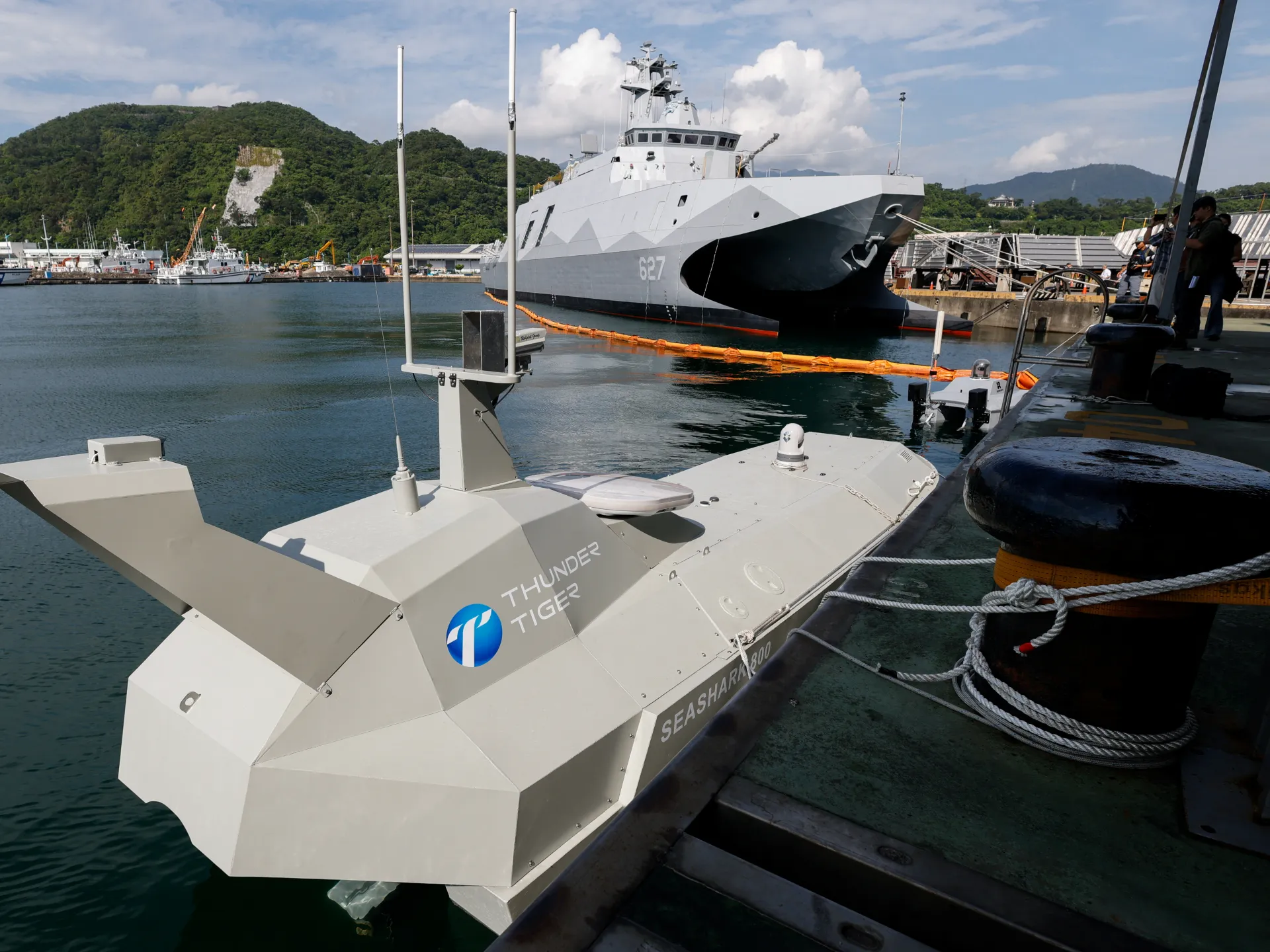
Enhancing Taiwan's Security Through Drone Technology
Raymond Greene, the de facto United States ambassador to Taiwan, recently articulated the strategic importance of drones in strengthening the island's defense capabilities. Speaking at a drone-focused forum in Taichung, Greene, who serves as the director of the American Institute in Taiwan, highlighted that drone technology presents a transformative opportunity to enhance Taiwan's security posture and contribute to regional stability. He likened the desired defense strategy to creating a 'hornet's nest' of air, surface, and subsurface drones, suggesting this approach would be highly effective in deterring potential aggression.
Taiwan, a self-governing entity that China claims as its territory, has been actively pursuing military modernization and increased defense spending. The US, despite lacking formal diplomatic ties, remains Taiwan's primary international supporter and arms supplier, consistently endorsing Taipei's efforts to bolster its defenses against perceived threats from Beijing. Greene underscored the potential for the US and Taiwan to collaboratively anchor democratic drone production, thereby reinforcing the collective deterrence capabilities of democratic nations globally.
The 'Hornet's Nest' Concept and Lessons from Ukraine
Greene elaborated on the concept of a 'hornet's nest,' asserting that such a robust drone presence would serve as the most effective deterrent against conflict. He drew parallels to the ongoing conflict in Ukraine, where drones have significantly empowered defenders, even when facing numerically superior forces. This observation reinforces the argument that unmanned systems can provide a substantial advantage in modern warfare, enabling smaller forces to challenge larger adversaries.
Taiwan's government has recognized the strategic value of drones and other asymmetric military systems. However, the implementation of these defense enhancements has encountered legislative hurdles. In May, the opposition-controlled parliament approved only a portion of the additional defense spending requested by President William Lai Ching-te, specifically allocating funds for US-sourced arms rather than the full package initially proposed.
Legislative Debates and Funding for Drone Acquisition
In response to these challenges, the government has put forth a new financial package totaling 210 billion Taiwan dollars (approximately US$6.59 billion). This funding is intended to cover the acquisition of surveillance, coastal attack, and small unmanned surface drones through the end of 2031. Concurrently, the Kuomintang (KMT), Taiwan's main opposition party, has introduced its own drone legislation. Their proposal caps spending at 240 billion Taiwan dollars (around US$7.5 billion) over six years, with an annual limit of 40 billion Taiwan dollars (approximately US$1.25 billion). A key distinction in the KMT's plan is the proposal to fund drone acquisition from the main national budget, contrasting with the government's preference for a special budget.
These legislative discussions unfold amidst broader regional dynamics. In May, a senior US military official indicated that a substantial $14 billion arms sale to Taiwan might be temporarily delayed to prioritize munitions for the US-Israel conflict. Such developments highlight the complex interplay of international relations and defense priorities that impact Taiwan's security planning.
President Lai's Emphasis on Asymmetric Combat Capabilities
President Lai Ching-te has consistently stressed the urgency of developing Taiwan's drone capabilities. During a meeting of his Democratic Progressive Party, he remarked on the critical need for speed in building asymmetric combat capabilities, citing the evolving geopolitical landscape and the nature of modern warfare. Lai reiterated his rejection of Beijing's sovereignty claims over Taiwan, asserting that the island's future is solely for its people to decide.
The ongoing discussions and strategic initiatives underscore Taiwan's commitment to strengthening its defense through innovative military technologies, particularly drones, as a means to deter aggression and safeguard its autonomy in a complex geopolitical environment.
Source: Taiwan needs to become a ‘hornet’s nest’ of drones, US diplomat says
Related Articles
 news
news
Ukrainian National Indicted in Germany Over Nord Stream Pipeline Explosions
 news
news
California Establishes Bruce Lee Day, Honoring Martial Arts Icon's Legacy
 news
news
Prominent Maltese Businessman Faces Trial in Journalist's Assassination Case
 news
news