
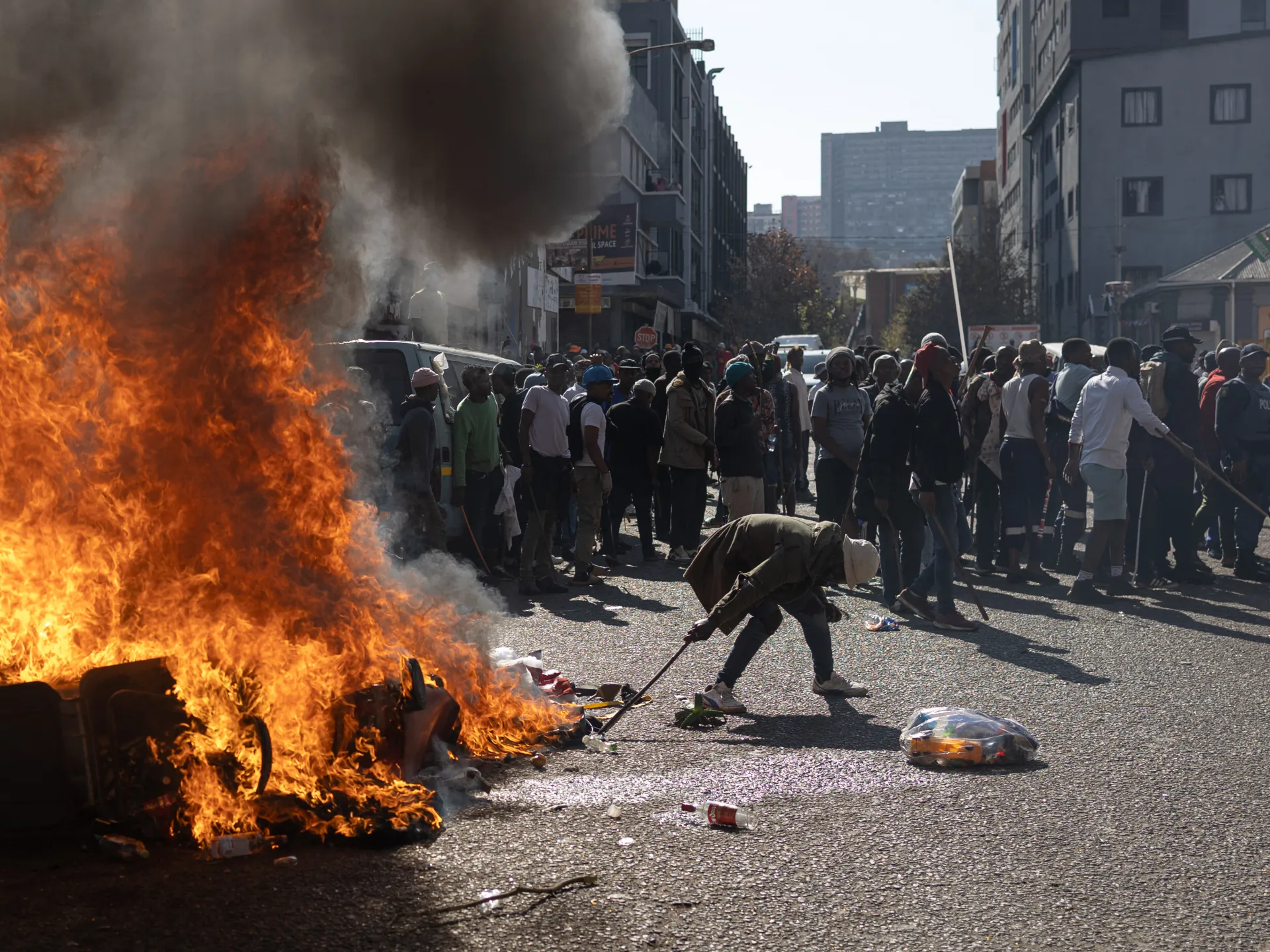
Widespread Arrests During South African Anti-Immigrant Protests
South African authorities have reported the arrest of over 900 people in connection with recent nationwide anti-immigrant demonstrations. While many of the organized events remained peaceful, certain areas experienced violent outbreaks, including instances of looting and a fatal shooting.
The protests, which took place on a Tuesday, were coordinated by a coalition comprising more than 20 civil society organizations, notably the March and March movement. These demonstrations were scheduled to coincide with an unofficial 'deadline' that had been set for undocumented immigrants to depart the country.
Scope of Protests and Police Response
Deputy National Police Commissioner Tebello Mosikili confirmed that out of 120 marches held across South Africa, 108 proceeded without incident, while police intervention was required in 12 instances. The arrests were made for various offenses, including public violence, robbery, and immigration violations.
Geographically, the Western Cape recorded the highest number of arrests, with 215 individuals taken into custody. The Eastern Cape followed closely with 208 arrests, indicating the widespread nature of the police operations.
Presidential Intervention and Public Concerns
In response to the escalating tensions, President Cyril Ramaphosa convened an urgent meeting with key protest organizers on the Monday preceding the main demonstrations. The objective of this meeting was to appeal for calm and de-escalate the situation.
A statement released by the Presidency acknowledged the underlying grievances expressed by the demonstrators. President Ramaphosa noted that "South Africans have raised deep concerns about illegal immigration, border management, pressure on public services… These concerns are real, and they deserve to be heard." This recognition highlights the government's awareness of the public's anxieties regarding immigration-related issues and their impact on national resources and infrastructure.
However, the President also drew a clear distinction, emphasizing that unlawful behavior would not be tolerated. He stated, "Whatever the motivation, taking the law into one’s own hands is vigilantism and has no place in our constitutional democracy." This assertion underscored the government's commitment to upholding the rule of law, even while acknowledging legitimate public concerns.
Incidents of Violence and Continued Calls for Action
Despite the presidential warnings, localized incidents of violence did occur. In Johannesburg's Alexandra township, police confirmed that one individual was fatally shot late on Tuesday during the looting of informal corner shops, commonly known as spaza shops, which are often foreign-owned. Additionally, military personnel were deployed to Johannesburg's inner-city Hillbrow neighborhood after a shooting incident that resulted in injuries to two people, including a 17-year-old.
In the coastal city of Durban, thousands of protestors marched, chanting "Abahambe!" (meaning "They must go!"). Jacinta Ngobese-Zuma, a leader of the March and March movement, addressed the crowds, indicating that demonstrations would persist every Thursday until the government implements stricter border control measures. This suggests a sustained effort by the protest organizers to pressure the government into enforcing more stringent immigration policies.
Human Rights Concerns and Socioeconomic Factors
Human rights organizations, including Amnesty International South Africa, have voiced their condemnation of the targeting of migrants. These groups argue that migrants are being unfairly scapegoated for deeper socioeconomic challenges prevalent in the country. They point to issues such as high unemployment rates and a backlogged asylum system as the true underlying causes of public discontent, rather than attributing them solely to the presence of immigrants.
This perspective suggests that while immigration may be a visible aspect of the current tensions, the root causes are more complex and intertwined with broader national issues. The debate continues regarding the most effective and humane ways to address both the concerns of the local population and the rights of migrants within South Africa.
The ongoing situation underscores the complex interplay between national identity, economic pressures, and human rights in contemporary South Africa, prompting calls for comprehensive solutions that address both immediate concerns and long-term societal challenges.
Source: Original Article
Related Articles
 news
news
Ukrainian National Indicted in Germany Over Nord Stream Pipeline Explosions
 news
news
California Establishes Bruce Lee Day, Honoring Martial Arts Icon's Legacy
 news
news
US Diplomat Advocates for Taiwan's Drone Defense Strategy
 news
news