
Shifting Narratives Amidst Battlefield Realities
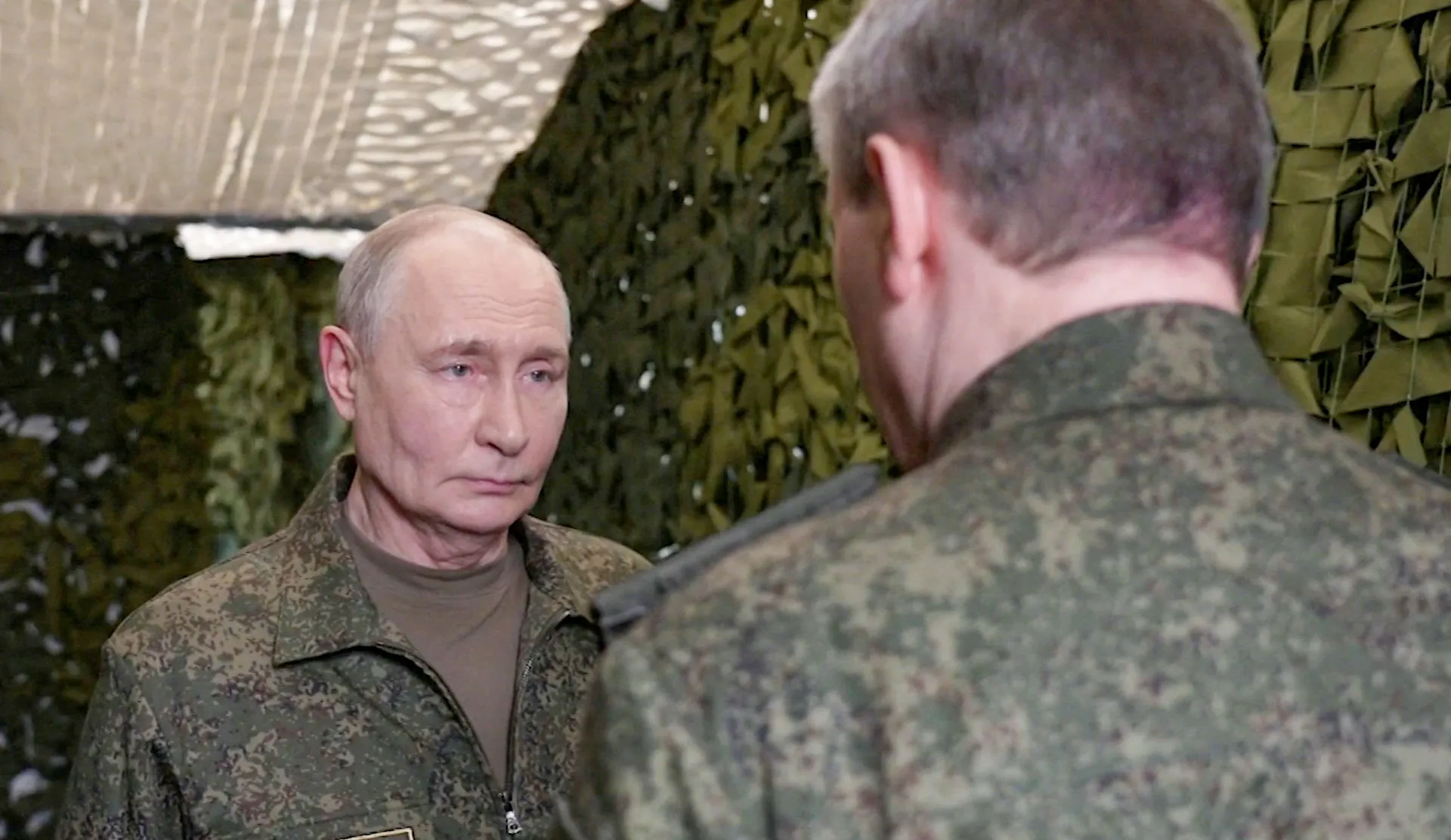
In a recent televised exchange, Russian President Vladimir Putin engaged with Valery Gerasimov, Chief of Russia's General Staff of the Armed Forces, concerning the ongoing conflict in Ukraine. Gerasimov asserted that the 'Kyiv regime,' facing battlefield setbacks, was attempting to convince its 'Western sponsors' of its operational initiative and significant gains. Putin responded by instructing Gerasimov to continue analyzing the involvement of each Western nation in the conflict, stating that this analysis would be crucial for future 'responsible decisions.' This dialogue occurred as Russia's initial objectives to 'demilitarize' Ukraine in 2022 have not materialized as planned.
Observers familiar with the conflict's trajectory noted the staged nature of the conversation and its reliance on unverified information. For instance, Putin claimed the 'complete liberation' of Kostiantynivka, an eastern city, despite Ukrainian forces retaining control over portions of it. Ukrainian President Volodymyr Zelenskyy subsequently challenged Putin to meet him in Kostiantynivka for diplomatic discussions. Furthermore, Putin asserted that Russia had seized over 3,000 square kilometers of territory in Ukraine this year. However, analysis from the Institute for the Study of War, a U.S.-based think tank utilizing geolocated data, indicates that Russia's actual territorial gains between January and July amounted to approximately 97 square kilometers due to shifting front lines and Ukrainian counteroffensives.
The Institute for the Study of War suggested that Putin is constructing a 'false reality' by disregarding tactical and operational developments. They emphasized that Putin's ability to control the information landscape and propagate narratives of Russian military success is vital to sustaining this manufactured perception. Reports also indicate that Russian claims of capturing towns or villages are sometimes based on symbolic acts, such as servicemen planting a flag in a central location, rather than securing full control. A Ukrainian serviceman, identified only as Andriy, described instances where Russian troops undertaking such missions were subsequently engaged by Ukrainian forces.
Justifying Prolonged Conflict and Mobilization
According to Lieutenant General Ihor Romanenko, former deputy head of Ukraine's general staff of armed forces, Putin's objectives are clear: to persuade the Russian populace that NATO's support transformed Russia's 'special military operation' into a protracted 'war with NATO.' Romanenko articulated that this narrative serves to justify why the conflict, initially projected to be brief, has extended into its fifth year. He added that the Kremlin employs this propaganda to explain the need for scaling up military efforts, framing it as a conflict not solely with Ukraine but with the entirety of NATO.
This rhetoric emerges amidst daily Ukrainian strikes on occupied territories and mainland Russia, coupled with a growing fuel shortage and economic pressures within Russia. The Kremlin appears to be preparing the Russian public for a potential broader mobilization, purportedly planned for after the September 18-20 parliamentary elections. Putin had previously declared a 'partial mobilization' in September 2022, which has since seen efforts to recruit 'volunteers' with financial incentives and compel migrants to enlist.
The shift in official language was further highlighted when Kremlin spokesman Dmitry Peskov used the term 'war' to describe the conflict, a term previously suppressed and punishable by law in Russia. Peskov stated, "There's a war going on, a real war... because everything began as a special military operation [but it] goes on like a war, because behind Kyiv stand Berlin, and Paris, and the Hague, and Oslo, and, unfortunately, Washington."
The 'Collective West' Narrative
Volodymyr Fesenko, head of the Kyiv-based Penta think tank, suggested that this framing allows Russia to justify military setbacks and internal issues by attributing them to a larger, more formidable adversary. He explained that when Russia faces difficulties on the front line, increased strikes on its territory, or domestic crises like the fuel shortage, it needs to provide an explanation to its audience. Rather than acknowledging Ukraine's growing strength and effectiveness, the narrative pivots to fighting the 'collective West,' thereby accounting for the prolonged nature of the conflict.
A consistent theme in Moscow's discourse is the purported 'integration' of Ukraine into NATO. Russian Foreign Ministry spokeswoman Maria Zakharova, echoing earlier Kremlin statements, claimed that NATO is providing Ukraine with advanced, AI-driven weaponry to target Russian airfields. She further asserted that Kyiv is 'dragging NATO into a direct armed conflict with Russia' in a desperate attempt to salvage its position. Ukrainian servicemen dismiss these claims, with one drone operator, Ihor, suggesting that Russia uses such narratives to 'save face' by portraying their adversaries not as Ukrainians, but as the combined forces of Western civilization aiming to undermine Russia's resources and traditional values.
Source: Original Article
Related Articles
 world
world
Mali Receives Russian Military Aid Amidst Northern Insurgency
 world
world
Cuba Experiences Widespread Power Outage Amid Deepening Energy Crisis
 world
world
Tanker Ablaze in Strait of Hormuz Following Projectile Strike
 world
world