
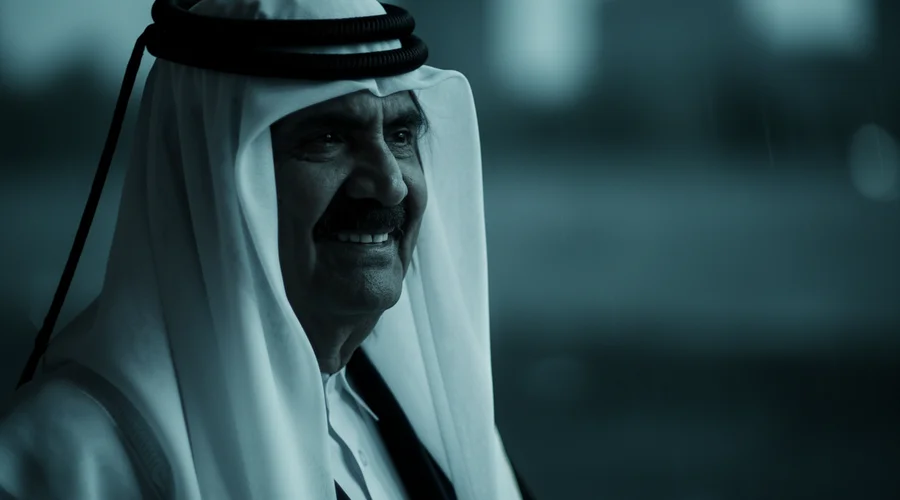
The Passing of a Visionary Leader
The Amiri Diwan has announced the passing of His Highness the Father Emir Sheikh Hamad bin Khalifa Al Thani at the age of 74. The official statement, released on Sunday, expressed profound sorrow and acknowledged the significant loss to the nation. Sheikh Hamad, who governed Qatar from 1995 until 2013, is widely credited as a principal architect behind the remarkable transformation of the energy-rich Gulf nation into a major global player.
During his nearly two-decade tenure, Qatar experienced extensive economic, social, and cultural advancements that substantially elevated its standing on the global stage. His leadership was instrumental in positioning Qatar as the world's leading exporter of liquefied natural gas, a move that underpinned considerable economic investments and fostered a wide array of international partnerships.
In a move that was rare among hereditary rulers in the Gulf region, Sheikh Hamad voluntarily transferred power to his son, Sheikh Tamim bin Hamad Al Thani, in 2013. Sheikh Tamim was 33 years old at the time of the succession, marking a pivotal moment in Qatar's modern history.
A Reign Defined by Development and Diplomacy
Sheikh Hamad bin Khalifa Al Thani's leadership began with the first meeting of his cabinet in Doha on October 30, 1996, laying the groundwork for an era of profound change. His strategic vision extended beyond economic growth, encompassing robust diplomatic engagement and a commitment to global issues.
His international presence was notable, as evidenced by numerous high-level meetings. In May 2003, just seven weeks after the commencement of the Iraq War, Sheikh Hamad met with then-US President George W. Bush at the White House in Washington, DC, underscoring Qatar's evolving role in regional and international security discussions. Diplomacy continued to be a cornerstone of his policy, as he engaged with leaders worldwide, including Indonesian President Susilo Bambang Yudhoyono during a visit to Jakarta in May 2009, and Brazilian President Luiz Inacio Lula da Silva in Brasilia in January 2010.
Beyond high-level state visits, Sheikh Hamad demonstrated a commitment to humanitarian and development efforts. In July 2010, accompanied by Lebanese President Michel Suleiman, he toured reconstruction projects in Bint Jbeil, southern Lebanon. These efforts, partially funded by Qatar, aimed to rebuild areas devastated by the 2006 conflict between Israel and Hezbollah, showcasing Qatar's role in regional stability and recovery.
Global Engagement and Cultural Milestones
Sheikh Hamad's international profile was further enhanced by his participation in significant global forums. In September 2010, he addressed the Millennium Development Goals Summit at the United Nations headquarters in New York. His address emphasized Qatar's support for the UN's objectives in poverty reduction, combating hunger and disease, and advancing education and equality, reflecting a broader commitment to global welfare.
His visits to European capitals also highlighted Qatar's growing influence. In September 2010, German Chancellor Angela Merkel escorted Sheikh Hamad and Sheikha Moza bint Nasser during their visit to Berlin. A month later, in October 2010, Sheikh Hamad and Queen Elizabeth II were pictured at Windsor Castle in England, symbolizing strong bilateral relations.
One of the most iconic moments of his reign, cementing Qatar's place on the world stage, occurred in December 2010. Sheikh Hamad, alongside Sheikha Moza, raised the World Cup trophy after FIFA announced in Zurich, Switzerland, that Qatar would host the 2022 World Cup. This achievement was a testament to Qatar's ambition and its successful bid to bring a major global sporting event to the Middle East.
Continuing his diplomatic engagements, Sheikh Hamad and Sheikha Moza were seen waving from a balcony of the Campidoglio, Rome's city hall, with Mayor Gianni Alemanno and his wife, Isabella Rauti, during a visit in April 2012. He also met with French President Francois Hollande in August 2012 at the Elysee Palace in Paris to discuss the escalating situation in Syria, demonstrating Qatar's active role in addressing regional crises.
Further reinforcing his commitment to international cooperation, Sheikh Hamad met with UN Secretary-General Ban Ki-moon during the UN General Assembly in September 2012 at UN headquarters in New York. In October 2012, he visited Gaza City, where he greeted Palestinians and participated in a cornerstone-laying ceremony for a Qatari-funded rehabilitation center, highlighting Qatar's humanitarian contributions in the Palestinian territories.
His final years in power included a meeting with then-US President Barack Obama in the Oval Office of the White House in Washington, DC, in April 2013, just months before his abdication. Throughout his 18-year rule, Sheikh Hamad bin Khalifa Al Thani oversaw unprecedented economic growth and a significant increase in Qatar's international importance, leaving behind a legacy of transformation and proactive global engagement.
Source: Original Article
Related Articles
 world
world
Escalating Tensions: Middle East on Edge Amidst Iran-US Confrontation
 world
world
Diplomatic Efforts Intensify to De-escalate US-Iran Tensions Through Gulf Mediation
 world
world
Escalation in Gulf: Iran Responds to US Strikes with Regional Missile Attacks
 world
world