
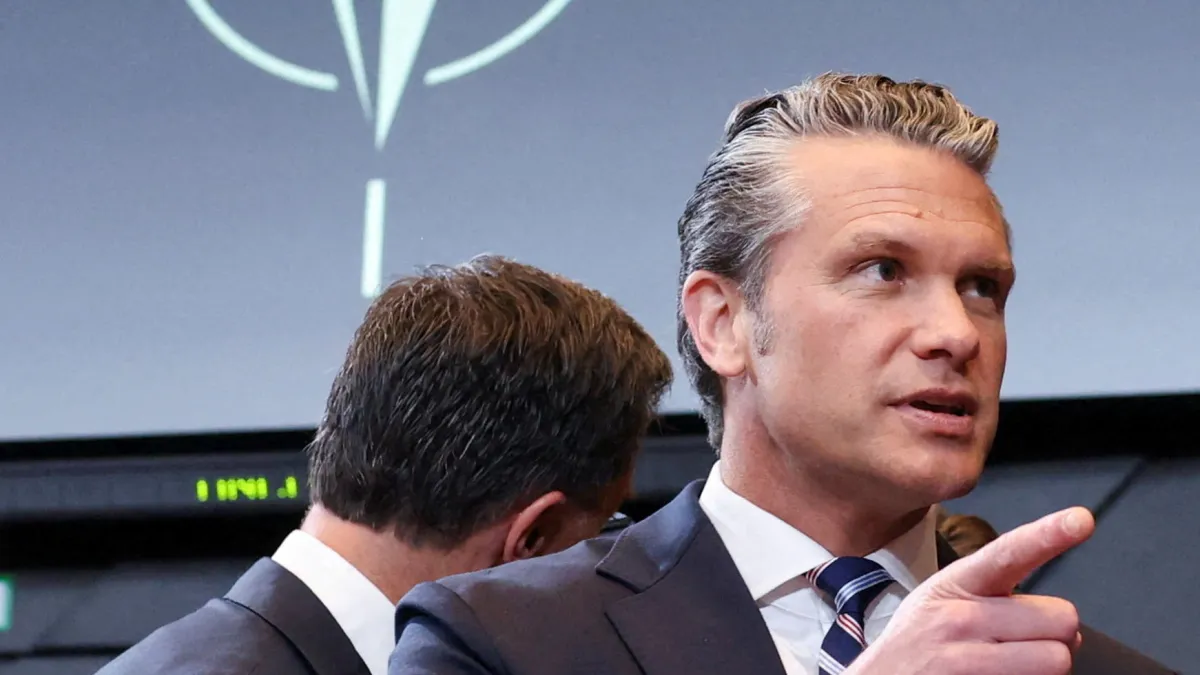
U.S. Defense Secretary Announces Troop Review and Criticizes Allies
U.S. Defense Secretary Pete Hegseth has revealed plans for a significant review of American troop deployments across Europe. This announcement comes with a stern warning to NATO member states, suggesting that the United States may reduce its financial contributions to the alliance if certain allies continue to fall short on their defense spending commitments. Hegseth articulated these points during a meeting with defense ministers at NATO headquarters in Brussels.
The proposed review is slated to span up to six months and will involve extensive consultations with the U.S. Congress. This legislative body has previously established minimum thresholds for the number of U.S. forces stationed in Europe, making their input crucial to the process. Hegseth emphasized the seriousness of this undertaking, stating, "Make no mistake about it, this will be a real review. It will be designed to ensure that NATO is moving fast and irreversibly towards Europe leading, stepping up to take primary responsibility for the defence of Europe."
Allies Urged to Increase Defense Spending and Support
Secretary Hegseth's remarks were not limited to troop deployments and financial dues. He also voiced strong criticism regarding some allies' lack of support for U.S. military operations, specifically citing instances where certain nations denied the U.S. basing and overflight rights during its conflict with Iran. The review, according to Hegseth, will also seek to guarantee such critical rights for future U.S. military activities.
These recent developments follow an earlier communication from the U.S. to its allies, indicating a reduction in the availability of specific U.S. naval vessels and aircraft for NATO operations in the event of an attack on a member state. This move has prompted European allies and Canada to assess how they can compensate for these anticipated capability gaps. According to U.S. Air Force General Alexus Grynkewich, NATO's top commander, this adjustment aims to gradually mitigate an "unhealthy codependence" on U.S. forces, as Washington prepares for the possibility of engaging in multiple simultaneous conflicts globally.
The Vision for "NATO 3.0"
Upon his arrival for the NATO meeting, Hegseth reiterated the U.S. commitment to open and frank discussions, both publicly and privately, with nations that need to enhance their contributions. He outlined his vision for "NATO 3.0," describing it as a post-Cold War recognition that the alliance must revert to a robust military pact equipped with substantial capabilities. This, he suggested, would enable it to effectively deter threats on the continent and assume primary responsibility for Europe's conventional defense.
These discussions unfold against a backdrop of increased defense spending by European allies and Canada. NATO Secretary-General Mark Rutte highlighted this trend, noting that these nations collectively allocated an additional $90 billion to defense last year, representing a 20 percent increase compared to 2024. Rutte also confirmed that the reduction in U.S. contributions to NATO's crisis response forces has already taken effect, stating, "The question yesterday came up: Is this immediate or not? It is immediate."
Impact on NATO Capabilities
While the U.S. has not publicly detailed the specific assets being reduced, military sources have indicated to Reuters that these reductions encompass a range of capabilities, from refueling aircraft to fighter jets, drones, and various types of ships. In response to these changes, some ministers at the Brussels meeting presented offers to increase their contributions to NATO’s crisis pool, signaling an effort to adapt to the evolving landscape of alliance responsibilities.
The comprehensive review and the U.S. stance underscore a pivotal moment for NATO, as the alliance navigates calls for greater burden-sharing and a re-evaluation of its strategic framework in the face of contemporary global challenges.
Source: Pentagon chief announces review of US forces in Europe, slams NATO allies
Related Articles
 news
news
Netanyahu Faces Scrutiny Following US-Iran Accord Excluding Israel
 news
news
Algeria's Humanitarian Aid to Gaza Orphans Commended After World Cup Match
 news
news
Greece's 'Operation ENTOS': A Controversial Approach to Public Order and its European Implications
 news
news