Pakistan's Diplomatic Ascent in US-Iran Rapprochement
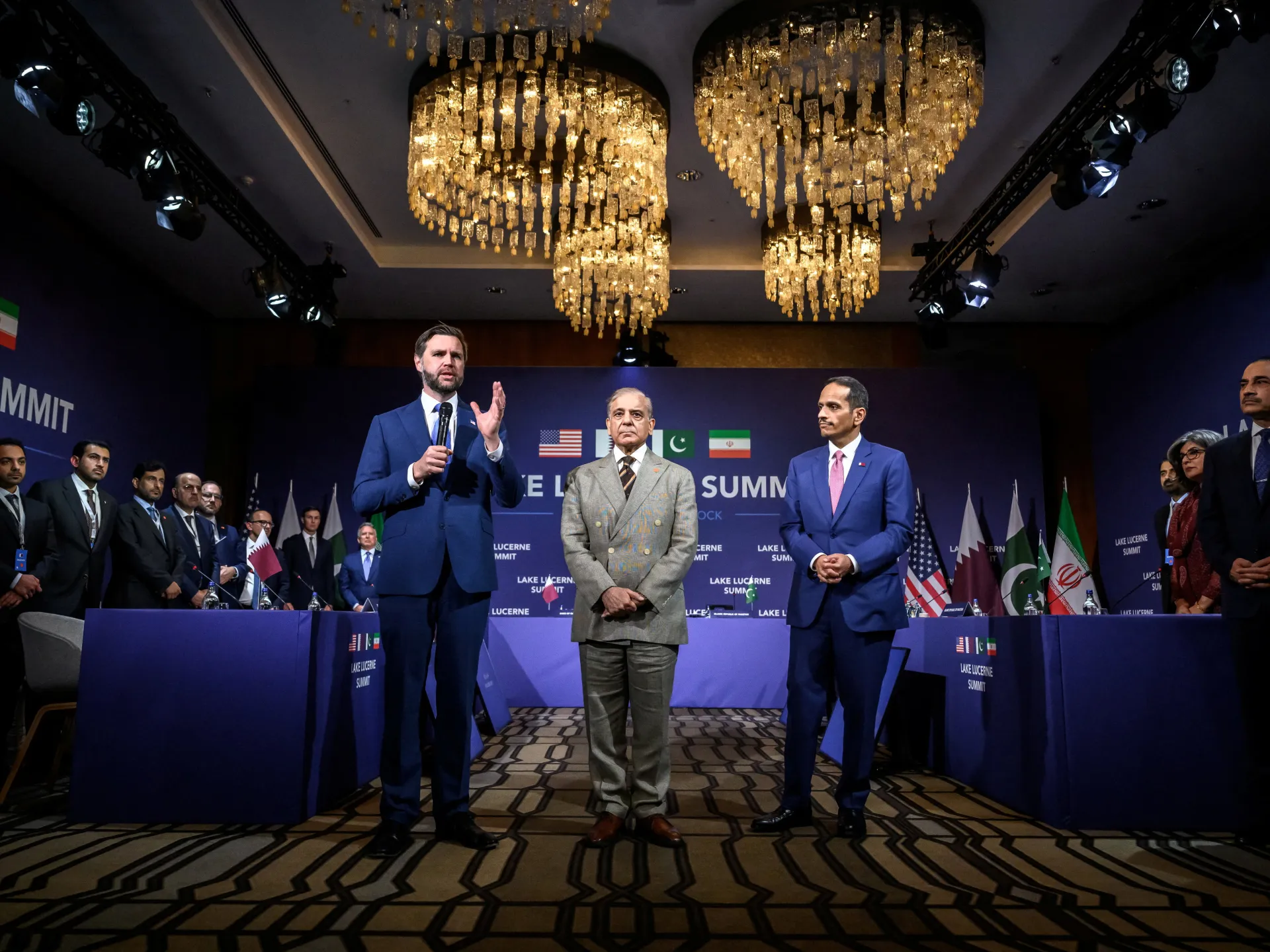
In a significant diplomatic development, Pakistan has emerged as a crucial intermediary in the recent peace framework between the United States and Iran. This past weekend, at the picturesque Burgenstock resort in Switzerland, US Vice President JD Vance publicly acknowledged Pakistan's instrumental role, specifically commending Pakistani military chief Asim Munir for his statesmanship. Vance, speaking alongside Pakistani Prime Minister Shehbaz Sharif and Qatari Prime Minister Sheikh Mohammed bin Abdulrahman bin Jassim Al Thani, highlighted Munir's contributions, noting, "We would not have been here without his statesmanship and military leadership." These sentiments were echoed by US President Donald Trump, underscoring the high regard in which Pakistan's efforts are held by Washington.
The praise for Islamabad's mediation has not been limited to the US. Iranian President Masoud Pezeshkian, on his inaugural foreign trip since the US-Israel attack on Iran in February, visited Pakistan's capital, Islamabad. During his visit, President Pezeshkian expressed gratitude for Pakistan's assistance in bringing Washington and Tehran to the negotiating table. This visit signifies a notable shift in Tehran's regional calculations, with Pakistan now occupying a more central position. Over the past four months, Pakistan has diligently served as an indispensable intermediary, facilitating confidential communications, hosting discussions in Islamabad, and navigating the complex political landscape of opening transit routes to Iran while carefully balancing its relationships with Gulf nations. The peace framework, agreed upon on June 18, and the subsequent 60-day negotiation period are direct outcomes of these sustained efforts.
Economic Prospects for Pakistan
For Pakistan's economy, which has faced ongoing challenges, the potential benefits of this diplomatic engagement are highly anticipated. While the country recently reported a gross domestic product growth of 3.7 percent for the past financial year—its fastest in four years—and an 8.2 percent increase in remittances to $30.3 billion, with a narrowed fiscal deficit, a deeper look reveals a more nuanced economic reality. Hina Shaikh, an economist based in Lahore with the International Growth Centre, suggests that the immediate economic gains for Pakistan might be constrained.
Shaikh elaborated that Pakistan's mediation could primarily lead to reduced energy import costs, particularly as the Strait of Hormuz reopens, and potentially revive momentum for the long-stalled Iran-Pakistan gas pipeline, provided sanctions relief remains consistent. She pointed out that the recent growth was largely a consequence of decreased oil and gas imports due to the Strait of Hormuz closure during the US-Israel conflict, rather than an expansion in domestic production. Pakistan continues to be part of a $7 billion loan program with the International Monetary Fund, marking its 25th such arrangement since the 1950s, approved in 2024.
While Western governments have expressed interest in deepening economic ties with Pakistan, analysts caution that diplomatic goodwill does not automatically translate into substantial investment or structural economic relief. Pakistan has experienced similar scenarios in the past; for instance, after the September 11, 2001, attacks, its alignment with Washington brought about debt rescheduling and multilateral support. However, these measures did not fundamentally address the persistent structural weaknesses plaguing its economy, such as a narrow tax base, weak exports, and chronic current account pressures. Shaikh emphasizes that while diplomatic relationships are valuable, Pakistan's core economic constraints are not primarily geopolitical and cannot be resolved by diplomatic prestige alone. Nevertheless, she acknowledges that such goodwill can provide Islamabad with crucial "breathing room" to accelerate necessary reforms.
Regional Dividends and Geopolitical Complexities
Within Pakistani policy circles, the prevailing view is that the more substantial rewards lie in the regional dividends that a stable Iran-US deal could yield, potentially reshaping Pakistan's geopolitical neighborhood. Lifting sanctions on Iran could reinvigorate trade flows along the Balochistan border, which have been restricted for years. Furthermore, the Iran-Pakistan gas pipeline, which has been dormant for over a decade due to US sanctions, could once again become a viable project.
However, the diplomatic landscape is more intricate than public statements might suggest. Umer Karim, an associate fellow specializing in Gulf and Pakistani affairs at the Riyadh-based King Faisal Center for Islamic Research and Studies, observes that Pakistan initially filled a specific void as a communication facilitator between the US and Iran when the Trump administration was wary of other mediators. This unique position allowed Pakistan to gain acceptance from both sides while coordinating mediation efforts with other key regional players like Egypt, Turkey, and Saudi Arabia.
Karim also highlights the limits of Pakistan's influence, stating that while Pakistan has integrated itself into the Middle Eastern security framework to a certain extent, it has not yet achieved the leverage required to significantly pressure Iran for concessions or persuade the US to accept specific Iranian demands. Maintaining balanced relationships with all Gulf players also remains a challenge.
The Role of Pakistan's Military
An underlying question in these diplomatic endeavors concerns who truly benefits from Pakistan's enhanced role. Vice President Vance's direct commendation of Field Marshal Munir, a non-civilian figure, at Burgenstock, has drawn attention. Observers note that the Pakistani military appears to be the institution that has most visibly benefited from the developments of the past four months. The military has historically exerted significant influence over Pakistan's domestic politics and foreign affairs, having directly governed the country for over 30 years of its nearly 80-year history. The army chief, particularly Munir, is often seen by critics as the de facto ruler of the nation.
Some argue that the costs of this diplomatic engagement will disproportionately affect those furthest from the diplomatic table. Tughral Yamin, a retired brigadier and Islamabad-based defense analyst, suggests that the true domestic measure of success will be whether any economic gains reach Balochistan, Pakistan's most impoverished province, which has been grappling with a two-decade-long armed insurgency by secessionist groups. Yamin believes that sharing economic benefits with the people of Balochistan could effectively eradicate terrorism in the region. He concluded by emphasizing that Pakistan stands at the precipice of significant economic opportunity, despite having missed many such opportunities in the past.
Source: Original Article
Related Articles
 world
world
North Korea Unveils New 5,000-Ton Destroyer, Enhancing Naval Capabilities
 world
world
Ukrainian Strikes Disrupt Power in Russian-Controlled Sevastopol Amid Escalating Conflict
 world
world
North Korea Unveils New Warship, Signals Intent for Nuclear-Capable Navy
 world
world