
Iraq Hosts Initial Funeral Rites for Ayatollah Ali Khamenei
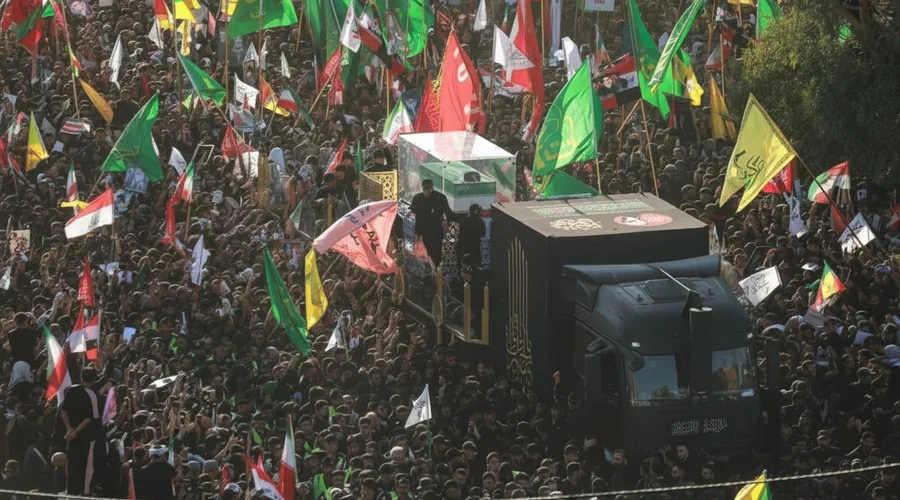
Funeral events for Iran's Supreme Leader, Ayatollah Ali Khamenei, are currently underway in Iraq, following his death in an alleged attack. The ceremonies commenced in the sacred city of Najaf, attracting thousands of participants who gathered to pay their respects. Iraqi authorities designated Wednesday as a public holiday to facilitate attendance, with processions beginning early in the morning in Najaf.
These events form part of a six-day series of public funeral ceremonies for Khamenei, which began on Saturday in Iran. A dedicated day was allocated for neighboring Iraq, underscoring the regional significance of the late leader. The extensive funeral arrangements are viewed by some as an effort to project national strength and unity amidst ongoing regional tensions, particularly in the context of recent hostilities between the US, Israel, and Iran.
Processions Through Holy Cities
Ayatollah Khamenei's remains arrived in Najaf on Tuesday evening at the international airport, where they were received by Iraqi officials and prominent politicians, alongside Iranian President Masoud Pezeshkian and Khamenei's eldest son, Mostafa Hosseini Khamenei. The coffin was then transported through the streets of Najaf, making its way to the revered shrine of Imam Ali, who is recognized as the son-in-law of Prophet Muhammad and the first Shia Imam.
Najaf holds immense religious importance, ranking as the third holiest site in Shia Islam, after Mecca and Medina. The city is accustomed to hosting substantial numbers of pilgrims for various religious observances, and the current funeral processions are noted for their significant scale. While precise figures are unavailable, estimates suggest hundreds of thousands of mourners are present in Najaf for these events.
Regional Significance and Mourner Sentiment
Following the ceremonies in Najaf, Khamenei's body is scheduled to be transported to Karbala, approximately 60 kilometers (37 miles) to the north. In Karbala, another procession will take place, culminating at the shrines of Imam Hussein, the third Shia Imam, and his brother Abbas. The final burial is planned for Thursday in Khamenei's hometown of Mashhad, located in northeast Iran.
Esmail Qaani, the head of Iran's Islamic Revolutionary Guard Corps' Quds Force, commented on the perceived connection between the two nations, stating, "The extensive planning for this historical event by the Iraqi government and people shows the depth of the spiritual bond between the two great nations of Iraq and Iran to the whole world." This sentiment was echoed by individuals like Mohammed al-Bayati, an Iraqi who traveled a considerable distance to attend the funeral, describing it as "an opportunity not to be missed to participate in the funeral of the person who challenged the power of America and Israel."
Absence of Mojtaba Khamenei
Notably absent from the public processions thus far has been Mojtaba Khamenei, who reportedly assumed the role of Supreme Leader shortly after his father's passing. Officials have indicated that Mojtaba Khamenei sustained injuries during the airstrikes that resulted in his father's death, though the extent of these injuries remains undisclosed. His absence from these high-profile events has drawn attention amidst the unfolding ceremonies.
The extensive funeral events, spanning multiple days and locations in both Iran and Iraq, highlight the profound religious and political implications associated with the passing of Ayatollah Ali Khamenei. The gatherings serve as a public expression of grief and solidarity, while also underscoring the complex regional dynamics at play.
Source: Original Article
Related Articles
 world
world
Spectator Displays Israeli Flag During Argentina-Egypt World Cup Match
 world
world
Gaza's Children Face a Summer Devoid of Play Amidst Ongoing Conflict
 world
world
International Debate Intensifies Over US Embargo on Cuba at United Nations
 world
world