
A Lifelong Devotion to the World Cup
Adel Mohsen, a 56-year-old football aficionado from Mukalla, eastern Yemen, has cultivated a profound tradition of watching every FIFA World Cup since 1982. This enduring commitment has persisted through numerous periods of conflict, severe economic downturns, and significant personal sacrifices. However, the current tournament presents unprecedented obstacles, highlighting the harsh realities of a nation grappling with over a decade of war and economic hardship.
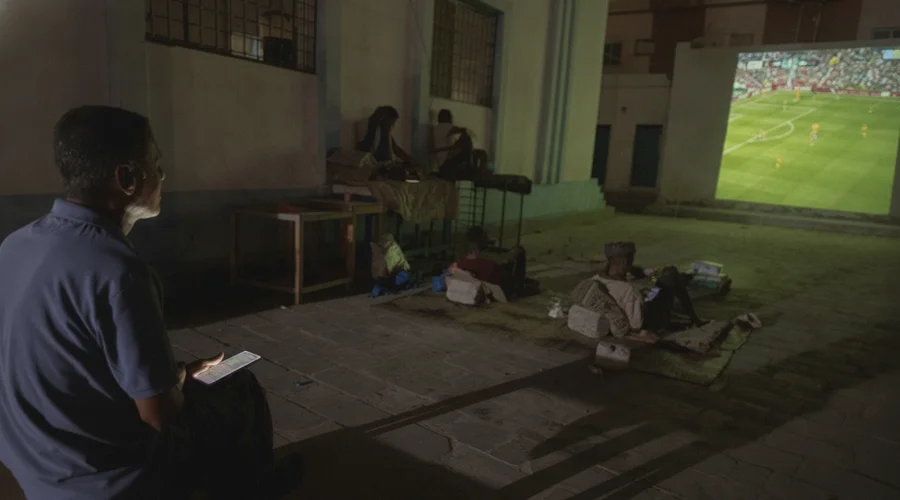
Weeks before the recent World Cup commenced, Mohsen faced a critical setback when his backup battery, essential for maintaining power during frequent electricity outages, failed. The financial strain of replacing it, coupled with a severe fuel shortage in Mukalla that restricted his mobility, meant his usual access to games was severely compromised. "I think this is the worst World Cup," Mohsen expressed, his gaze fixed on a large public screen at a local stadium. "I might miss a lot of matches because of the power cuts."
Despite subscribing to a local television service broadcasting the games, the $200 needed for a new home battery remained out of reach, as did the funds for internet vouchers to stream matches on his mobile phone. Consequently, public viewing areas like the local stadium became his primary recourse. On the evening of the opening match between South Africa and Mexico, the rhythmic hum of generators signaled the projector's activation just minutes before kickoff, casting a flickering light across the dimly lit, stone-paved courtyard where a sparse crowd had gathered.
Undeterred by the oppressive heat and humidity, Mohsen quickly immersed himself in the game. "The Mexicans will keep attacking until they score a goal," he predicted, consulting notes on his old mobile phone for an analysis he intended to share on local TV or social media. His prediction soon materialized. "I watch matches now through the eyes of an analyst rather than as a casual fan," he explained, observing the modest attendance. "Matches between big teams, such as Brazil, or Arab teams, usually attract far larger crowds of fans."
The Genesis of a Passion: 1982 and Beyond
Mohsen's lifelong love affair with football began in 1982, when Spain hosted the World Cup. At the time, television was a relatively new phenomenon in Mukalla and other cities of the former People’s Democratic Republic of Yemen (PDRY), or South Yemen. Twelve-year-old Adel distinctly remembers gathering with others to witness the spectacle. "That was like a first lover engraved in memory," he recalled with a smile, vividly recounting player names and stadium details from that era. He spoke of Brazil's legendary team, featuring stars like Zico, Falcao, and Eder, and the controversial tactics of Italy's defenders, notably Claudio Gentile.
He spent those tournament days glued to the screen with his father and brothers, fostering a familial atmosphere around the sport. Neighbors without televisions would often join in, creating a communal viewing experience. In those days, matches were recorded in Aden, the capital of South Yemen, and transported by bus to Mukalla's television station, meaning fans watched games a day later. Yet, the novelty and excitement were such that viewers enjoyed them as if they were live.
Football as a Constant Amidst Turmoil
The political landscape of Yemen soon grew tumultuous. In January 1986, violent infighting within the ruling Socialist Party in Aden led to thousands of casualties. Months later, with the victors consolidating power, Mexico hosted the World Cup. Sixteen-year-old Adel, now in secondary school, watched the tournament with a more discerning eye. "That tournament belonged to [Diego] Maradona," he reminisced.
By 1990, the year North and South Yemen unified, Mohsen was a 20-year-old amateur footballer, playing for local clubs. The World Cup in Italy became a learning ground, where he studied tactics and skills, applying them to his own training and matches across various Yemeni cities. However, the period of unity proved short-lived. In 1994, civil war erupted, coinciding with the World Cup in the United States. "That was the worst World Cup I have ever watched," Mohsen stated. "It was the most difficult tournament because people were worried about the war and what would come after it. Security was unstable, and frequent power outages made it even harder to follow the games. I would watch one match and then miss three."
As Mohsen matured, his role transitioned from player back to devoted spectator. Yemen experienced a period of relative stability following the 1994 civil war, making the tournaments of 1998, 2002, 2006, and 2010 easier to follow. Yet, the 2014 World Cup in Brazil arrived as Yemen once again descended into instability, marked by intensified attacks from al-Qaeda in the Arabian Peninsula (AQAP) and the expansion of Houthi rebels. "The country was entering a new political and economic crisis," Mohsen observed.
While Mukalla has largely been spared direct battles within its city limits during the subsequent 12 years of war, it has not escaped the profound economic challenges and service shortages that often prevent Mohsen from enjoying his beloved sport. Despite the constant power cuts, mounting financial pressures, and criticism from those who view sports as a luxury in a crisis-ridden nation, Mohsen remains steadfast in his commitment to this four-decade-old ritual. "I see sports as relief from hardship," he affirmed, the glow of the giant screen illuminating his sweat-drenched face. "People ask why we talk about football when there are so many problems. What do they want us to do – commit suicide? Sports give us a brief escape from all the hardships around us." For this year's tournament, Adel's prediction for the winner is France.
Source: Original Article
Related Articles
 world
world
US-Iran Ceasefire Talks Postponed Amidst Escalating Israeli-Lebanese Tensions
 world
world
Escalating Tensions: Israeli Strikes Persist in Southern Lebanon Amid Diplomatic Efforts
 world
world
US-Iran Peace Efforts Face Jeopardy Amid Escalating Israeli Actions in Lebanon
 world
world