
Diplomatic Strain Overshadows Ukraine Recovery Efforts
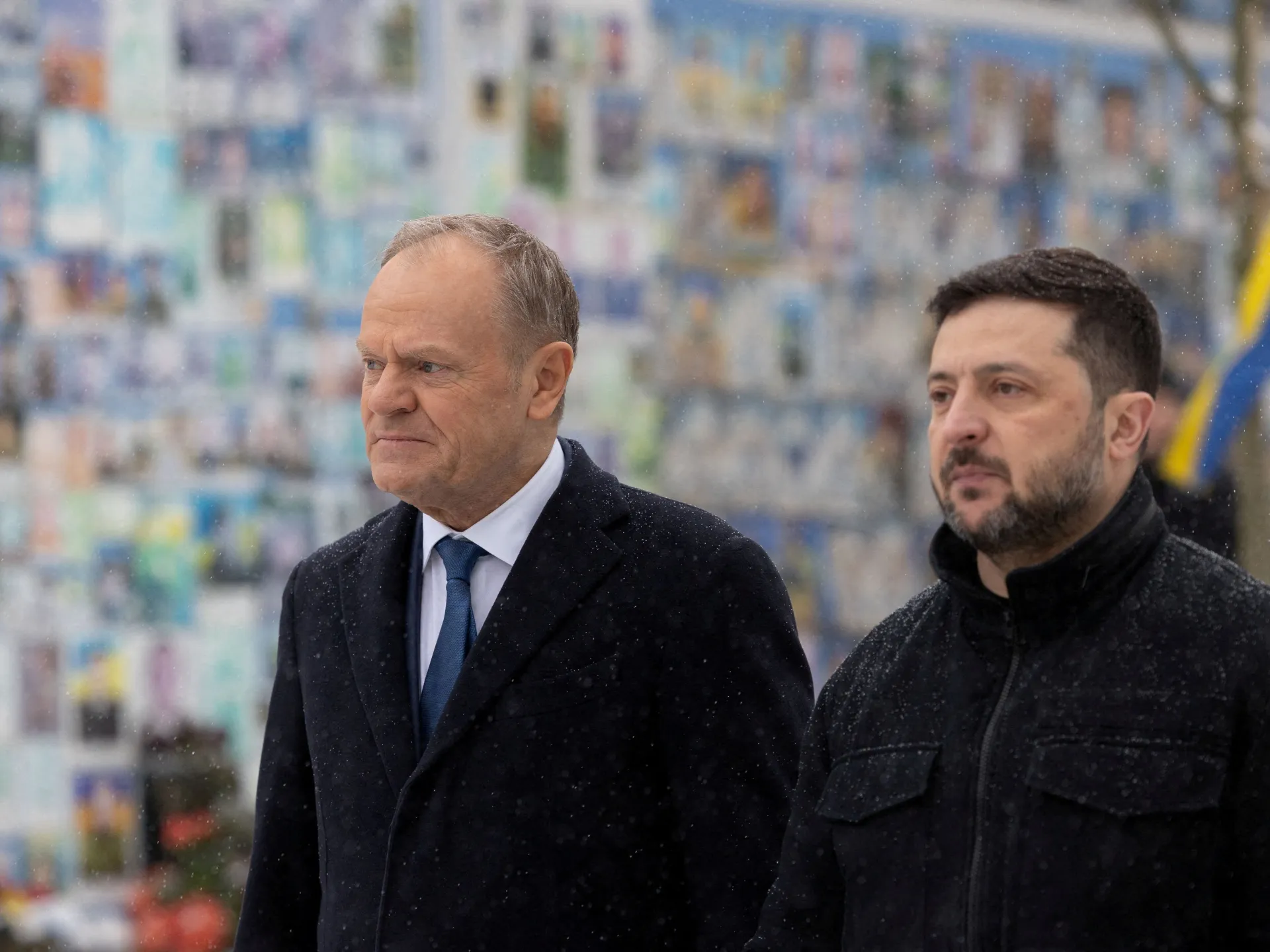
A significant conference dedicated to Ukraine's post-war recovery is scheduled to take place in Gdansk, Poland, even as a notable diplomatic disagreement has emerged between the two allied nations. This friction has prompted Ukrainian President Volodymyr Zelenskyy to forgo his attendance at the event, underscoring the delicate nature of their relationship despite shared geopolitical concerns.
The current tensions trace back to a series of actions taken by President Zelenskyy in May 2026. On May 22, he participated in a solemn reburial ceremony at a military cemetery near Kyiv for Andriy Melnyk, a former leader of the Organization of Ukrainian Nationalists (OUN), and his wife Sofiya. Melnyk, who passed away in West Germany in 1964, was honored as a "Ukrainian hero" by Zelenskyy for his efforts towards an independent Ukraine. Just four days later, Zelenskyy further stirred controversy by naming an elite military unit after "the heroes of the Ukrainian Insurgent Army" (UPA), a nationalist paramilitary force that originated from the OUN. The UPA is historically recognized for its involvement in World War II and its subsequent resistance against the Sovietization and Russification of western Ukrainian territories, which were historically part of Poland.
These actions by the Ukrainian presidency elicited a strong rebuke from Polish President Karol Nawrocki, escalating into a diplomatic dispute that shows no immediate signs of resolution. Poland has been a steadfast supporter of Ukraine since Russia's full-scale invasion in 2022, serving as a critical logistical hub, providing arms and humanitarian aid, and offering refuge to millions of Ukrainian citizens. However, on June 19, Nawrocki revoked Poland's highest state honor, the Order of the White Eagle, from Zelenskyy. The Polish president cited the UPA's historical role, stating on social media that it "remains above all a formation responsible for cruel crimes against" Poles during World War II. In a reciprocal move, several high-ranking Ukrainian officials, including Kyrylo Budanov, head of Zelenskyy’s administration, Foreign Minister Andriy Sibiha, and former President Petro Poroshenko, returned their own Polish state awards.
The Enduring Alliance Amidst Historical Disagreements
Despite the current diplomatic friction, experts suggest that Poland's fundamental support for Ukraine is unlikely to waver significantly. Anton Shekhotsov, an expert on European far-right groups and head of the Vienna-based Centre for Democratic Integrity, noted that both nations perceive Russia as a far greater, existential threat. He highlighted that most of present-day Poland was under Tsarist rule for over a century, and post-World War II, it became a Soviet satellite state. "In the Kremlin, they understand that such conflicts don’t have any actual impact on the bigger picture, which is Polish support for Ukraine’s military efforts," Shekhotsov told Al Jazeera. However, he cautioned that Kremlin-funded media would likely exploit the UPA issue to sow discord between Poland and Ukraine.
Ahead of the Ukraine Recovery Conference, which convenes Kyiv's Western allies, Polish Prime Minister Donald Tusk sought to de-escalate tensions. On June 19, Tusk posted on X, stating, "A conflict between Poland and Ukraine delights [Russian President Vladimir] Putin and shocks our allies. The frontline lies elsewhere." Consequently, President Zelenskyy will not attend the conference, with Ukrainian Prime Minister Yulia Svyrydenko leading Kyiv's delegation instead.
Understanding the Ukrainian Insurgent Army (UPA)
The emergence of the UPA was influenced by a confluence of factors, including deep-seated Ukrainian nationalist aspirations, the tumultuous conditions of World War II, and the devastating Holodomor famine. Other contributing factors included purges of religious figures and intellectuals, forced Russification policies, and the deportation of entire ethnic groups. Some historical observers argue that UPA leaders, in a bid to choose what they perceived as the lesser of two evils, initially aligned with Nazi Germany, which invaded the Soviet Union in 1941 and occupied much of Ukraine. While the Nazis promised to dismantle collective farms and restore religious freedom, they ultimately had no intention of granting Ukraine independence.
Before turning against the Nazis, the UPA participated in the Holocaust and was responsible for the killing of tens of thousands of ethnic Poles in western Ukraine, a region that was historically part of Poland. Nadiya, a 95-year-old Ukrainian woman who witnessed the killings in Volyn in 1943, recounted to Al Jazeera her escape from an attack by UPA-affiliated youths during what is known as the Volyn Massacre. She requested anonymity due to safety concerns in contemporary Ukraine, where the UPA is largely venerated, and streets are named after its leaders.
Historian Ivan Katchanovski of the University of Ottawa noted in 2019 that Ukraine's pro-Western leaders have often "denied, minimised or justified" the UPA's role in these atrocities. He further asserted that most UPA members "assisted the Nazi occupational authorities in implementing genocidal policies towards the Jews, Ukrainians, Russians, and Poles by helping to carry out mass executions." The lionization of the UPA, particularly its leader Stepan Bandera, has created deep divisions within Ukrainian society. Annual marches commemorating Bandera's birthday often provoke strong protests from Polish and Israeli embassies. These marches are frequently organized by far-right and ultra-nationalist groups, many of whose members volunteered to fight Moscow-backed separatists in Donbas in 2014, playing a crucial role when the regular Ukrainian army struggled against the rebels.
The Pragmatic View of Nationalist Forces
Some analysts attribute Zelenskyy's support for the UPA to pragmatic military considerations, despite his Jewish grandfather's family being victims of the Holocaust. Nikolay Mitrokhin, a researcher at Germany's Bremen University specializing in far-right movements, told Al Jazeera that "Radical Ukrainian nationalists are a free or very cheap military force, and they eagerly keep enlisting youngsters to the front line with the help of heroic symbolism." He added that the military units formed by these nationalists often perform more effectively than the regular Ukrainian army. Mitrokhin also suggested that far-right intellectuals are influential in shaping Ukraine's political culture and guiding the ideological decisions of Zelenskyy's administration.
Vyacheslav Likhachev, an expert on Ukrainian and Russian ultra-nationalists, explained that the ongoing war with Russia simplifies the historical narrative surrounding those who fought for Ukraine's independence. "Within the context of Ukraine’s war for independence [from Russia], anyone who takes part in this war and sees independence as a value easily associates themselves with those who fought for independence before," he stated. According to Likhachev, other historical complexities become "absolutely irrelevant for the popular understanding of history and for the government’s memory policies." He concluded that, "Of all the UPA’s enemies, only one matters – the one we’re fighting now, the Moscow Empire – personified by the Soviet Union then and by Russia now."
Source: Original Article
Related Articles
 news
news
US and Iran Disagree on Nuclear Inspections as Senate Moves to Limit Presidential War Powers
 news
news
Ukrainian Forces Target Key Railway Bridge in Northern Crimea Amid Supply Route Campaign
 news
news
Addressing South Africa's Challenges: Beyond Blaming Migrants
 news
news