
A Steadfast Advocate for Palestine
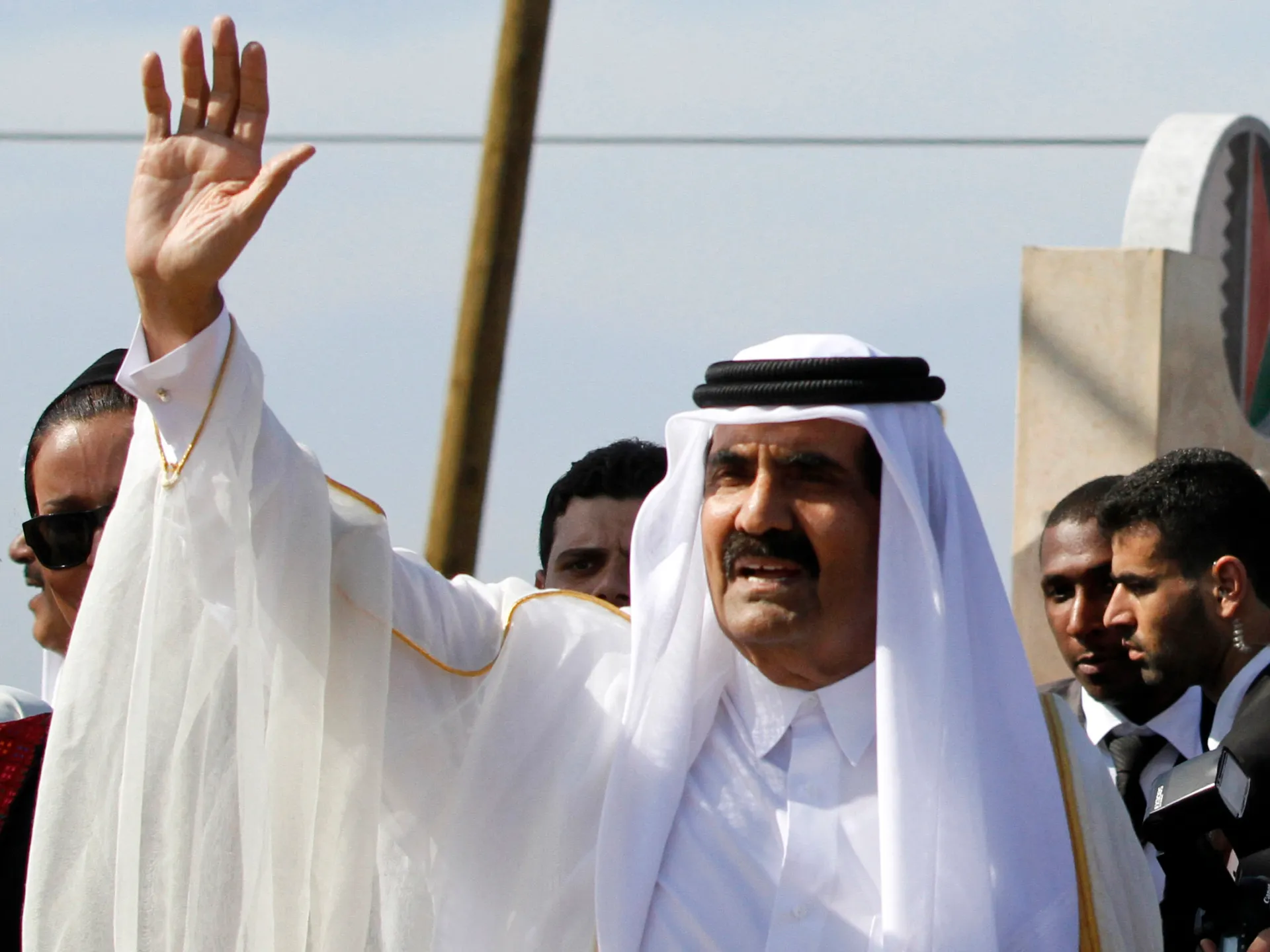
The recent passing of Qatar's Father Emir, Sheikh Hamad bin Khalifa Al Thani, has brought renewed attention to his significant contributions and enduring legacy, particularly his steadfast advocacy for the Palestinian people. Among his most recognized actions was his groundbreaking visit to the Gaza Strip in October 2012, a move that positioned him as the sole Arab leader to personally challenge the stringent blockade imposed on the territory. This act of solidarity, undertaken six years after the blockade's inception following the 2006 Palestinian elections, underscored his commitment to humanitarian principles and regional stability.
Accompanied by Sheikha Moza bint Nasser and a high-level delegation, Sheikh Hamad's visit bypassed the political isolation that Western powers and various regional entities had enforced on the enclave. His arrival was met with an enthusiastic reception from both official bodies and the general populace, signaling the profound impact of his presence. Khaled Meshaal, who heads Hamas's diaspora office, emphasized the symbolic weight of the visit, stating that it felt as though "Jerusalem, Gaza and Palestine mourn him." Meshaal further characterized Sheikh Hamad as "the first Arab and Muslim leader to visit Gaza, standing by its side with chivalry and magnanimity, as if officially announcing the breaking of the siege in its darkest circumstances," describing him as a leader of intelligence, bravery, and unwavering principles.
A Personal Connection to the Palestinian Struggle
Ahmed al-Sheikh, a veteran journalist and former news director for Al Jazeera Arabic Channel, highlighted the Father Emir's profound affection for Palestine, observing, "Has any other leader in the Arab world done that [visit to Gaza], except Hamad bin Khalifa?" He elaborated that Sheikh Hamad's motivation stemmed from a perception that Gaza was being neglected by its surroundings, prompting his decisive action. During this pivotal visit, Sheikh Hamad announced a substantial increase in Qatar's reconstruction grant for Gaza, elevating it from $254 million to $400 million. This funding was allocated to critical projects in housing, infrastructure, and healthcare, directly benefiting thousands of Palestinians. Addressing a gathering at the Islamic University of Gaza, where he and Sheikha Moza received honorary doctorates, he lauded the resilience of the Palestinian people while openly critiquing what he viewed as international double standards.
Sheikh Hamad's dedication to the Palestinian cause was evident long before the Gaza blockade. In 1999, he made history as the first Gulf leader to visit the Palestinian territories since 1967, engaging with the late Palestinian President Yasser Arafat during a period of significant political tension. According to al-Sheikh, the Emir's perspective on the Palestinian struggle was deeply personal. He recalled Sheikh Hamad's profound distress when former Israeli Prime Minister Ariel Sharon besieged Arafat's headquarters in Ramallah, with the Emir reportedly feeling as though the attack on the Muqata’a was an assault on Qatar itself. This personal connection was further amplified by his regret at never having visited Jerusalem before its 1967 occupation, leading him to commission a comprehensive three-hour documentary to capture the city's historical and cultural essence. He firmly believed in the agency of the Palestinian people, viewing them as the primary drivers of their own liberation, famously telling al-Sheikh, "You will do the primary action and without this action there can be no liberation."
Challenging Regional Norms and Building for the Future
Sheikh Hamad's principled stance often diverged from the prevailing regional consensus. This was particularly evident during the 2008–2009 conflict in Gaza, which exposed deep divisions among Gulf Cooperation Council (GCC) members regarding an appropriate response. In a bold move, Sheikh Hamad convened an emergency Arab summit in Doha, where he proposed a $250 million reconstruction fund and advocated for a maritime corridor to circumvent the blockade. His public expression of disappointment over the lack of an Arab quorum for this critical meeting highlighted his frustration with the collective inaction.
Many of Gaza's essential infrastructure projects prior to the conflict in October 2023 were direct outcomes of financial commitments made by Sheikh Hamad. Qatar financed the revitalization of key highways and the development of Sheikh Hamad City in Khan Younis, a significant $58 million public housing initiative comprising 53 modern apartment buildings designed for thousands of low-income families. Furthermore, the Sheikh Hamad Hospital for Rehabilitation and Prosthetics, inaugurated in April 2019, emerged as the region's leading facility for amputees and children with hearing impairments.
Tragically, much of the infrastructure that Qatar helped finance under Sheikh Hamad's leadership has been systematically damaged or destroyed during recent conflicts. Satellite imagery from May of this year confirms the extensive destruction of Hamad City and other areas in southern Gaza. Despite suffering direct attacks, severe shortages, and the broader collapse of Gaza's healthcare system, the Sheikh Hamad Hospital managed to resume its vital services last December. Operating the sole CT scanner in northern Gaza, the hospital has even expanded its operations by opening a new branch in the south to address a staggering 225 percent increase in amputation cases. The continued functionality of Sheikh Hamad Hospital amidst ongoing hostilities stands as a powerful testament to the late Emir's unparalleled efforts in the besieged enclave, ensuring that his legacy of support for Gaza will resonate for generations to come.
Source: Original Article
Related Articles
 world
world
Israeli Army Unveils Footage of Subterranean Tunnels Beneath Lebanon's Beaufort Castle
 world
world
Elderly Palestinian Recounts Assault by Israeli Settlers in West Bank
 world
world
Escalating Tensions: Iran Targets US Military Installations in Middle East
 world
world