
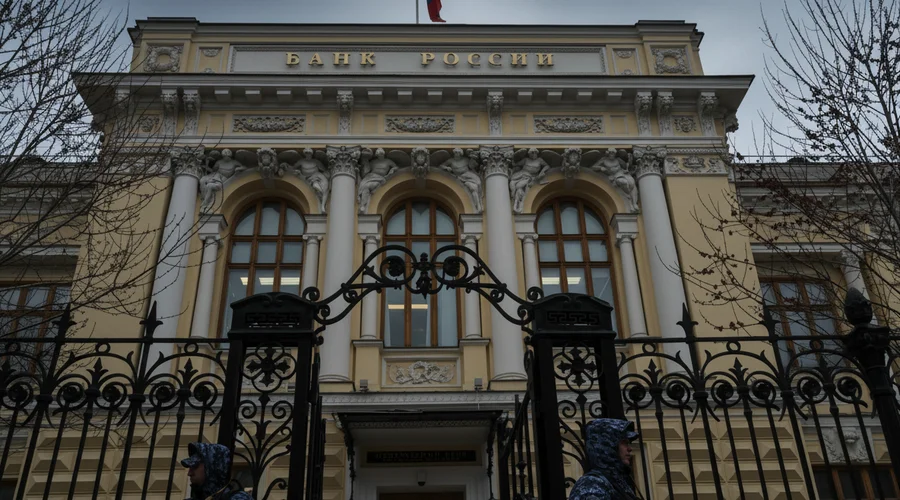
Economic Pressures Mount for Russian Citizens
In the past year, approximately 500,000 Russian citizens filed for bankruptcy, a significant increase attributed to the financial repercussions of the conflict in Ukraine. This figure, highlighted in a European intelligence report, suggests that the cost of living is placing considerable pressure on Russian households. While individual financial distress is evident, experts largely discount the likelihood of a full-scale banking crisis.
As the conflict extends into its fourth year, Russia's Ministry of Economic Development has revised its GDP growth forecast for 2026 downward, from 1.3 percent to 0.4 percent. The report, which Reuters had access to, identifies escalating household debt as a factor contributing to an 'explosive' banking environment. However, analysts maintain that despite the hardships faced by individuals, the broader banking system is likely to remain stable.
The Role of Banks in a Wartime Economy
The European intelligence report reveals that the Russian government's continued investment in its military operations in Ukraine has led to an increased reliance on domestic banks to support both businesses and individual borrowers. This strategy has involved the extension of a growing number of 'risky' loans, enabling the war effort and assisting many Russians in managing their daily expenses, including home purchases. However, this approach has simultaneously introduced heightened financial risks, including a rise in loan defaults and personal bankruptcies.
The two-page intelligence brief, intended to inform European officials about the state of Russia's banking sector, also underscores the vulnerability of these institutions to Western sanctions. Although Russian banks have largely withstood sanctions imposed by the United States and European nations since the full-scale invasion in 2022, the report notes that the European Union is preparing a 21st package of sanctions targeting banks and cryptocurrency networks, expected to be finalized in July.
Factors Contributing to Financial Strain
The European intelligence report indicates that Russian banks have issued an increasing volume of 'bad' loans, characterized by a higher risk of default. It estimates that 10 percent of Russia's corporate loans are now considered doubtful, a substantial increase compared to two years prior. Concurrently, the number of Russians declaring bankruptcy last year rose by nearly one-third year-on-year, surpassing 500,000 individuals. State-backed credit programs have also encouraged over 13 million Russians to take out three or more loans simultaneously to cope with the rising cost of living.
Vladislav Inozemtsev, an associate fellow at Chatham House's Russia and Eurasia Programme, noted that overdue corporate loans currently stand at approximately 7 trillion roubles ($91 billion), accounting for 3 percent of Russia's estimated $2.65 trillion GDP. This sum represents two years' worth of the banking system's total profits. Inozemtsev further explained that more than half of these overdue corporate loans are linked to defense-industry enterprises or companies associated with state defense, suggesting that the state will ultimately cover these debts or ensure interest payments are maintained to protect the banks' stability. He added that overdue individual loans total another 1.7 trillion roubles ($22 billion), a segment where many bankruptcies are anticipated, necessitating banks to write off a portion of these loans, though reserves have already been allocated for such eventualities.
Assessing the Risk of a Banking Crisis
The European intelligence report suggests that the Russian banking sector's reliance on government support, including state-backed credit programs and widespread loan restructuring, might be masking an impending crisis. It posits that a new economic shock, such as additional sanctions or an increase in defaults on risky loans, could expose this underlying instability. The report states, "The situation creates the illusion of a dynamic economy that, in reality, conceals an explosive situation which an economic shock, such as an ambitious package of sanctions against banks … could trigger."
However, Russian authorities have consistently downplayed these concerns. Filipp Gabunia, Deputy Governor of the Russian Central Bank, stated last month that "vulnerabilities in the financial sector are not critical." Experts, including Inozemtsev, generally agree that a full-blown banking crisis in Russia is unlikely. Russian banks reported substantial profits of $80 billion to $90 billion over 2024 and 2025. Inozemtsev noted that despite an economic slowdown in 2026, the banking sector continues to generate significant profits, with total net profit exceeding 1.9 trillion rubles ($24.8 billion) in the first five months of the current year. The full-year forecast stands at 3.9 trillion ($51 billion), potentially setting a new record.
Inozemtsev attributes the resilience of the Russian banking system to its structure, which comprises a few large, heavily supervised banks. He argues that even if smaller banks fail or individuals face bankruptcy, it would not trigger a systemic crisis. He confidently asserts, "That is why I am confident that Russia cannot experience a banking crisis even remotely resembling the banking crisis of 2012-14, when banks from the top 50 went under every month – to say nothing of 1998, or of the situation in the United States during the Great Depression. I see no threats to the stability of the Russian banking system."
Economic Transformation Under Conflict
The conflict has fundamentally reshaped Russia's economy, shifting it to a wartime footing. Economic growth, which slowed to 1 percent last year and is projected at 0.4 percent this year by Russian authorities, is now primarily driven by defense production and state spending. Western sanctions have curtailed Russia's exports, particularly oil, from major foreign markets and investments. Russia has mitigated some of these effects by utilizing a 'shadow fleet' for oil exports.
While the wartime economy has proven more robust than many anticipated, signs of strain are emerging. The Russian energy sector has been impacted by Ukrainian drone attacks on energy facilities. A recent Gallup poll indicated that 60 percent of Russians believe their economic conditions are deteriorating, the first time in two decades that a majority has held this view. Additionally, 56 percent report declining living standards, and 58 percent perceive it as a challenging time to find employment, despite low unemployment rates due to military recruitment and defense industry jobs.
Inozemtsev observed that the economy has become more isolated globally, with reduced dependence on external factors. He noted, "The economy attempted to pursue import substitution (successful in only a few industries), stopped relying on inflows of foreign investment, and its stock market no longer reacts to movements on foreign exchanges – in every sense, the Russian economy has become more closed."
Implications for the War Effort
The conflict has led to a rapid escalation in military spending and an increased tax burden, which are exerting pressure on the economy. While some economists suggest that Russia's economy could sustain growth indefinitely through military orders, Inozemtsev believes this is improbable. He stated, "Military spending is effectively a pure deduction from overall welfare, and Russia cannot wage war in this mode forever; the country is losing both its current and its future economic potential." He also pointed to a significant brain drain, declining investment, and a near absence of innovation.
Inozemtsev further argued that government policies, including the nationalization of 'strategic' companies, tax increases, and cuts to social spending, are causing more damage to the economy than Western sanctions and the deteriorating external environment combined. He concluded, "Frankly, it is hard to imagine any improvement in the state of the Russian economy before the war ends."
Source: Why have half a million Russians gone bankrupt amid Ukraine war?
Related Articles
 economy
Global Shipping Poised for Recovery and Adaptation Post-Conflict
 economy
OPEC+ Members Announce Fifth Consecutive Oil Production Increase Amid Market Recovery
 economy
Iran Issues Warning to Vessels in Strait of Hormuz Over Unsanctioned Routes
 economy