
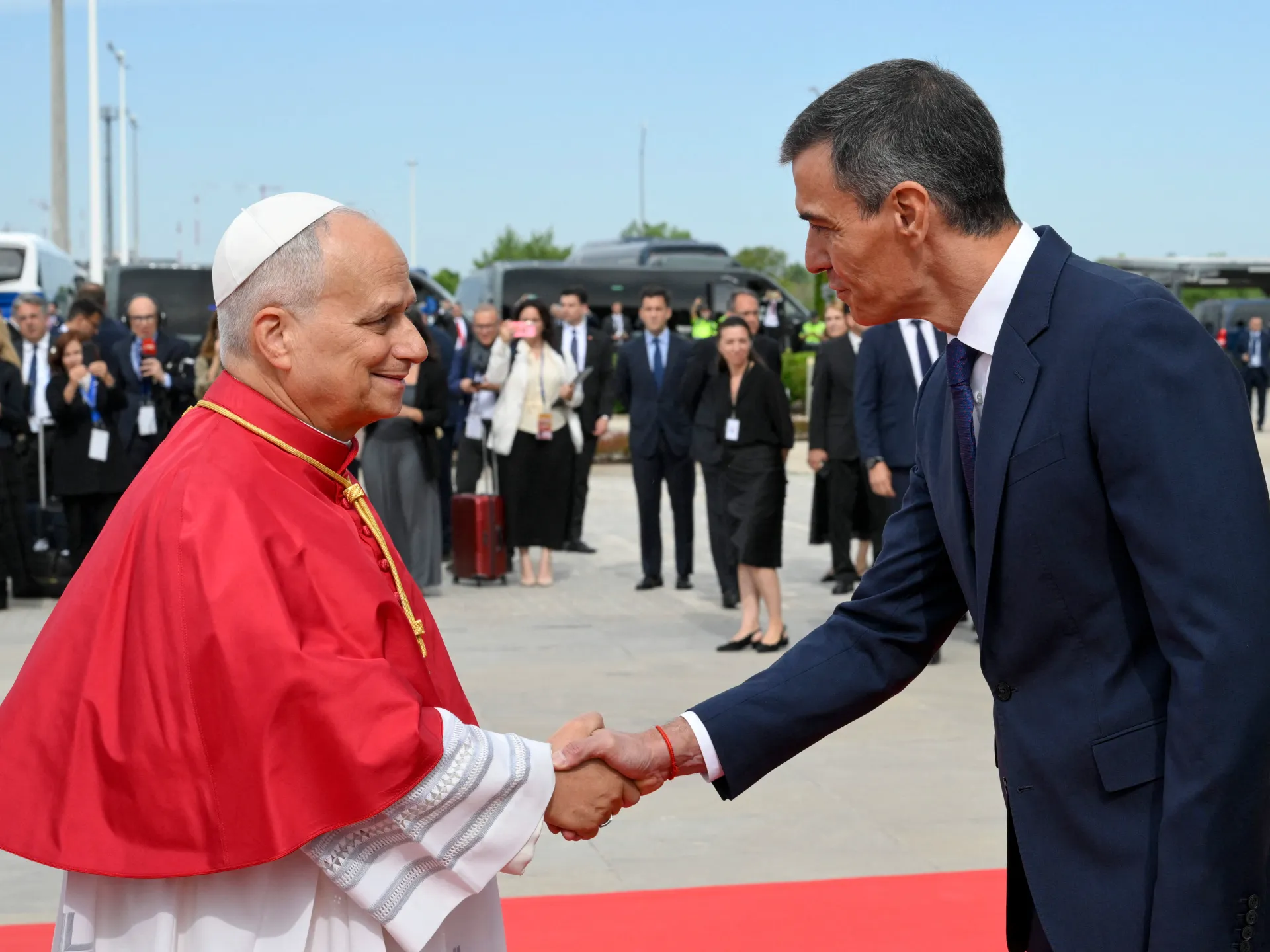
Pope Leo XIV's Visit to Spain and Its Repercussions
Pope Leo XIV's recent apostolic visit to Spain has brought into sharp focus the intricate dynamics between faith, national identity, and immigration policies within the nation. The visit, concluding recently, appears to have created an unexpected discomfort for Spain's far-right party, Vox, typically a fervent proponent of Catholic values as central to Spanish identity. The pontiff's pronouncements, particularly on issues of migration, human dignity, and conflict, seemingly challenged the political platform championed by Vox, led by Santiago Abascal.
During his address to the Spanish parliament, Pope Leo XIV invoked the historical legacy of the School of Salamanca, a 16th-century theological movement that championed the rights and dignity of Indigenous populations in the Americas against colonial subjugation. This historical reference served as a clear indictment of contemporary political approaches that might disregard the vulnerable. In a country currently grappling with intense debates surrounding immigration, the implications of such a message were unmistakable. Vox's policy positions, which include advocating for extensive deportations, termed 'remigration,' of undocumented migrants, children of immigrants—even those born in Spain—and individuals accused of relying on public assistance or failing to assimilate, stand in stark contrast to the humanitarian principles espoused by the Pope.
Addressing the Migration Crisis
A significant aspect of Pope Leo's visit included a trip to Gran Canaria, an island that serves as a critical entry point for migrants undertaking the perilous Atlantic route from Africa to Europe. This route has claimed numerous lives, with statistics from the International Organization for Migration indicating over 1,214 deaths or disappearances last year alone, a figure NGOs suggest is considerably higher. The Pope's deliberate decision to highlight the plight of these asylum seekers and migrants underscored a consistent theme of his papacy, which has previously put him at odds with political figures like former US President Donald Trump, admired by Abascal.
Conversely, Spanish Prime Minister Pedro Sanchez, whose government recently initiated measures to regularize the status of at least 500,000 undocumented migrants and asylum seekers, found reason to welcome the papal visit. The alignment of the Pope's message with his government's more inclusive approach to immigration provided a degree of moral reinforcement for his administration's policies.
Shifting Religious Landscape in Spain
To fully grasp the context of Pope Leo's visit, it is essential to consider the evolving religious demographics of Spain. A decade ago, state polls indicated approximately 68 percent of Spaniards identified as Catholic. By spring 2025, this figure had declined to 52.8 percent, with only 17.3 percent identifying as practicing Catholics. Despite this overall secularization trend, a surprising resurgence of Catholic identity has been observed among Generation Z and young millennials. A 2026 survey by the Fundacion SM revealed a significant increase in young Spaniards identifying as Catholic, from 31.6 percent to roughly 45 percent within five years, reversing long-standing secularizing patterns. This shift has coincided with a notable rightward political turn among young voters.
Pope Leo XIV appeared to directly address this new societal landscape. During a large open-air mass in Madrid, attended by over a million people, the pontiff explicitly linked Christian values with a rejection of far-right political ideologies. His admonition that “no one can kneel before the Lord and despise their brother” was a clear message to Abascal, Vox, and their younger conservative supporters, indicating a divergence between the Pope's agenda and theirs.
Political Implications and Challenges
Following the Pope's address to parliament, Abascal's response, stating that one “must distinguish between speeches and practical policy. These are the words expected of a religious leader,” suggested an attempt to downplay the pontiff's message. However, the growing difficulty for Vox to reconcile its claimed Christian values with its political stances is becoming apparent. The party's recent criticism of Spanish bishops for supporting the government's migrant amnesty prompted Pope Leo to issue a warning against the instrumentalization of the Church for political ends.
These developments carry potential implications for Spain's upcoming general election. Vox is currently engaged in rebuilding regional alliances with the conservative People’s Party (PP), having already formed agreements in Extremadura, Aragon, and Castilla y Leon. The hope is to extend this partnership to the national level, anticipating a projected PP victory. However, as the PP aligns itself with Vox, adopting policies such as the far-right's 'national priority' which favors Spaniards over foreign-born individuals in housing and benefits, it risks alienating a segment of the Catholic vote that has historically supported it.
While Pope Leo and Prime Minister Sanchez appear to be aligned on issues like immigration and the condemnation of the US-Israel war on Iran (which the Pope called “unjust” and the Prime Minister “illegal”), the Socialist Party should not assume an enduring alliance with the American pontiff. The Catholic Church operates with a long-term, cautious strategy, having historically navigated political landscapes through compromise. A deeper consideration for the Church is the shifting global center of Christianity towards the Global South, the very regions from which much of Europe's migration originates. Therefore, the Church's defense of migrants is rooted not only in principle but also in its strategic future.
The Enduring Influence of Faith in Politics
Despite these convergences, on many ethical issues, such as family and abortion, the Catholic Church's doctrinal positions remain closer to Vox than to the Socialist Party. These are rooted in doctrine rather than political expediency. Sanchez's most realistic aspiration is a tactical alignment with the pontiff, leveraging favorable moments to differentiate the votes of progressive Catholics from traditionalists. In 'catolicisima' Spain, a country once envisioned as profoundly Catholic, even such a tactical gain represents a significant achievement.
It is noteworthy that in an era where overt religious sentiment is less common, the Catholic Church continues to play a central role in political discourse, particularly in Spain where religious identity still profoundly shapes political identity. In a world where politics often struggles to provide a shared sense of meaning and caters to individuals often connected only by transient fears, the Church still offers an ancient sense of community. This explains why politicians from opposing factions seek to engage a Pope who steadfastly refuses to align himself with any political party, and why his words in Madrid inevitably resonated with profound political significance.
Source: Original Article
Related Articles
 politics
Georgia Primary Elections Yield Mixed Outcomes for Trump-Backed Candidates
 politics
US Primary Elections: Mixed Results for Trump-Endorsed Candidates Ahead of Midterms
 politics
Makerfield By-Election: A Pivotal Moment for UK Politics Beyond a Single Seat
 politics