
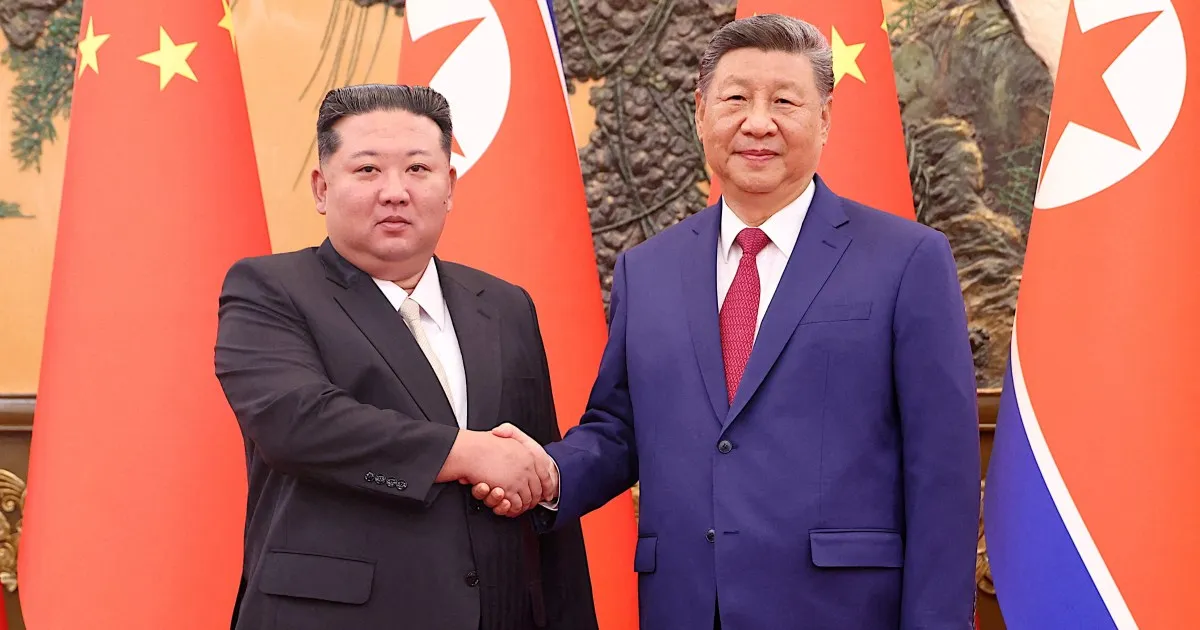
Xi Jinping's Visit Underscores Enduring China-North Korea Ties
Chinese President Xi Jinping recently concluded a significant visit to Pyongyang, marking his first trip to North Korea since 2019. The visit was characterized by elaborate state ceremonies, including military honors, floral displays, and enthusiastic crowds, underscoring the deep-rooted alliance between the two nations. North Korean leader Kim Jong Un and his wife, Ri Sol Ju, personally welcomed President Xi and his wife, Peng Liyuan, at Pyongyang's international airport, initiating a series of choreographed displays of solidarity across the capital.
Banners proclaiming "Long Live the Unbreakable Friendship and Unity between North Korea and China" were prominently displayed, according to Xinhua, China's state news agency. This reaffirmation of ties comes at a time when both governments are keen to solidify a relationship that has weathered numerous challenges, including economic hardship, nuclear tensions, diplomatic strains, and an evolving global landscape. The relationship is frequently characterized by the traditional Chinese idiom, "as close as lips and teeth," a metaphor popularized by Chairman Mao Zedong in the 1950s to illustrate the indispensable nature of their alliance.
A Legacy Forged in Revolution and War
The foundations of the China-North Korea relationship extend back even before the establishment of their modern states. Many early North Korean leaders, including Kim Il Sung, had strong connections with the Chinese Communist movement. Formal diplomatic relations between the Democratic People's Republic of Korea (DPRK) and the newly founded People's Republic of China were established on October 6, 1949.
The alliance faced its most severe test during the Korean War (1950-1953). When North Korean forces were pushed back by UN-backed forces, China intervened decisively, deploying large numbers of the People’s Volunteer Army across the Yalu River. This intervention was critical in preventing the collapse of North Korea and ultimately led to the armistice that divided the Korean Peninsula. While the human cost for China was substantial, the war solidified a profound bond that continues to influence the collective memory of both nations.
Treaty of Friendship and Periods of Strain
In 1961, China and North Korea formalized their alliance by signing the Treaty of Friendship, Cooperation and Mutual Assistance. A pivotal clause in this treaty mandates mutual assistance in the event of armed attack, making it China’s sole formal defense pact with another country. However, Beijing has not interpreted this as an open-ended commitment, and the relationship has experienced periods of tension.
During the Sino-Soviet split in the 1960s and 1970s, North Korea strategically navigated between Beijing and Moscow, leading to some strain with China. Relations further deteriorated during China's Cultural Revolution but saw improvement in the 1970s. A subsequent cooling occurred when China declined to support North Korea's aspirations for renewed conflict with South Korea.
Economic Shifts and Nuclear Disagreements
The 1990s marked a significant period of change when China began its economic reforms and expanded its international diplomatic engagement. Beijing's decision to normalize relations with South Korea in 1992 was particularly unsettling for Pyongyang. As China embraced market-oriented reforms and global trade, the two neighbors diverged significantly in their economic and political paths. The collapse of the Soviet Union, North Korea's primary patron, further isolated Pyongyang and increased its dependence on China, creating new dynamics in a relationship once rooted in shared revolutionary ideals.
North Korea's nuclear weapons program introduced another major source of tension. China consistently voiced its opposition to nuclear weapons on the Korean Peninsula and condemned North Korea’s nuclear tests, including its first in 2006. While Beijing did not block several rounds of United Nations sanctions against Pyongyang, it remained North Korea's most crucial economic lifeline, highlighting a complex balancing act.
Renewed Engagement and Future Prospects
The current warmth between Xi and Kim follows several years of renewed diplomatic contact. Kim Jong Un has visited China multiple times since 2018, and Xi Jinping made a trip to Pyongyang in June 2019. Xi's recent visit, despite his increasingly rare international travel, underscores the strategic importance China places on its relationship with North Korea.
Economic ties remain robust, with bilateral trade experiencing a 22 percent increase in the first two months of 2026 compared to the previous year. China accounts for the overwhelming majority of North Korea’s official trade, supplying essential goods such as fuel, food, machinery, and consumer products. Chinese ports and companies also serve as vital conduits for North Korean exports, including minerals, seafood, and various manufactured goods. North Korea also continues to seek revenue from overseas labor, despite international sanctions.
However, analysts suggest that China may be observing North Korea's deepening ties with Russia with some concern. Xi's personal visit could be interpreted as an effort to reassert Beijing's central role in North Korea’s future, both to Pyongyang and the international community. While China holds significant economic leverage, Kim Jong Un has repeatedly demonstrated a willingness to pursue an independent security strategy, even when it complicates China’s diplomatic objectives.
Looking ahead, a closer relationship with Pyongyang could strengthen Xi’s position in any future discussions concerning the Korean Peninsula, especially as US President Donald Trump has expressed interest in reviving diplomacy with Kim. Despite recent signals from Kim Jong Un about expanding nuclear capabilities, Beijing's overarching goals remain consistent: preventing conflict on its border, maintaining influence on the Korean Peninsula, and ensuring North Korea does not drift too far into Russia’s orbit. Xi’s visit serves as a powerful reminder that, amidst shifting geopolitical currents, the China-North Korea relationship remains a critical partnership in East Asia.
Source: Al Jazeera
Related Articles
 world
world
US Central Command Publishes Footage of Strikes Against Iranian Targets
 world
world
Allegations of Sexual Violence Surface in Israeli Detention Facilities
 world
world
UN Watchdog Demands Iran Account for Enriched Uranium Stockpiles Amid Regional Tensions
 world
world