
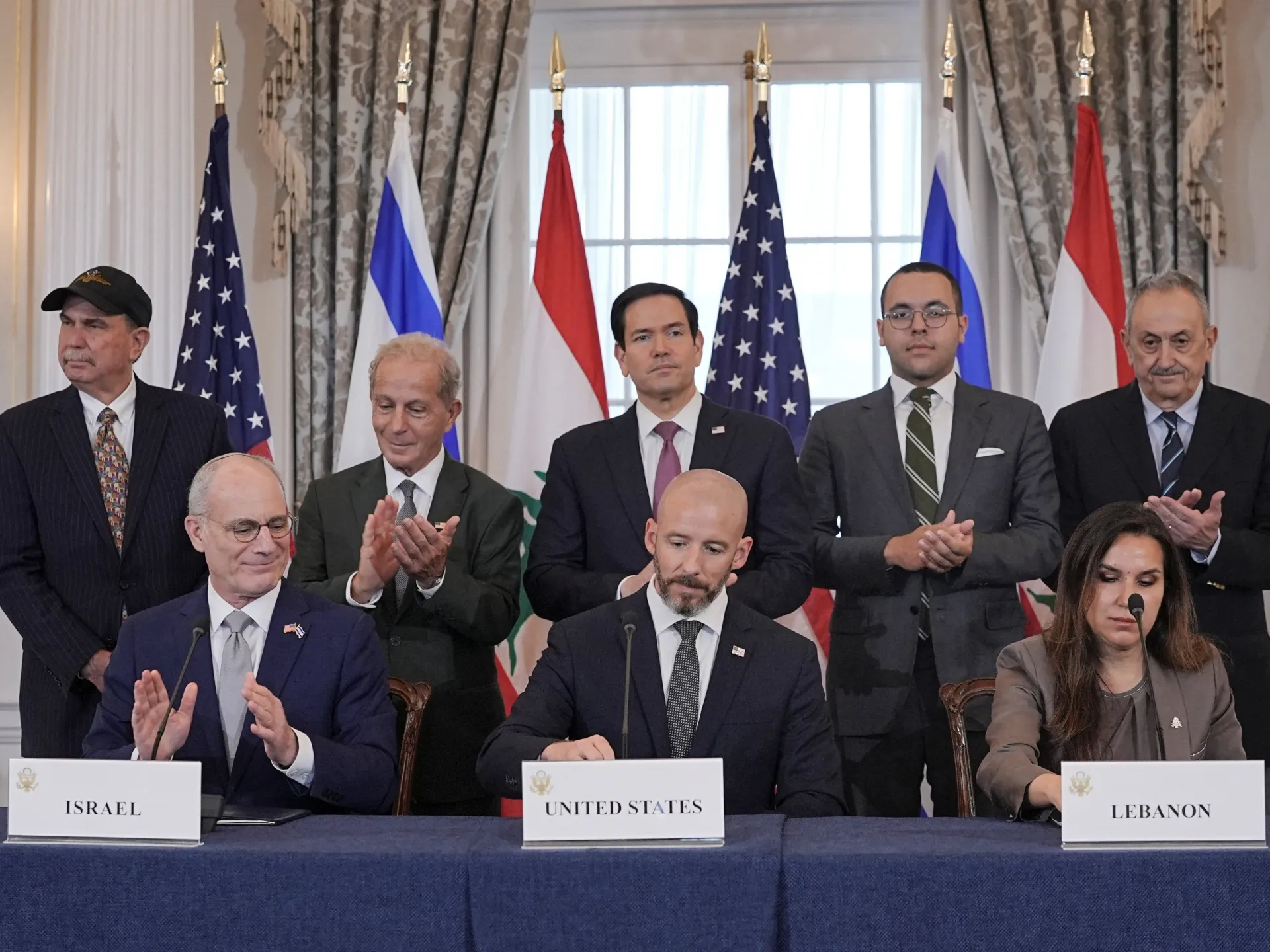
Controversial Accord Signed Amidst Regional Tensions
In a significant diplomatic development, Lebanon and Israel recently formalized an understanding following a period of intense negotiations and regional pressure. The agreement, signed in Washington, D.C., has been met with immediate and widespread condemnation from various Lebanese political factions, including Hezbollah and its allies, alongside public protests and critical media commentary. Observers have highlighted numerous issues with the document, deeming it impractical, politically volatile, and constitutionally questionable. A central concern articulated by critics is that the accord might not only fail to prevent future hostilities but could also create a framework wherein Lebanon is held accountable for any subsequent escalation.
Echoes of Past Agreements: A Troubling Precedent?
The diplomatic approach taken in the recent Lebanon-Israel agreement draws parallels to previous interim arrangements, such as the Oslo Accords. These earlier agreements were characterized by broadly worded declarations and the deferral of critical issues like borders, settlements, and sovereignty. In the context of the Israeli-Palestinian conflict, this approach led to a hardening of interim structures, enabling Israel to maintain operational flexibility, expand its territorial control, and attribute blame to Palestinians for unmet conditions often beyond their control. While the specific circumstances and documents differ, the underlying diplomatic logic, which seeks to declare an ambition to end conflict without providing definitive solutions, is seen by some as a potential trap for Lebanon.
The Challenge of Implementation: Hezbollah's Role
A significant hurdle to the effective implementation of the new framework lies in the Lebanese state's capacity to assert control over non-state actors, particularly Hezbollah. The group's military capabilities are deeply intertwined with a broader political narrative concerning deterrence, community protection, and perceived state failures in national defense. Critics argue that such a deeply entrenched structure cannot be dissolved simply by signing a document. Furthermore, the Lebanese army, which is expected to assume a more sovereign deterrent role, remains underfunded, politically compromised, and reliant on external military aid that is often constrained by the geopolitical interests of external powers, including Israel and the United States. Consequently, Lebanon is being asked to demonstrate sovereign authority in areas where its capabilities are weakest, controlling armed groups it cannot defeat and negotiating with an adversary it cannot deter, all while adhering to obligations enforced by external powers whose primary objective may not be Lebanese sovereignty.
Constitutional and Legal Ramifications
Beyond the immediate security implications, the agreement contains clauses that extend into Lebanon's international legal and political engagements. Provisions requiring both parties to cease 'hostile' or 'adverse' actions in international forums are particularly alarming to some, as they could restrict Lebanon's diplomatic, legal, and political tools—its primary recourse given its military disadvantage. Constraining these avenues, such as Lebanon's potential accession to the International Criminal Court, in the name of 'de-escalation,' is viewed by some as disarming the state in arenas where it still possesses leverage.
Moreover, the accord faces significant constitutional scrutiny within Lebanon. There is debate over whether the declaration represents a political understanding or a binding agreement. If the text addresses matters of war, peace, territorial arrangements, international obligations, or restrictions on Lebanon's legal conduct, it transcends mere diplomatic rhetoric. Lebanon's constitutional framework dictates that treaties and international accords require institutional approval, with major decisions concerning war, peace, and national security falling under the purview of the Council of Ministers, not solely the president or prime minister. Using a declaration of intent to bypass these constitutional safeguards is seen as problematic. The Lebanese constitution also mandates the preservation of territorial integrity, raising questions about any clauses that might implicitly normalize an Israeli security presence or condition Lebanese sovereignty on Israel's assessment of Hezbollah's disarmament.
Political Obstacles and the Risk of Delay
The controversial nature of the agreement makes it politically explosive within Lebanon. Hezbollah, the Amal Movement, and their allies are incentivized to challenge the accord, potentially leveraging Lebanon's complex political machinery to delay or obstruct its implementation. They can argue for the necessity of cabinet approval, question whether it constitutes normalization, demand clarity on Israeli withdrawal, and object to any clauses limiting Lebanon's legal pursuit of Israel. This could lead to the process being mired in committees, constitutional debates, and procedural paralysis. Ironically, in this particular context, such delays might be perceived as the least dangerous immediate outcome.
The Broader Regional Context and Future Conflict
The true implications of the agreement are seen as being shaped by a wider regional dynamic involving the United States, Iran, and various mediators. The core understanding is not what Lebanon formally signed, but rather the directives issued by Tehran to Hezbollah, the guarantees provided by Washington, the concessions Israel seeks to extract, and the overall stability of the broader U.S.-Iran relationship. In the short term, developments within regional diplomatic tracks are considered more influential than the specific language of the declaration. If the regional de-escalation efforts are sustained, Hezbollah might absorb the agreement without open confrontation. However, if these efforts collapse, the declaration is unlikely to prevent conflict.
While Lebanese government leaders may believe they are buying time by signing this document, there is a risk that the accord could outlive the political moment that produced it. The agreement, however loosely worded, carries significant consequences. Should Hezbollah fail to comply with its terms, or if the under-resourced Lebanese army cannot fulfill its stipulated roles, Israel could use the declaration to assert that Lebanon has failed. Similarly, if Beirut pursues legal action against Israel or rejects Israeli security conditions, Israel could claim a breach of good faith or a rejection of peace. This perspective suggests that the declaration, rather than preventing war, could instead provide the legal and political justification for a future conflict.
Critics argue that while Lebanon is finally being called upon to act as a sovereign state after years of its sovereignty being undermined by external and internal factors, this agreement exposes the fragility of that sovereignty. Instead of utilizing this moment to define and build a robust, capable state with a strong army, a clear defense doctrine, and constitutional integrity, Lebanon has entered a framework that highlights its current vulnerabilities.
Source: Original Article
Related Articles
 world
world
UNRWA Faces Critical Funding Gap Amid Warnings of Worsening Humanitarian Crisis for Palestinians
 world
world
Sweden's Evolving Migration Landscape: A Decade of Policy Shifts and Personal Impacts
 world
world
Cross-Border Tensions Escalate as Pakistan Reports Intercepting Drones from Afghanistan
 world
world