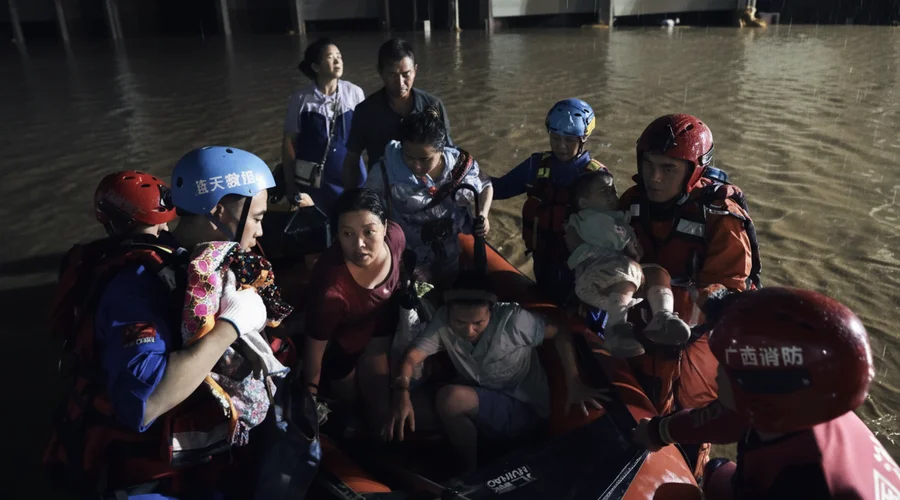
Overview of Recent Natural Disasters in China
China is currently grappling with a series of severe weather events, including a significant landslide in the western province of Gansu and widespread thunderstorms impacting various parts of the country. These incidents have led to fatalities, numerous injuries, and substantial displacement, prompting an urgent national response.
Details of the Gansu Landslide
In the mountainous terrain of Gansu province, a recent landslide has resulted in at least 16 people remaining buried. Initial reports indicated that 33 individuals were trapped following the event. According to state broadcaster CCTV, rescue operations have successfully extricated 17 people from the debris. The precise cause of this particular landslide has not yet been determined.
Impact of Thunderstorms Across China
Concurrently, various regions of China have been experiencing intense thunderstorms. In the eastern part of central Hubei Province, at least eight fatalities were reported after severe storms struck on Monday night. Additionally, one person remains unaccounted for in the aftermath of these storms. The cities of Huangshi, Huanggang, Ezhou, and Xianning were particularly affected, experiencing strong winds that reached speeds of up to 149 kilometers per hour (approximately 92.58 mph).
By Tuesday morning local time, the Xinhua news agency reported that a minimum of 275 individuals had sustained injuries due to these weather conditions. The National Meteorological Centre has issued warnings for continued torrential rainfall across several areas, potentially affecting around 200 million people. Forecasts indicate that the southeastern region of Guangxi and the eastern provinces of Jiangsu and Shandong could receive up to 260 millimeters of rain over a 24-hour period, a volume capable of triggering further landslides. Other regions in China's northeast and south are also on alert for potential tornadoes.
Presidential Response and Ongoing Alert
Chinese President Xi Jinping has called for a comprehensive and concerted effort to rescue those impacted by these natural disasters and to provide necessary relief. The national government is mobilizing resources to address the immediate aftermath and prepare for further anticipated weather events.
Adding to the meteorological concerns, China is also monitoring the progression of Super Typhoon Bavi. This powerful typhoon is currently traversing the Pacific Ocean and is projected to approach Taiwan. The US National Weather Service reported that as of Monday, Super Typhoon Bavi was generating winds of up to 290 kilometers per hour (180 mph) as it passed over Guam, Tinian, Saipan, and Rota. The potential trajectory and impact of this typhoon are being closely watched by authorities.
Broader Context of China's Weather Challenges
These recent events underscore the significant challenges China faces annually from various natural phenomena, including heavy rains, landslides, and typhoons. The country's diverse geography, ranging from mountainous regions to extensive coastlines, makes it susceptible to a wide array of weather-related hazards. Government agencies and emergency services are frequently engaged in disaster preparedness and response efforts to mitigate the human and economic impact of such occurrences.
The current situation highlights the critical importance of early warning systems, robust infrastructure, and efficient disaster management protocols in safeguarding communities. As rescue operations continue in Gansu and other affected areas, the focus remains on ensuring the safety and well-being of the population while also preparing for potential future weather-related incidents.
Source: Original Article