
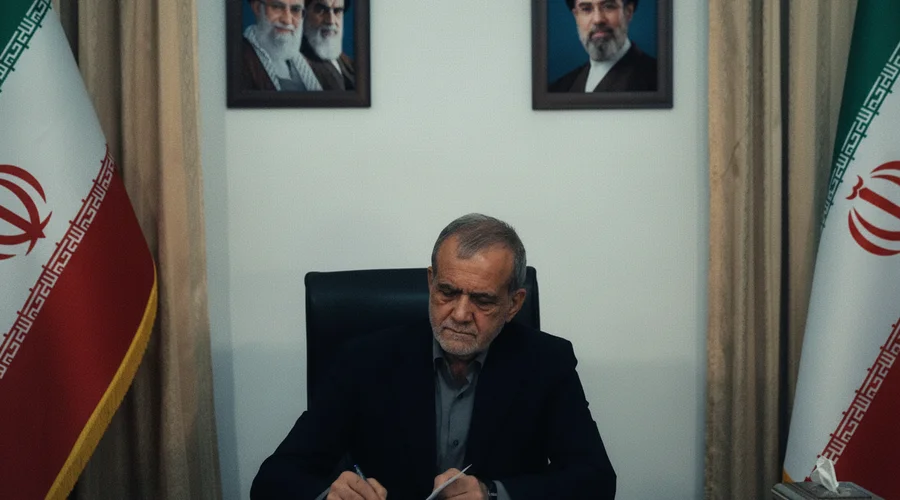
Iranian Political Dynamics: Pezeshkian's Role Amidst Factional Tensions and MoU Uncertainty
Recent developments in Iran have brought to the forefront discussions surrounding a Memorandum of Understanding (MoU) signed between the United States and Iran, intended as a framework for peace talks. However, escalating hostilities, including reported strikes by the United States that have resulted in casualties, have cast significant doubt on the future of this agreement. Within Iran, a narrative appears to be emerging that places considerable responsibility for the MoU's perceived fragility on President Masoud Pezeshkian. This focus on the president, however, is increasingly viewed as a strategy to deflect from and manage internal political divisions among the nation's leadership.
The architecture of this blame assignment became more apparent shortly after the MoU's signing. Supreme Leader Mojtaba Khamenei publicly articulated a 'different view' on the agreement. While he permitted its advancement, he explicitly stated that President Pezeshkian, in his capacity as the head of the Supreme National Security Council, had committed to safeguarding Iranian national interests and the 'Resistance Front,' thereby accepting direct responsibility. Notably, Khamenei's statement conspicuously omitted any mention of Mohammad Bagher Ghalibaf, the speaker of parliament and the acknowledged head of the negotiating team, despite Foreign Minister Abbas Araghchi's confirmation that Ghalibaf was entrusted with the negotiation process by the 'nezam' (the system).
This deliberate omission is not accidental. It suggests a strategic separation of potential outcomes: should the MoU prove successful, credit is likely to be attributed to Ghalibaf; conversely, if it falters, the blame is being directed towards Pezeshkian. This dynamic offers insights into the intricate power distribution within Iran's post-conflict political landscape.
Fractures Within Iran's Ruling Bloc
The MoU itself is understood to have been orchestrated by what has been described as Iran's core ruling bloc: a 'military-bonyad complex.' This complex represents a fusion of the Islamic Revolutionary Guard Corps (IRGC) and state security forces with powerful revolutionary-religious foundations, known as bonyads, such as the Mostazafan Foundation, Setad, and the Imam Reza Shrine Foundation. This network, which expanded significantly through asset transfers disguised as privatization in the early 2000s and was bolstered by shadow-finance networks necessitated by sanctions, now controls a substantial portion of Iran's economy, operating largely beyond civilian oversight. Its leadership is appointed directly by the supreme leader, with the Guardian Council providing protection by tailoring legislation to safeguard its monopolies and prevent significant challenges.
Despite its formidable influence, this complex is not monolithic. The recent period of conflict has, in fact, highlighted a structural division that the MoU has further exposed. On one side stands a technocratic-economic faction, exemplified by Ghalibaf, whose career trajectory—encompassing leadership roles in the IRGC's Khatam al-Anbiya construction conglomerate, the mayorship of Tehran, and the parliamentary speakership—reflects the institutional evolution of the complex. On the opposing side is an ideological-maximalist faction, primarily organized around the Paydari Front, which views any engagement with the United States as a betrayal and perceives Western investment as a threat to the regime's fundamental survival.
A clear point of contention between these factions is the proposed $300 billion private Reconstruction and Development Fund, a central economic element of the MoU. Ghalibaf's faction advocates for this fund, believing economic recovery and measured integration into global capital markets are essential for stability, contrasting with a strategy of perpetual isolation. The Paydari Front, however, interprets such foreign investment not as recovery but as an unwelcome penetration, arguing that it would grant Washington and its regional allies undue influence over reconstruction efforts, effectively trading sovereignty for capital.
Ghalibaf's faction ultimately prevailed in the internal debate, leading to the securing of the deal. Yet, as the ceasefire and MoU encounter difficulties, it appears unlikely that Ghalibaf will be held accountable for any failures. His long-standing proximity to Khamenei's inner circle and his strong lineage within the IRGC provide him with institutional backing that Pezeshkian conspicuously lacks.
The Role of the Presidency as a 'Circuit Breaker'
Pezeshkian's suitability for the presidency, in the eyes of the ruling bloc, was precisely rooted in his relative lack of independent political power or a strong personal base. Unlike previous presidents such as Akbar Hashemi Rafsanjani, Mohammad Khatami, or Hassan Rouhani, who commanded significant political, social, or security networks, Pezeshkian entered office without comparable leverage. His elevation in 2024 was seemingly intended to present a moderate public face capable of restoring public confidence after a period of unrest, without challenging the authority of the military-bonyad complex. His perceived weakness is not an oversight but rather a deliberate aspect of his appointment, positioning him as an ideal figure to endorse agreements initiated by others.
In essence, the Iranian presidency has been reconfigured to function as a 'circuit breaker': designed to absorb the repercussions if an agreement fails, and to be bypassed if it succeeds. Interestingly, media outlets associated with the IRGC and close to Ghalibaf have recently offered a degree of protection to Pezeshkian against the more severe criticisms from the Paydari faction. This is seen less as genuine support and more as strategic maintenance, ensuring the operational capacity of the presidency and providing a convenient repository for blame. This protection is likely to persist only as long as the deal's survival requires it, and would likely dissipate should the MoU collapse.
This strategic setup echoes a playbook previously used by Ali Khamenei, who approved nuclear diplomacy while publicly expressing distrust of the U.S., thereby preserving his standing with the ideological base regardless of the outcome. His son has adopted a similar approach, but with a crucial refinement: instead of general hedging, a named officeholder has been explicitly assigned responsibility. For the moment, the strategy of scapegoating Pezeshkian appears to be effective, channeling discontent over the faltering MoU towards the presidency and thereby averting a direct confrontation between the two major wings of the military-bonyad complex. However, this is merely a postponement of an inevitable reckoning. The fundamental divergence between a faction prioritizing economic recovery for survival and another whose influence depends on perpetual confrontation appears increasingly entrenched, suggesting that no single scapegoat can indefinitely absorb these tensions. When the current strategy reaches its limit, the true struggle for the Islamic Republic's future direction is expected to unfold within the ruling bloc itself.
Source: In Iran, Pezeshkian will be the scapegoat for the failed MoU
Related Articles
 politics
Examining the Absence of Unscripted Press Conferences by Indian Prime Minister Modi
 politics
Senator Lindsey Graham, Staunch Ally of Israel and Key Republican Figure, Passes Away at 71
 politics
Venezuela's Diplomatic Shift: Pragmatism Over Ideology in Rapprochement with Israel
 politics