
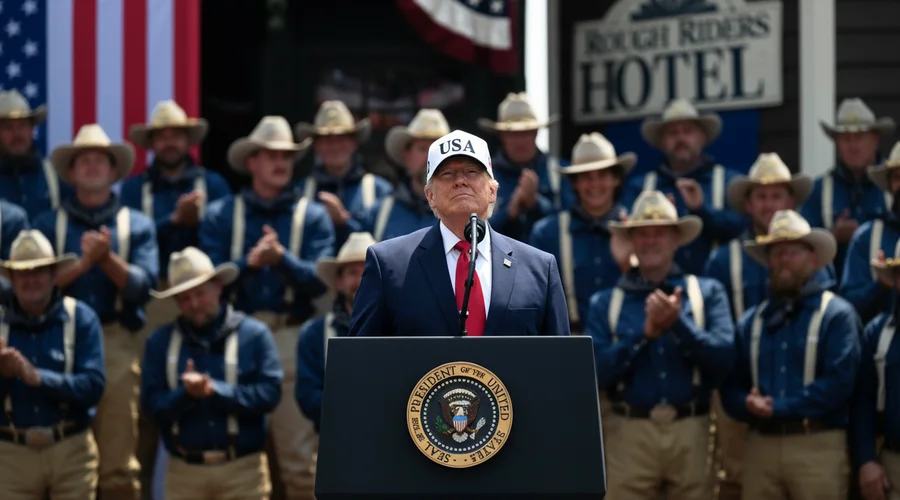
Former President Trump's Remarks at Theodore Roosevelt Library Event
Former U.S. President Donald Trump recently participated in the dedication ceremony for the Theodore Roosevelt Presidential Library in North Dakota. Arriving at the event aboard what was referred to as 'the Freedom 250 Train,' Trump delivered remarks touching on various topics, including international maritime activities and geopolitical concerns. The ceremony itself featured a backdrop of Spanish-American War reenactors, providing a historical context to the proceedings.
Observations on the Strait of Hormuz
During his address, Trump made a specific reference to the Strait of Hormuz, a critical chokepoint for global oil shipments. He asserted that a 'record number' of ships were currently transiting through the strait. The Strait of Hormuz is strategically significant as it connects the Persian Gulf to the open ocean, making it a vital waterway for international trade and energy transportation. Approximately one-fifth of the world's total oil consumption, and a substantial portion of its liquefied natural gas (LNG), passes through this narrow passage daily. The security and unhindered navigation of this strait are therefore of paramount concern to numerous nations and global economic stability.
While the former president's statement regarding 'record numbers' of ships was made, specific data or context to support this claim were not detailed during his speech. Maritime traffic in the Strait of Hormuz is subject to various factors, including global energy demand, geopolitical tensions, and seasonal variations. Organizations such as the U.S. Energy Information Administration (EIA) and various international shipping bodies regularly monitor and report on vessel movements through the strait, providing statistics on the volume and types of cargo transported.
Assessment of Global Threats
In addition to his comments on maritime traffic, former President Trump also articulated his perspective on what he considers to be the 'greatest threat' facing the world. He identified communism as this primary concern. This viewpoint aligns with historical U.S. foreign policy stances that have often viewed communist ideologies and states as significant adversaries, particularly during the Cold War era.
The concept of communism, as an economic and political ideology, advocates for a classless society in which the means of production are owned and controlled by the community as a whole. Throughout the 20th century, various states adopted communist systems, leading to significant geopolitical rivalries and conflicts with capitalist democracies. Critics of communism often point to issues such as state control over individual liberties, economic inefficiencies, and human rights abuses in regimes that have implemented communist principles.
Conversely, proponents argue that communism aims to eliminate economic inequality and exploitation. The debate over the merits and demerits of communism continues in academic and political discourse globally. Modern interpretations and applications of communist principles vary significantly across different countries and political movements.
The Theodore Roosevelt Presidential Library Context
The event itself, the dedication of the Theodore Roosevelt Presidential Library, provided a notable setting for these remarks. Theodore Roosevelt, the 26th U.S. President, was known for his robust foreign policy, including his 'Big Stick' diplomacy, and his advocacy for American power and influence on the global stage. His presidency (1901-1909) saw the United States emerge as a more significant player in international affairs, particularly in the Caribbean and Pacific. The presence of Spanish-American War reenactors at the dedication further emphasized a period of American expansion and military engagement.
The choice of venue and historical context might be seen as reflecting a broader theme of American strength and leadership, which has often been a recurring motif in Trump's public addresses. The library aims to preserve and interpret the legacy of Theodore Roosevelt, offering insights into his life, presidency, and enduring impact on American society and foreign policy.
Source: Original Article
Related Articles
 politics
Constitutional Scholar Examines Presidential Authority and Democratic Principles
 politics
Birthright Citizenship Debate Reignited by Supreme Court's Fractured Decision
 politics
Supreme Court Upholds Birthright Citizenship, Drawing Varied Reactions
 politics