
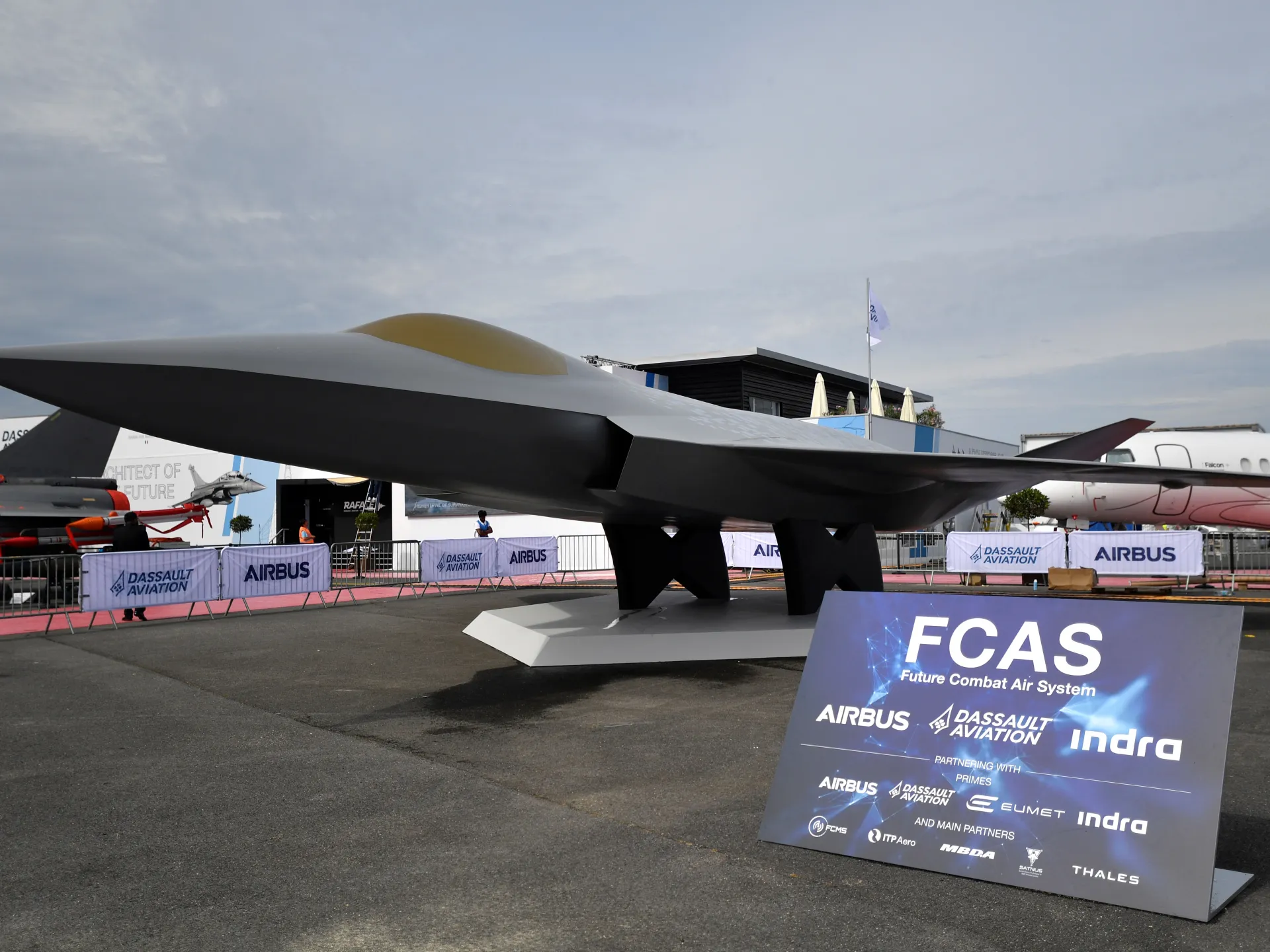
France-Germany Jet Project Collapse: A Setback for European Defense?
The joint French-German initiative to develop a sixth-generation fighter jet, known as the Future Combat Air System (FCAS), has officially been terminated. French President Emmanuel Macron confirmed the project's dissolution, a move widely interpreted as a significant blow to efforts aimed at bolstering defense cooperation among European Union member states. This development unfolds against a backdrop of escalating uncertainty regarding the United States' commitment to its NATO allies, particularly under the leadership of President Donald Trump.
Trump's long-standing skepticism regarding Europe's reliance on American security guarantees has been a recurring theme. His past remarks, including discussions about acquiring Greenland, a self-governing territory within the Kingdom of Denmark, have underscored a growing transatlantic rift. These comments, coupled with threats of trade tariffs against nations opposing his views, have generated considerable unease in European capitals. While the Greenland proposition ultimately saw Trump agree to a 'framework of a future deal' with NATO's Mark Rutte, the initial threat of military action sent shockwaves across the continent, highlighting the potential for previously inconceivable scenarios.
Further exacerbating these tensions, Trump's administration has scaled back support for Ukraine and consistently criticized European NATO partners for insufficient defense spending, actively urging them to reduce their dependence on the U.S. for military protection. More recently, Europe's reluctance to fully engage in the U.S.-Israeli conflict with Iran, which commenced with strikes on Tehran in February, has further strained relations, intensifying concerns that a widening transatlantic divide could undermine Europe's security posture and potentially embolden Russia.
The FCAS Project: Ambition Meets Obstacle
Until recently, the FCAS project served as a symbol of Europe's ambition to counter these emerging concerns. This landmark pact, originally involving France, Germany, and Spain, aimed to collaboratively develop a next-generation fighter jet. However, internal disagreements over leadership roles, specifically whether France's Dassault Aviation or Airbus (representing Germany and Spain) should spearhead the initiative, ultimately led to its collapse. Despite this significant setback, analysts suggest that the pursuit of European strategic autonomy is not entirely lost. They argue that the path forward lies in enhanced military integration, rather than solely shared political aspirations.
Giuseppe Spatafora, a policy analyst at the European Union Institute for Security Studies, notes that the FCAS project's challenges "highlight the limitation of Europe’s defence industrial landscape, where national needs sometimes clash with the broader goal of defence integration." However, he cautions against overestimating the impact of the project's dissolution.
A Setback, Not a Collapse: Perspectives on European Defense Integration
Jamie Shea, a retired NATO official and associate fellow with the International Security Programme at Chatham House, concurs, viewing the FCAS's termination as a setback rather than a complete collapse of European defense integration. Shea emphasized the project's importance as a "high-tech, innovative and future-oriented programme that Europeans need to be able to achieve successfully if they are to become strategically autonomous and break their dependence on the US for major weapons systems." He had hoped FCAS would drive advancements in artificial intelligence (AI), space technology, data fusion, and the interface between manned and autonomous systems, potentially attracting further partners and creating a ripple effect in next-generation defense technologies across Europe.
Crucially, Spatafora points out that the project originated in 2017, a different geopolitical era before Russia's full-scale invasion of Ukraine and Trump's return to the White House. "Nowadays, the project might be designed differently to reflect the scenario," he observed, adding that the collapse "doesn’t affect the broader trend in Europe towards reducing dependencies on US military systems and strengthening its own defence capabilities."
Despite the overall project's cancellation, France and Germany intend to continue with certain FCAS components, such as the "combat cloud" feature, which aims to enhance Europe's cyber command-and-control capabilities. Airbus and various German companies are also exploring the continuation of the program in other areas, particularly software architecture and drone technology. Shea believes that this could still yield benefits for European defense and its technological base, even without a manned fighter aircraft. Furthermore, he highlights the existence of numerous other joint defense projects currently underway in Europe, albeit less ambitious than FCAS.
Guntram Wolff, a senior fellow at the European think tank Bruegel, also advises against excessive alarm. "I would not interpret this decision overly negatively," Wolff stated. "FCAS was a very complicated project and its military relevance may well be overstated at a moment of increasing importance of cheap autonomous systems. In part, the decision also reflects a reassessment of whether the high cost was really warranted."
Building on Existing Strengths and Addressing Challenges
Analysts identify several areas where Europe possesses inherent strengths, including shipbuilding, submarines, short-range missiles, and air defense systems like the German IRIS-T and the French-Italian SAMP/T. The continent has also demonstrated its capability in developing advanced fighter jets, as evidenced by the Eurofighter Typhoon, Tornado, and Gripen programs.
However, Europe's primary challenges lie in underinvestment and the difficulty in scaling up to the mass production levels required by modern warfare. This was recently underscored by the resignation of the UK's Secretary of State for Defence, who cited insufficient funding as a barrier to national security. To truly match U.S. military capabilities in the future, European nations will need to enhance their collective efforts. Shea emphasizes the need for integrating all systems and domains into a unified battlefield management space, an area where the U.S. currently holds an advantage. The ongoing conflict in Ukraine, with its widespread use of drones, offers valuable lessons for Europe, particularly regarding the need for affordable, mass-produced capabilities. FCAS, being a highly expensive project, may not have addressed Europe's most pressing deterrence needs today.
The FCAS collapse also brings to the fore the complex issue of coordinating large-scale projects that individual nations cannot undertake alone, especially when national industrial interests might clash. This conundrum is likely to influence the design of future EU instruments supporting cooperative defense initiatives. Another significant challenge is the lengthy development cycle for major platforms like aircraft, ships, or land warfare vehicles, with contracts signed today yielding equipment only by 2040. Europe will need to prioritize upgrading existing capabilities, such as the Eurofighter jet and Leopard tank, and seek gap-fillers elsewhere.
Spatafora argues that the FCAS's termination should not push European countries back towards greater reliance on American systems. He contends that the Trump administration's approach and the depletion of U.S. stock after the Iran conflict have considerably diminished the reliability of U.S. supplies and guarantees. He notes that U.S. reliability depends more on assets like long-range missiles, forward-deployed troops, and command-and-control infrastructure than on a next-generation fighter jet.
Future Directions: Military Requirements Over Political Ambition
Shea suggests that the FCAS failure benefits both Russia and the U.S., with the latter potentially hoping to sell more F-35s and maintain Europe's traditional dependency on U.S. military equipment. Consequently, a strategic rebound from the collapsed project is deemed essential. Analysts indicate that this rebound is already in motion, with Europe increasingly seeking to reduce its reliance on the U.S.
They point to renewed interest in the UK-Italy-Japan Global Combat Air Programme (GCAP) for a sixth-generation stealth fighter jet, enhanced military space capabilities through the European Space Agency, and EU defense financing mechanisms like the Security Action for Europe (SAFE). Joint ventures with Ukraine, which has excelled in mass drone production and AI technology amidst its conflict with Russia, could also help Europe stay abreast of key technological advancements. Spatafora concludes that while Washington will remain relevant for certain capabilities, particularly nuclear deterrence, European countries will progressively aim to develop more of their own defense capabilities.
Ultimately, Shea argues that the core lesson from FCAS is that defense integration must be driven by "military requirements rather than political ambition." He highlights the historical difficulties in Franco-German cooperation due to the presence of large defense companies unwilling to play a secondary role. A more promising model, he suggests, is the joint UK-Norway agreement for a new destroyer-class warship, where shared operational needs in the North Atlantic and Baltic Sea drove a bottom-up, natural cooperation, rather than a top-down political mandate.
Source: France-Germany jet plans crash: Can Europe end reliance on US for security?
Related Articles
 world
world
International Sanctions Target Settlers Amidst Escalating West Bank Tensions
 world
world
G7 Leaders Convene in France Amidst Critical Discussions on Iran and Ukraine
 world
world
Iran Cautions Against Israeli Presence in Lebanon, Citing Potential US Accord Violation
 world
world