
Widespread Devastation in Kyiv
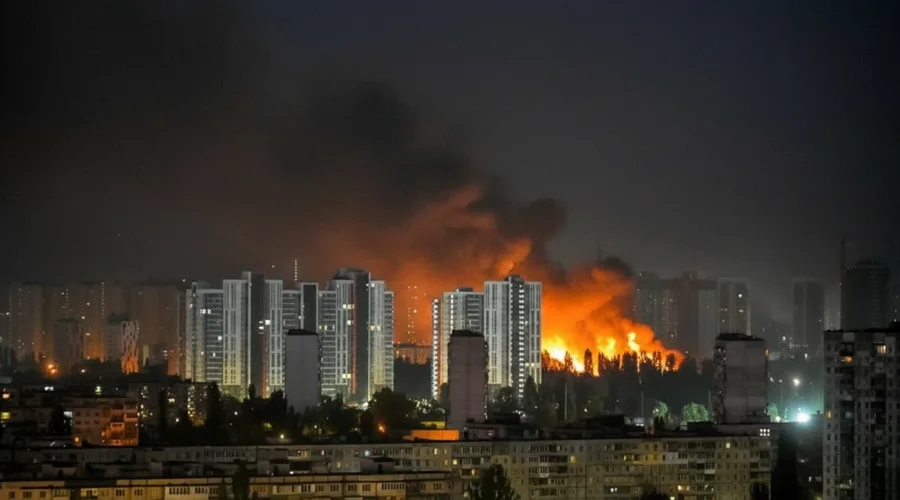
Ukraine's capital, Kyiv, experienced a significant assault early on a Monday morning, as Russian forces launched a barrage of missiles and drones. This attack, the second major strike on the city within a week, tragically claimed the lives of at least ten individuals and caused damage to over a dozen residential structures. Tymur Tkachenko, head of Kyiv's military administration, reported that an additional 46 people sustained injuries in the capital alone. The intensity of the assault prompted thousands of residents to seek refuge in underground shelters as air raid sirens blared across the nation.
The impact of the strikes was particularly severe in Kyiv, where at least 15 buildings were affected, including four in the historically significant Podilskyi district. Rescue operations are currently underway throughout the capital, and officials have indicated that the death toll could potentially rise as efforts continue. Tkachenko conveyed to reporters, "Unfortunately, this is not the final information," as the number of confirmed fatalities in Kyiv ascended from seven to nine.
Broader Regional Impact and Military Response
Beyond Kyiv, the surrounding districts also felt the brunt of the Russian aggression. Authorities confirmed that one person was killed and ten others were injured in these areas. The Ukrainian military provided details on the scale of the attack, stating that Russia deployed 68 missiles and 351 drones overnight. The Kyiv Independent reported a sequence of explosions, with the first occurring around 1:40 AM local time, followed by subsequent strikes at 2:10 AM and 3:15 AM.
This latest offensive underscores a concerning trend of escalating conflict, particularly in the lead-up to significant international diplomatic events. The use of both missile and drone technology in these coordinated attacks highlights a continued evolution in the tactics employed by Russian forces.
Zelenskyy's Pre-Summit Warning and Geopolitical Context
The recent attacks unfolded just as Ukrainian President Volodymyr Zelenskyy had issued a warning of an impending Russian assault. In his nightly address on the preceding Sunday, Zelenskyy indicated that intelligence suggested Russia was preparing another large-scale strike. He is scheduled to meet with United States President Donald Trump on the sidelines of the NATO summit in Turkiye, which is set to commence later in the week.
Zelenskyy’s statement, as reported by the Kyiv Independent, emphasized the timing of these actions: "Intelligence once again indicates that the Russians are preparing a new massive strike. This is typical of Putin: right after America’s Independence Day and before the NATO summit in Ankara." This perspective suggests a deliberate strategic timing behind the Russian operations, potentially aimed at influencing geopolitical discussions or demonstrating military resolve.
Escalation of Long-Range Warfare
Late last week, Kyiv was subjected to a similar, devastating attack involving dozens of missiles and hundreds of drones, which resulted in 31 fatalities. These previous strikes were noted as the deadliest to impact the capital this year, signaling a notable intensification of the conflict.
Both Russia and Ukraine have increasingly relied on long-range weaponry, including missiles, marking a new phase in the protracted four-year conflict. Ukraine, in particular, has concentrated its offensive efforts on Russian energy infrastructure, seeking to disrupt Moscow's war capabilities. This strategic focus aims to weaken the logistical and economic underpinnings of the Russian military campaign.
Impact on Russian-Controlled Territories
The conflict's reach extends to Russian-controlled territories as well. Mikhail Razvozhayev, the governor of Russian-controlled Sevastopol, a key Black Sea port in Crimea, reported on Monday that a Ukrainian strike near the city had caused electricity outages. He stated via Telegram, "Following an enemy attack on energy infrastructure near Sevastopol, our city was temporarily left without electricity." This incident illustrates the reciprocal nature of the long-range attacks, with both sides experiencing the consequences of intensified warfare.
The ongoing exchanges of long-range strikes underscore the persistent and evolving nature of the conflict, with significant humanitarian and infrastructural impacts on both sides, particularly in the context of broader international diplomatic engagements.
Source: Original Article
Related Articles
 world
world
US Sanctions Target Rwandan Entities Over Alleged Role in DR Congo Conflict Minerals Trade
 world
world
Iran Observes Multi-Day Funeral for Slain Supreme Leader Ali Khamenei
 world
world
Pacific Missile Test by China Sparks Regional Concerns
 world
world