Trump Family Crypto Firm Yields Significant Earnings and Diplomatic Pathways
Recent financial disclosures for former US President Donald Trump in 2025 revealed that his family's cryptocurrency enterprise, World Liberty Financial (WLF), contributed over $500 million to his earnings through token sales alone. This sum constitutes a portion of a broader crypto-related financial gain amounting to hundreds of millions more. Notably, Pakistan was among the initial nations to engage with this particular firm.
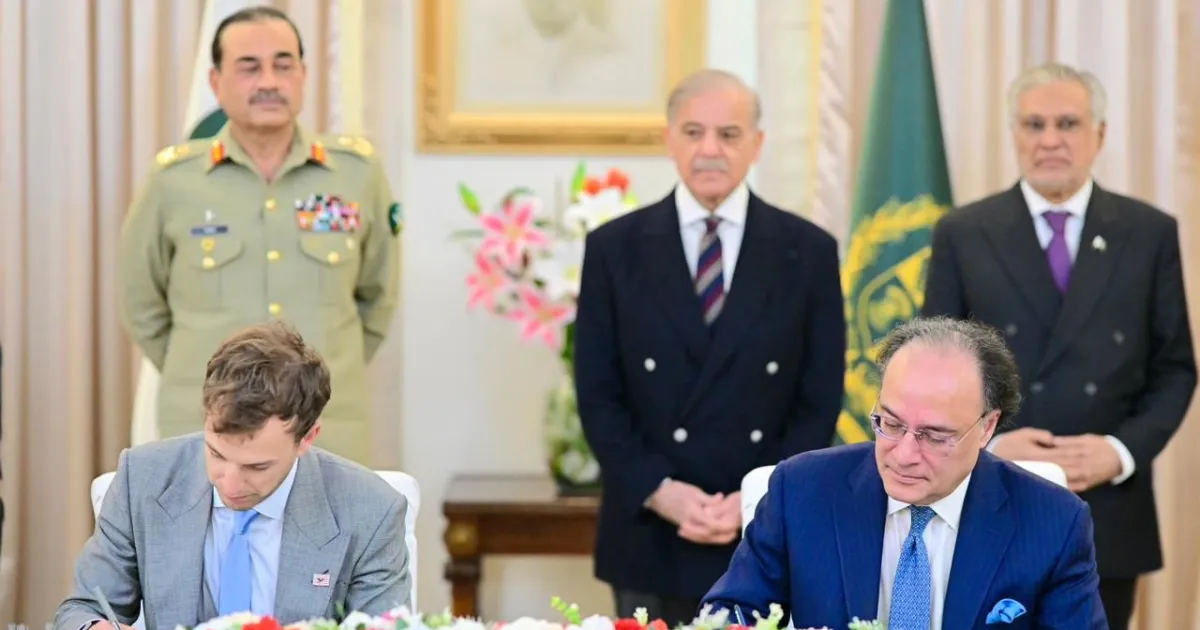
In January, Pakistan's Ministry of Finance formalized an agreement with SC Financial Technologies, an entity affiliated with World Liberty Financial. The memorandum of understanding aimed to investigate the potential application of WLF's USD1 stablecoin, which is pegged to the US dollar, for facilitating cross-border transactions. The signing ceremony in Islamabad was attended by high-ranking Pakistani officials, including Prime Minister Shehbaz Sharif and army chief Field Marshal Asim Munir, who welcomed WLF executives. Among these executives was Zach Witkoff, son of Trump adviser Steve Witkoff, who co-signed the agreement with Pakistan's Finance Minister Muhammad Aurangzeb.
Despite the high-profile nature of the agreement, Pakistani officials have indicated, nearly six months later, that no pilot projects utilizing USD1 have commenced, no licenses have been issued, and no transactions involving the stablecoin are known to have occurred. Nevertheless, analysts suggest that Pakistan has garnered a significant, albeit indirect, benefit from this engagement: enhanced access to the Trump administration, a diplomatic achievement considered as valuable as the financial gains realized by the Trump family through WLF.
The Utility and Ambiguity of Stablecoins in Pakistan
A stablecoin functions as a digital currency designed to maintain a stable value, typically by being pegged to a fiat currency like the US dollar. Its primary purpose is to enable online money transfers without direct reliance on traditional banking systems. USD1 represents World Liberty Financial's proprietary stablecoin. The firm generates revenue from interest accrued on the reserves that back each coin, meaning increased adoption of USD1 would directly contribute to the income of its owners, including the Trump family.
Pakistan stands as one of the world's most active cryptocurrency markets. According to the Chainalysis crypto adoption index, the country ranked third globally last year, trailing only India and the United States. A substantial portion of informal crypto transactions within Pakistan is believed to be conducted using Tether's USDT, the largest stablecoin globally. There is currently no evidence to suggest that USD1 has been used in any transactions within Pakistan. The overall volume of money transacted through such informal channels remains largely unquantified. A senior banking executive in Pakistan, who requested anonymity, noted that reliable estimates are unavailable, with figures often inferred from formal inflows rather than direct measurement. Informal channels are estimated to account for approximately one-tenth of total remittances, with stablecoins representing an unspecified fraction of this amount.
This uncertainty exists even as Pakistan experiences record formal remittance inflows. The State Bank of Pakistan reported that remittances reached an all-time high of $38.3 billion in the last fiscal year, marking a 27 percent increase from the preceding year. In May, the most recent month for which data is available, inflows reached a record $4.25 billion, with the central bank projecting over $42 billion for the current year.
These figures prompt questions regarding the rationale behind the WLF agreement. Ibrahim Khalil, a Canada-based banking and finance professional, questioned the necessity of using stablecoins like USDT given Pakistan's record formal remittances and increasingly instantaneous banking transfers. He suggested that individuals using stablecoins might be intentionally avoiding traditional banking channels, an issue that USD1, if it involves banking channels, would not resolve. Khalil also highlighted a practical concern: Pakistan's central bank held $16.5 billion in reserves in late June, sufficient for approximately two months of imports. He argued that unless Pakistan's trading partners directly accept USD1, the central bank would still need to convert the token back into US dollars for use, potentially adding friction rather than streamlining transactions.
Regulatory Progress Amidst Implementation Challenges
Despite these uncertainties, Pakistan has made strides in establishing a regulatory framework for virtual assets. The Virtual Assets Act, enacted in March, created the Pakistan Virtual Assets Regulatory Authority (PVARA), a permanent regulatory body empowered to license firms and impose penalties, including imprisonment for up to five years, for operating without proper authorization. In April, the State Bank authorized banks to open accounts for licensed crypto firms. However, PVARA is currently only accepting preliminary applications, with comprehensive licensing rules yet to be published. While global exchanges Binance and HTX have received no-objection certificates and are registered, they are not yet authorized to commence operations.
The senior banking executive, speaking anonymously, described the World Liberty Financial agreement as exploratory, focused on technical dialogue and knowledge sharing, with no firm commitment to deploy a specific stablecoin. He emphasized that any firm meeting PVARA's licensing requirements could potentially fulfill the same function, stating, “The architecture matters more than the counterparty.” He further estimated that the full process of licensing, bank onboarding, piloting, and scaling would realistically span several months.
Diplomatic Implications and Access as a Primary Outcome
While the economic benefits for remittance workers remain speculative, the diplomatic advantages of the agreement for Pakistan are more evident. The World Liberty Financial delegation first visited Islamabad in April of the previous year, shortly after a militant attack in Indian-administered Kashmir’s Pahalgam escalated tensions between India and Pakistan. In June of the same year, Pakistan nominated Donald Trump for the Nobel Peace Prize, citing his “stellar statesmanship” in de-escalating the May standoff with India. Furthermore, Trump hosted Field Marshal Munir for lunch at the White House in June 2025, a rare instance of a US president receiving a Pakistani army chief who was not also a head of state.
The January MoU preceded the US-Israeli conflict with Iran, during which Pakistan positioned itself as a mediator between Washington and Tehran. Last month in Switzerland, US Vice President JD Vance commended Munir for his role in brokering a framework for peace between Washington and Tehran, referring to him as a significant “statesman.” Bilal Bin Saqib, who chairs PVARA, served as an adviser to World Liberty Financial from April of the previous year until he joined the Pakistani government. In March 2026, Bin Saqib told Bloomberg that the crypto initiative had opened doors and helped rebuild trust with Washington. The White House has stated that no conflicts of interest were involved. Requests for comment from Bin Saqib, PVARA, and the Finance Ministry went unanswered.
Ultimately, whether the deal delivers tangible benefits for Pakistani workers may be secondary to its diplomatic outcomes. Khurram Husain, a Karachi-based economist and commentator, described the MoU as primarily an “instrument of access” lacking a strong policy basis. He asserted that the “calculation was access, and it paid off spectacularly,” providing Islamabad with significant access to the Trump White House, which was further leveraged during the diplomacy surrounding the Iran conflict. Khalil echoed this sentiment, concluding that the entire exercise was essentially a “pay for access” arrangement.
Source: Original Article