
An Enduring Faith Under Threat
In the secluded valleys of Nepal's Mustang region, nestled within the Himalayas, lies Lubra, a village steeped in the traditions of Bon, an ancient Tibetan religion. For centuries, this community has preserved its unique spiritual practices and way of life. However, Lubra and its inhabitants are now confronting an unprecedented challenge: the destructive forces of climate change, which manifest as increasingly severe and frequent monsoon floods.
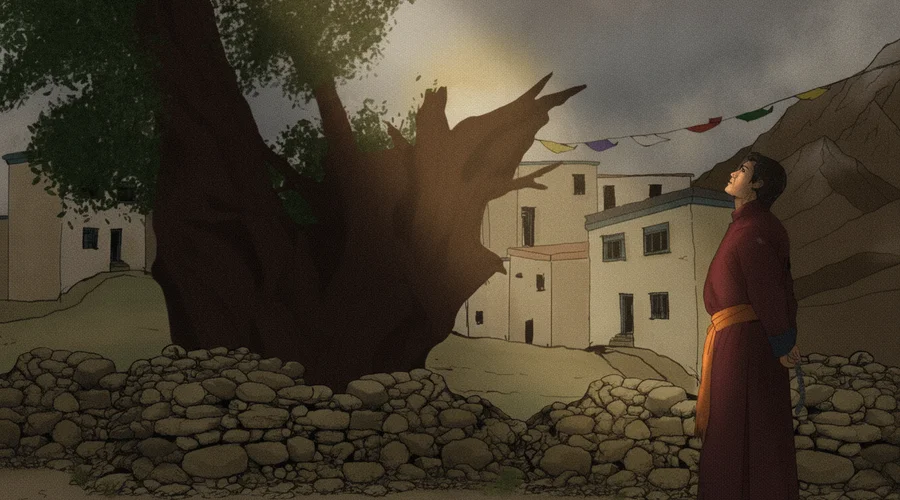
Lama Tsultrim, a 76-year-old spiritual leader and the latest in a long lineage of Bon lamas in Lubra, recounts the village's founding story. According to tradition, the great monk Trashi Gyaltsen established Lubra 20 generations ago after a miraculous walnut tree sprouted from a single pine needle. This ancient walnut tree, with its gnarled roots intertwined with the foundations of homes, still stands today, a living testament to the village's deep historical and spiritual roots. Yet, even this symbol of endurance now finds itself precariously close to the ever-widening riverbed, a stark indicator of the environmental changes gripping the region.
Tsultrim points to his former home, a three-story clay and wood structure, now abandoned. "I left this house two years ago because of flooding," he explains. Over the past decade, severe floods during the monsoon season have forced four families to desert their ancestral residences. Once-fertile farmlands, including apple orchards—a primary source of income—and fields of potatoes and buckwheat, have been transformed into mudflats strewn with rocks, their terraced stone walls crumbling. These physical scars on the landscape are clear evidence that Lubra's historical and cultural fabric is under severe environmental duress.
The Distinctive Path of Bon
Bon is recognized as the indigenous religion of Tibet, with historical roots that are believed to incorporate influences from Persia, Central Asia, China, and ancient Tibetan traditions. While contemporary Bon practices, known as Yungdrung Bon, share many similarities with Buddhism—including the ultimate goal of enlightenment—subtle yet significant differences distinguish it. For instance, Bon monks like Lama Tsultrim wear maroon robes trimmed with blue, a color exclusive to their order. They also circumambulate sacred monuments, such as chortens, in an anti-clockwise direction, contrasting with Buddhist custom. Lubra's monastery houses a unique pantheon of deities, prominently featuring Tonpa Shenrab Miwo, revered as the founder of Bon, said to have been born thousands of years before the Buddha in the mythical land of Olmo Lungring. The religion also preserves pre-Buddhist rituals and its own cosmology.
Anthropologist Charles Ramble, an expert in Bon and Tibetan studies, highlights Lubra's exceptional status. "Lubra is unique because it is the first Bonpo monastery to be founded in Nepal, and it's the only one that's still alive in Mustang. It is extremely unusual," he states. While other Bon families exist in Mustang, Lubra remains the sole village where the entire community adheres to the faith. Historically, Mustang was part of Zhangzhung, an ancient kingdom where an early form of Bon flourished. When Buddhism gained royal favor in the 7th century CE, many Bonpos sought refuge in remote borderlands like Mustang to escape persecution. Lubra was settled in the 11th century by Bonpo families, many of whom migrated from northern Mustang.
The lamas of Lubra are unique in that they are non-celibate, often referred to as "householder monks." This tradition mandates that the eldest son in each family assumes religious duties while also engaging in work, marrying, and raising children. The village's proximity to Tibetan religious centers historically facilitated a continuous exchange of knowledge, deeply integrating religious practice into daily life.
The Chinese Communist takeover of Tibet in 1959 severely impacted Bon communities, forcing many monks to flee and leading to the destruction of major monasteries like Menri during the Cultural Revolution. Menri was later re-established in northern India in 1967. Within the broader Tibetan resistance, which was predominantly Buddhist, Bonpos often found themselves marginalized. It wasn't until 1979 that the Dalai Lama officially recognized Bon as a Tibetan religion, granting its leaders representation in the Tibetan Parliament-in-exile. Given the widespread destruction of Bon centers in Tibet, villages like Lubra in Nepal represent some of the few communities where these ancient traditions have survived decades of upheaval. However, the very landscape that once offered sanctuary now presents a new, climate-induced threat to their continued existence.
The Relentless March of Climate Change
Yangchen Gurung, a resident of Lubra, vividly recalls the day her home, situated closest to the river, was inundated in 2021. "It had rained without stopping for many days," she recounts. A warning from someone higher up the valley allowed her and her family to gather a few belongings and flee to safety. "The floods are ferocious. They bounce off the cliffs across the valley, churning, and plough into everything in the way," she describes. Yangchen and her husband, Palsang Tsering, now reside in a new dwelling higher up the valley.
While flooding has always been a feature of the narrow valley, even woven into local folklore through tales of curses, the intensity and destructiveness of recent floods are unprecedented. "Big floods now happen every few years," Yangchen notes, adding that the 2021 flood was unlike anything the elders had ever witnessed. "The first time the water came, we lost a bit of land. The second time, we lost more land. Then the worst flood hit, and it buried our house." She shows photographs of her old home, submerged in thick, gray sludge, with only half the structure remaining.
The 2021 floods also obliterated the village's flood defenses. Palsang Tsering explains that a significant government budget of approximately $80,000 was spent on constructing gabion walls—mesh structures filled with inorganic materials designed to prevent erosion. "Then, in one day, it was destroyed," he laments. Both Yangchen and Palsang attribute these changes to climate change. "Before, in winter, there used to be so much snow you couldn’t leave the house," Yangchen says, indicating waist-high snow levels. "But these days it barely snows. For three years, it hasn’t snowed at all." She observes a drastic shift in precipitation patterns: "Before, it wasn’t this warm; it was a lot colder. And in the monsoon, it used to rain steadily. Now it won’t rain for a long time, then when it rains, it rains really heavily. Then there is flooding." The expanding riverbed, the destroyed farmlands, and the abandoned homes serve as grim reminders of how a changing climate is directly imperiling the tangible heritage and spiritual continuity of Lubra's Bon community.
Source: Original Article
Related Articles
 world
world
Global Displacement Sees First Decline in a Decade: What Led to Millions Returning Home?
 world
world
Iran Urges US to Ensure Israeli Compliance with Lebanon Ceasefire Amid Regional Tensions
 world
world
The Long Road Home: Examining the Surge in Refugee Returns Amidst Lingering Challenges
 world
world