
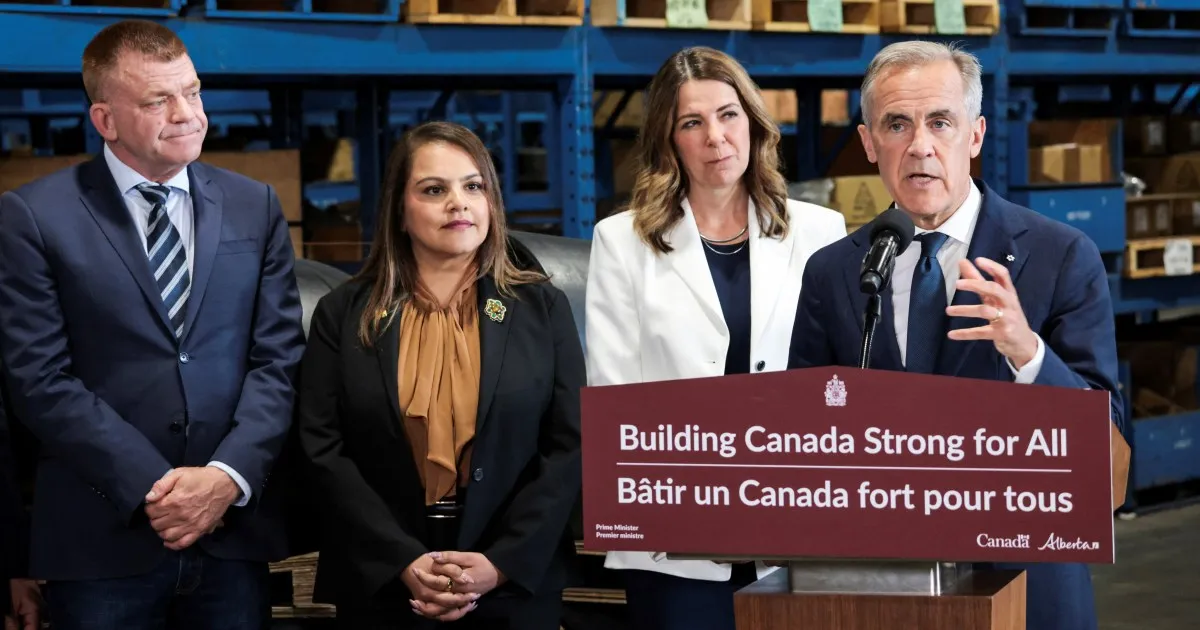
Canadian Leadership Secures Landmark Pipeline Agreement
Canadian Prime Minister Mark Carney has successfully brokered an investment agreement with British Columbia for the construction of a substantial oil pipeline. This development marks a pivotal moment for Canada's energy sector, aiming to facilitate increased oil exports to international markets and mitigate the nation's economic dependence on the United States.
The proposed pipeline is projected to transport an estimated one million barrels of oil daily. Its route will traverse from Alberta, a province rich in oil resources, across British Columbia to Canada's western coastline. This strategic pathway is intended to unlock new access to Asian markets, thereby diversifying Canada's export destinations and bolstering its economic resilience, particularly in light of ongoing trade dynamics with the United States.
Strategic Expansion and Economic Diversification
During a joint press conference with Alberta Premier Danielle Smith, Prime Minister Carney emphasized the urgency of this initiative. "It's time to move to action," Carney stated, highlighting the strategic advantages of the chosen route. He noted, "The best route for a new pipeline is one that goes through one that already exists, south through the Trans Mountain corridor, to our Pacific Coast, the gateway to the world's fastest-growing markets."
Carney has outlined an ambitious national objective for Canada: to double its non-U.S. exports within the coming decade. He articulated that a new pipeline infrastructure would not only achieve this but also potentially alleviate the price disparities currently observed in oil sales to U.S. markets. The planned pipeline is designed to closely parallel the existing Trans Mountain pipeline corridor, extending from Bruderheim, located northeast of Edmonton, Alberta, to the southern coast of British Columbia. This configuration would enable the delivery of over one million barrels per day to tankers destined for Asian markets.
Premier Smith affirmed Alberta's commitment to the project, announcing a partnership between the provincial government, the federally-owned Trans Mountain Corporation, and Calgary-based Pembina Pipeline. This collaboration is set to realize what they refer to as the West Coast oil pipeline. Smith underscored the global demand for Canadian energy, stating, "The world is asking Canada to step up and provide stable, democratic and reliable energy supply that countries around the world are looking for."
Alberta's Production Ambitions and Regional Dynamics
Premier Smith has expressed a long-term vision for Alberta to significantly increase its oil production, aiming to reach eight million barrels per day over the next 10 to 15 years. Her advocacy for the energy sector has often been framed against previous federal policies, with Smith contending that the administration of Prime Minister Justin Trudeau hindered Alberta's energy industry and inadvertently fostered separatist sentiments within the province. Alberta is slated to hold a public vote in the autumn to determine whether a referendum on secession from Canada should be pursued.
The pipeline project has also navigated complex regional concerns. While the southern route is proceeding, there has been notable opposition from British Columbia and certain First Nations communities regarding any pipeline development through northern British Columbia. Prime Minister Carney addressed these environmental considerations, reiterating commitments made earlier in Vancouver. He confirmed, "The tanker ban will remain in place. We will be protecting the northern coast of British Columbia."
Furthermore, Carney announced that British Columbia would receive compensation for any environmental risks associated with the pipeline's construction in the southern part of the province. A prior memorandum of understanding between Ottawa and Alberta had included provisions for adjusting an oil tanker ban off specific sections of the British Columbia coast. However, British Columbia Premier David Eby clarified that he had secured a commitment to uphold the northern tanker ban, thereby safeguarding the province's pristine northern coastline. "It ensures that the northern tanker ban remains in place," Eby affirmed.
Historical Context and Future Outlook
Preceding this agreement, former Prime Minister Justin Trudeau had opposed pipeline projects that would traverse northern British Columbia and the ecologically sensitive Great Bear Rainforest. While he approved the Trans Mountain pipeline, connecting Alberta to British Columbia's southern coast, he rejected the Northern Gateway project due to significant opposition from environmental groups and Indigenous communities.
Since the expansion of the Trans Mountain pipeline became operational through British Columbia's southern coast in 2024, a substantial portion—roughly two-thirds to three-quarters—of the crude oil shipped from Canada's Pacific Coast has been directed to Asian markets. This historical precedent demonstrates Canada's ongoing efforts to lessen its reliance on the U.S. market for energy exports. The current strategy to open up to more global markets is also seen as a proactive measure to address potential trade disputes, such as those initiated by U.S. President Donald Trump, who, in his second term, implemented various tariffs on energy products and goods originating from Canada and other nations.
Source: Original Article
Related Articles
 economy
Iran Issues Warning to Vessels in Strait of Hormuz Over Unsanctioned Routes
 economy
EU's Digital Border System Faces Scrutiny Amidst Pre-Summer Travel Disruptions
 economy
Global Oil Prices Decline Amid Hopes for Iran Peace Deal
 economy