A Distant Passion: Bangladesh's Argentina Obsession
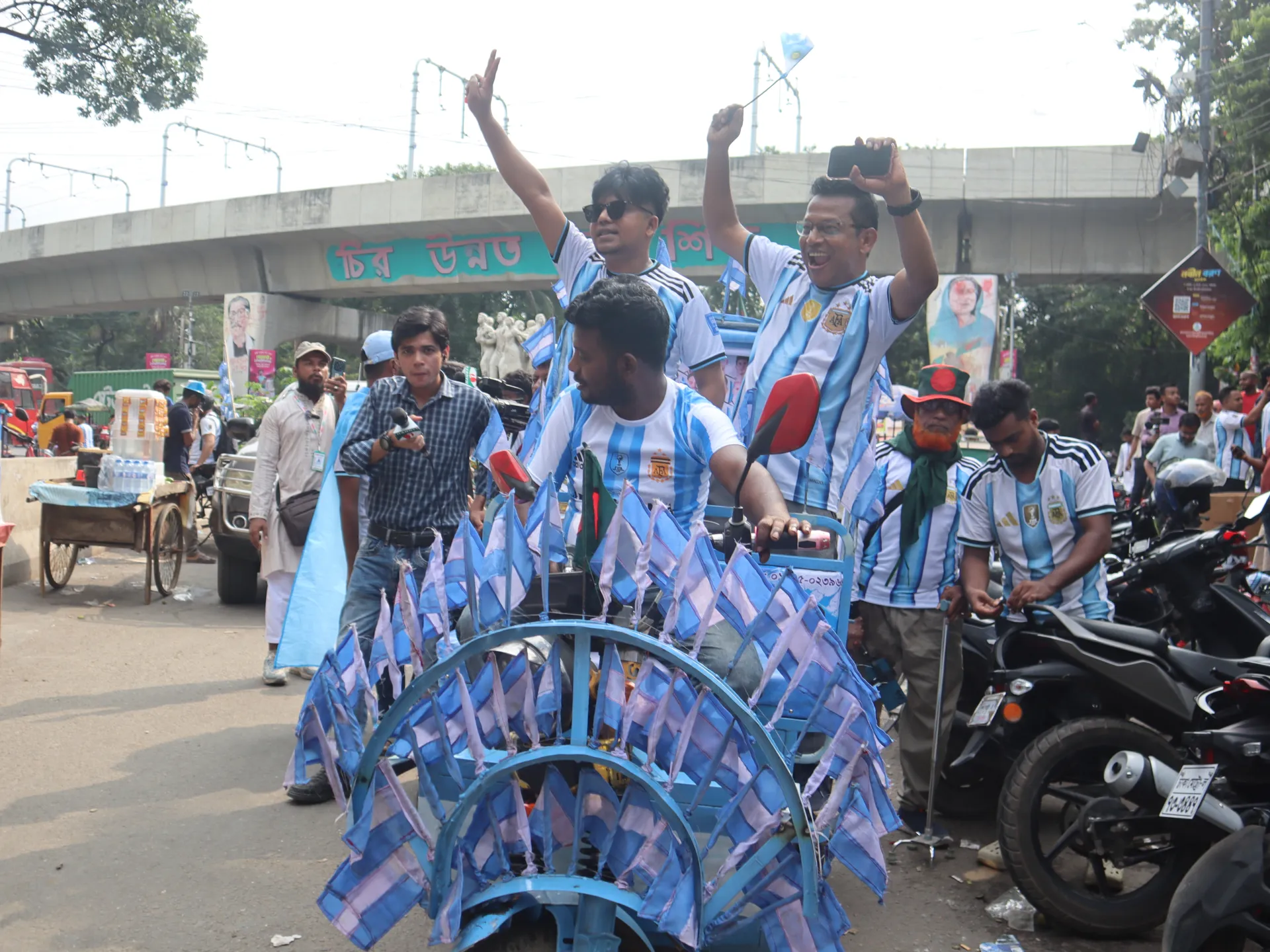
In the bustling streets of Dhaka, Bangladesh, a vibrant sea of sky blue and white engulfs crowds, vuvuzelas blare, and chants of “Argentina! Argentina! Messi! Messi!” echo through the night. This scene, often associated with Buenos Aires, is a regular occurrence in the South Asian nation, located some 17,000 kilometers from Argentina. Even as a giant screen momentarily faltered, enthusiasm remained undimmed after Lionel Messi's hat-trick in Argentina's opening World Cup match against Algeria. Young men, draped in Argentinian flags, celebrated with an intensity typically reserved for a home team, showcasing a deep-seated devotion that transcends geographical and cultural boundaries.
Bangladesh, a nation yet to secure a spot in the FIFA World Cup, transforms into a hub of Argentinian support every four years during the tournament. Neighborhoods nationwide erupt in celebration, with giant screens erected on university campuses and in communities. Apartment complexes host overnight watch parties, and streets are awash in Argentina's iconic colors.
The Maradona Legacy: Igniting a Nation's Love Affair
For individuals like Abdul Hai, a 50-year-old Dhaka resident, this fervent support for Argentina predates the Messi era. His loyalty stems from the 1986 World Cup, where Diego Maradona famously led Argentina to victory. “I fell in love with Maradona in 1986,” Hai recounted. “I was very young, but I saw firsthand how people became crazy about him. His style, his passion, his skill – even the ‘Hand of God’ – everything captivated us like nothing else. He became a legend and a sensation for us.” Argentina's subsequent World Cup triumph would only materialize 36 years later, with Messi at the helm in Qatar during the 2022 event. Hai, however, found the wait worthwhile. “After I saw Messi holding the World Cup, I have no regret with football any more,” he stated. “This World Cup I’m watching with deep joy instead of the apprehension I felt in previous tournaments.”
Shafiqul Islam Manik, a former coach and player for the Bangladesh national football team, affirms that Hai's experience mirrors the origins of Argentina's popularity in Bangladesh. “From what I have seen, it really started in 1986,” Manik observed. He highlighted Argentina’s victory over England following the Falklands War, coupled with Maradona's World Cup win, as pivotal moments. “Watching Maradona’s individual brilliance, Bangladesh’s football supporters gradually became Argentina supporters.”
Manik also noted that Brazil already enjoyed a substantial following due to its historical World Cup successes and famous players. “Argentina became the counter to Brazil,” he explained. “Before that, most people in Bangladesh supported Brazil. From 1986 onwards, Argentina began building its own fan base.” He believes that Argentina's defeat in the 1990 World Cup final, where Maradona was visibly emotional, only deepened the bond with Bangladeshi fans. “When Maradona couldn’t lift the trophy in 1990 and cried after the final, that touched ordinary people here,” he said. “From then on, Argentina’s support became firmly established.” This emotional connection, Manik suggests, is why other football powerhouses like Germany or Italy never garnered similar widespread support, as “Argentina and Brazil had already occupied that emotional space.”
Football Diplomacy and the Messi Generation
The profound affection Bangladeshis hold for Argentina has also resonated in diplomatic spheres. Marcelo Carlos Cesa, Argentina’s ambassador to Bangladesh, has frequently joined fans at public screenings in Dhaka, partaking in their celebrations. Following the global attention garnered by Bangladesh's ardent support for Argentina during the 2022 World Cup, the Argentinian government reopened its embassy in Dhaka in 2023, ending a 45-year hiatus. While the reopening was driven by broader diplomatic and commercial interests, officials from both nations have acknowledged football as a significant catalyst for strengthening people-to-people connections.
For the younger generation of Bangladeshi fans, however, the fascination lies more with Messi's contemporary brilliance than with Maradona's historical legacy. Dwin Islam, a private-sector employee, articulated this sentiment: “I have loved Argentina since I was a child, especially because of Messi.” Unlike Hai's generation, Islam never witnessed Maradona play. During a “welcome rally” for Argentinian supporters in Dhaka, he joined hundreds of others, beating drums, waving oversized flags, and singing through the rain-soaked streets. Many inherit their allegiance, like Mohammad Jahir, whose father was an Argentina fan. “My father has been a fan of Argentina. I inherited that support,” he said. “Then I started understanding football myself and fell in love with the way they play.” Despite World Cup matches often being broadcast in the early hours of the morning in Bangladesh due to time differences, the devotion remains unwavering. “I don’t even need an alarm,” Jahir chuckled, “When Argentina play, I wake up automatically.”
The Argentina-Brazil Divide: A Cultural Phenomenon
Sports journalist and commentator Shahanoor Rabbani attributes Bangladesh's captivation with Argentina and Brazil to a broader attraction to sporting heroes. “If we look back in football history, those are the two teams from South America that have done well during and after Bangladesh’s independence [in 1971],” Rabbani noted. “From Maradona to Ronaldo and Rivaldo, and now Messi and Neymar, there have always been stars that attracted people towards those teams.” He added, “It’s not only the style of football but the players they have. Bangladesh, in general, loves to have a protagonist, a hero, even if it’s a team game.”
Within Bangladesh, football loyalties often create friendly divides within families and communities. Aiman, a sixth-grade student and Brazil supporter, found himself at an Argentina rally, jokingly coerced by his older brother, Salman. “We argue at home sometimes,” Salman admitted, revealing that their father supports Argentina while their mother roots for Brazil. This rivalry was evident again at a public screening near Dhaka University, where a lone teenage Brazil supporter stood amidst a sea of Argentinian shirts, good-naturedly teased by his friends. Zubaida Islam Jerin, a young political activist, proudly showcased her pet cat, named Messi, adorned in an Argentina jersey, further illustrating the personal depth of this fandom. First-year college student Saikat Hasan, after witnessing Messi's hat-trick, exclaimed, “It feels amazing,” while his friend Mahir confidently proclaimed, “This time, the World Cup is ours.”
Translating Passion into National Success
The question of what “ours” truly signifies troubles Rabbani. He ponders why Bangladesh's intense football passion has not translated into national sporting success, with the country ranking 181st in FIFA's men's national team rankings. “It makes me really happy when I see their reactions,” he said of the Bangladeshi fans. “But at the same time, it also makes me sad because we have so much passion, yet our football team and our sports in general are nowhere near where they should be.” Rabbani argues that Bangladesh lacks the necessary infrastructure to convert this widespread enthusiasm into tangible achievements. “There aren’t enough fields, facilities or academies, and there isn’t a proper pathway for young people who want to become athletes,” he explained. “People have the passion. They want to play. But many simply don’t know how to pursue it.”
Former national coach Manik agrees that Bangladesh once possessed the foundations for a robust football culture but failed to build upon them. “We had many quality players, but nobody thought about building the next generation or creating a proper system,” he lamented. “Young people aren’t asking Bangladesh to qualify for the World Cup tomorrow. They simply want a roadmap and to see football moving in the right direction.” Rabbani points to Bangladesh's cricket history as an example of how investment can galvanize national pride. “When Bangladesh qualified for the Cricket World Cup in 1997, the whole country celebrated. When Bangladesh beat Pakistan in the 1999 [cricket] World Cup, the whole country celebrated again. It wasn’t just about sport. It felt like Bangladesh had won,” he recalled. He concludes by asking, “If sport can give the country that sort of happiness, then why shouldn’t there be more investment in sport?”
Source: Original Article