Mistaken Identity Red Card Incident in World Cup Quarterfinal
The recent World Cup quarterfinal clash between Argentina and Switzerland witnessed a significant moment of controversy, as Switzerland's Breel Embolo was shown a red card following a Video Assistant Referee (VAR) review. This incident marked the first instance of a player being sent off for 'mistaken identity' after a VAR intervention in the tournament, drawing considerable attention and debate among football enthusiasts and experts alike. The decision, which occurred in the 72nd minute of the match held in Kansas City, ultimately had a profound impact on the game's outcome.
The Sequence of Events Leading to the Dismissal
The contentious situation began when Argentina's Leandro Paredes was initially cautioned with a yellow card for a foul committed against Embolo. However, this on-field decision was subsequently brought under scrutiny by the VAR system in the 71st minute. Play, which had briefly resumed, was halted once more as a full VAR review was initiated. Following this detailed examination, the original decision to penalize Paredes was not only overturned, but Embolo himself was issued a second yellow card for what was deemed 'mistaken identity' by match referee Joao Pedro Silva Pinheiro, leading to his automatic dismissal from the game.
Rationale Behind Embolo's Red Card
The core reason for Embolo's red card stemmed from the VAR team's assessment that the 29-year-old Swiss forward had simulated a foul during a challenge with Paredes. The on-field referee had initially missed this crucial detail, which led to the incorrect initial booking of the Argentinian player. Operating from a remote location, the VAR team identified the perceived dive and promptly recommended a review. Upon consulting the replays and engaging with the VAR officials, Referee Pinheiro returned to the pitch to reverse his initial decision, nullifying Paredes's yellow card and instead issuing one to Embolo. As Embolo had already received an earlier booking in the match, this second yellow card resulted in his immediate sending off in the 72nd minute, at a point when the score remained level.
“The 29-year-old was deemed to have dived while in a tackle with Paredes, but the on-field referee ostensibly did not see this and penalised the Argentinian at first.”
Swiss Reaction and Expert Consensus
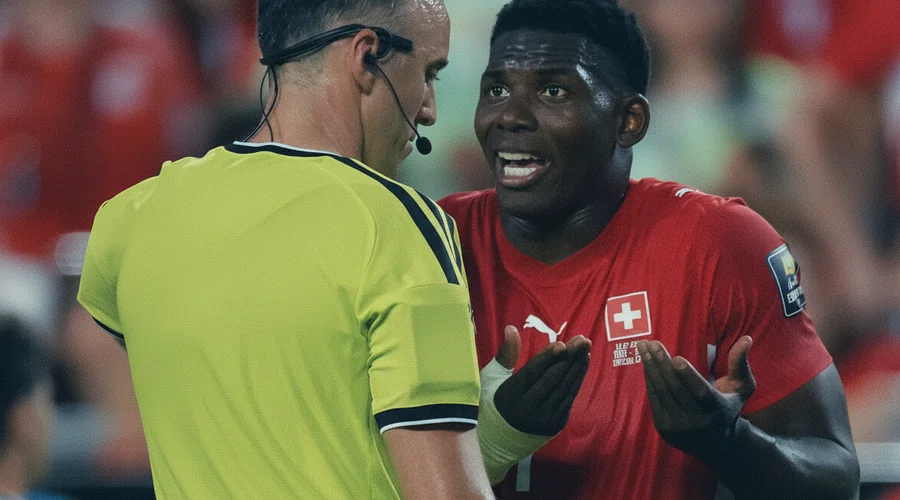
The decision to send off Embolo was met with strong protests from the Swiss players and their coaching staff, who vociferously expressed their disagreement with the referee. Despite their animated remonstrations, the decision stood. While the Swiss contingent was visibly displeased, a broad consensus emerged among many football experts and neutral observers, who largely supported the referee's final judgment. Embolo, visibly emotional and in tears, was comforted by his teammates as he made his way off the field, a moment captured by images showing Portuguese referee Joao Pinheiro brandishing the red card.
Defining 'Mistaken Identity' in Football
The concept of 'mistaken identity' in football officiating is recognized by the International Football Association Board (IFAB), the body responsible for the Laws of the Game, as a potentially 'match-changing' error. According to IFAB's guidelines, a mistaken identity occurs when a referee issues a yellow or red card but has unequivocally sanctioned the incorrect player for the infraction in question. The advent of new VAR regulations has significantly enhanced the ability of officiating teams to identify and review such instances, ensuring that disciplinary actions are correctly applied to the responsible player.
Impact on the Match Outcome
Prior to Embolo's dismissal, the quarterfinal contest was finely balanced, both in terms of ball control and the scoreline, which stood at 1-1 with less than 20 minutes remaining in regular time. The numerical disadvantage imposed by Embolo's red card proved to be a critical turning point. Although Switzerland managed to hold the score level until the conclusion of normal time, the strain of playing with ten men ultimately took its toll. They conceded two goals during extra time, leading to their elimination from the tournament. The incident underscores how VAR interventions, particularly in cases of mistaken identity, can dramatically alter the trajectory and result of high-stakes football matches.
Source: What was the mistaken identity red card shown in Argentina vs Switzerland?