
The US Semiquincentennial: A Nation Divided in Celebration
As the United States approaches its 250th anniversary in 2026, the nation is preparing for a series of events to mark the significant milestone. This “semiquincentennial,” a term denoting half of 500, reflects a historical tradition of commemorating significant anniversaries. However, the current celebrations are notable for the emergence of two distinct organizing bodies, America250 and Freedom 250, each with different philosophies and facing various controversies, particularly concerning political influence and transparency.
Historically, US semicentennial celebrations have evolved significantly. The first 50-year anniversary in 1826 was a somber affair, overshadowed by the deaths of former presidents John Adams and Thomas Jefferson on the very day of the commemoration. Fifty years later, in 1876, the US hosted its first world’s fair in Philadelphia for its centennial, showcasing global art, culture, and technology. The 150th anniversary in 1926 also featured a world's fair in Philadelphia, though it was less successful. The bicentennial in 1976 set the modern precedent for a year-long, cross-country celebration, including a train-mounted museum and volunteer-driven covered wagon tours, which were generally well-received despite some commercialization.
Current Celebrations and Key Events
The 250th anniversary is set to feature a diverse array of events across the country, with Washington, D.C., serving as a central hub. Planned activities include:
- UFC Freedom 250: A mixed martial arts event on the White House lawn.
- The Great American State Fair: An exhibition on the National Mall showcasing all 50 states.
- Freedom 250 Grand Prix: An IndyCar race around capital monuments.
- World Cup Fan Zone: A dedicated area for football fans in Washington, D.C.
- Mount Rushmore Fireworks: A pyrotechnic display in South Dakota.
- Concerts and Exhibitions: Major cities like New York, Los Angeles, and Boston will host various cultural events.
- Freedom Trucks: Mobile museums touring the nation.
- America’s Block Party: An initiative encouraging community engagement and charitable activities.
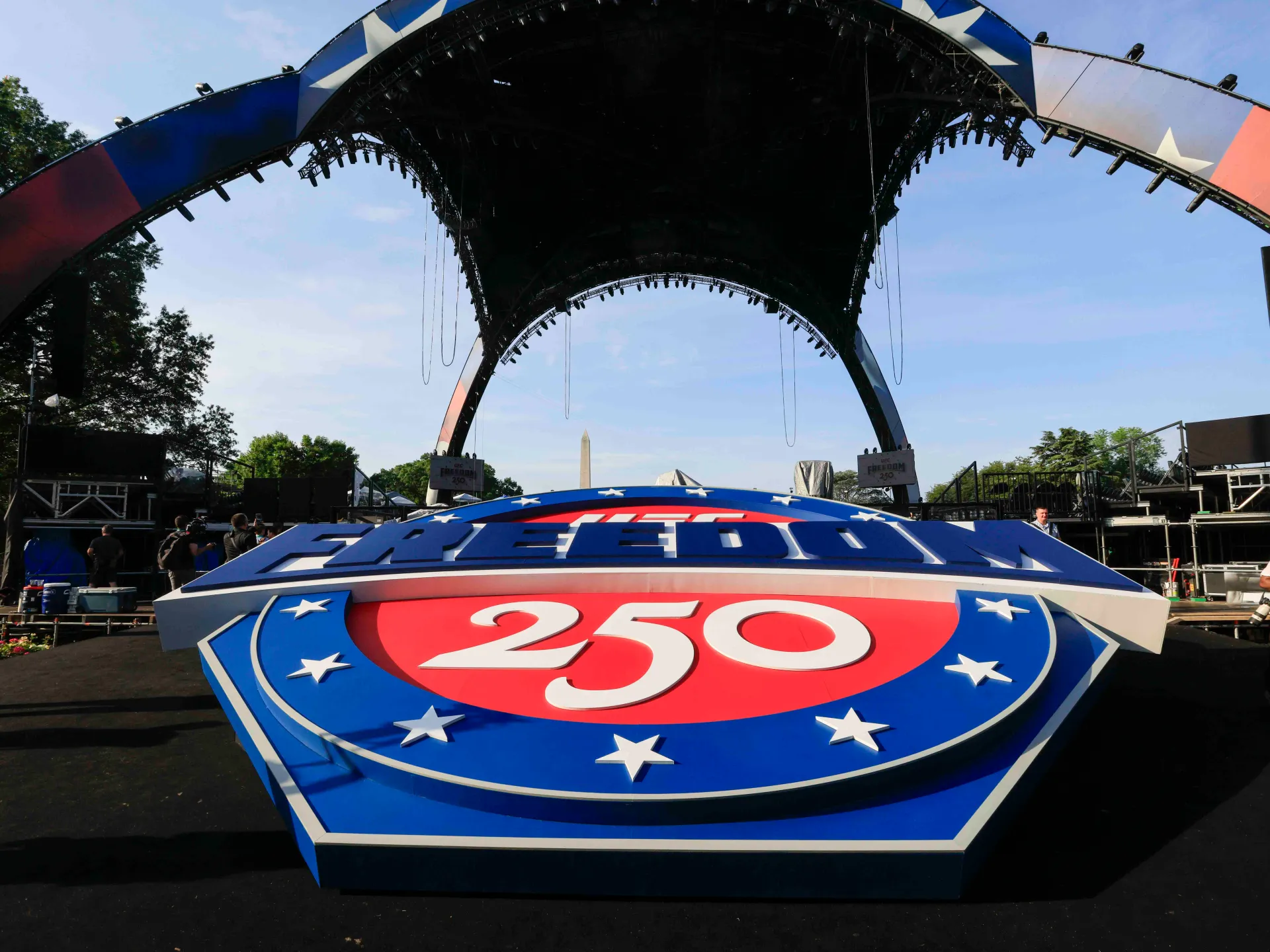
One of the most scrutinized events is the UFC Freedom 250, scheduled for June 14, coinciding with Flag Day and President Trump's 80th birthday. Organized by Dana White, CEO of the Ultimate Fighting Championship and a prominent political donor, the event has drawn criticism regarding potential conflicts of interest, given President Trump's reported stock holdings in UFC's parent company. A federal judge recently dismissed a petition to halt the fight, which aimed to prevent the alleged use of government property for private business interests. White has stated that his organization is funding the event, which features two title fights and several undercard matches, intended to 'tell the story of America.'
America250 vs. Freedom 250: Two Approaches to a National Milestone
The organizational landscape for the semiquincentennial is characterized by two distinct entities: America250 and Freedom 250. America250 is a bipartisan non-profit established by the US Congress in 2016, tasked with planning and orchestrating the anniversary. It is led by private citizens and focuses on community participation through initiatives like America’s Block Party and the Giving 4th program, which promotes charitable giving on July 4.
Conversely, Freedom 250 is a public-private partnership operating within the National Parks Foundation, the charitable arm of the National Park Service. It is linked to the White House Task Force 250, which President Trump established in 2025 to plan, organize, and execute the semiquincentennial, with him serving as its chair. Freedom 250 tends to focus on large-scale, marquee events such as the IndyCar race, the World Cup Fan Zone, and Sail4th 250, which involves tall ships and military vessels touring Atlantic coast cities.
While both organizations ostensibly aim to celebrate the nation's founding, their relationship has not been without tension. The creation of the White House Task Force 250 and the launch of Freedom 250 were perceived by some as an attempt by President Trump to exert control over the celebrations outside of congressional oversight. This perception intensified after the appointee chosen to lead America250, Ari Abergel, was dismissed for alleged breaches of authority, which he denied.
Funding and Transparency Concerns
Both America250 and Freedom 250 receive taxpayer funding, but neither is required to disclose its private donors. This lack of transparency has raised concerns, particularly regarding Freedom 250, which has fewer oversight mechanisms than America250's parent commission, which submits annual reports to Congress. Reports have surfaced about Freedom 250 allegedly offering access to presidential receptions in exchange for large donations, although America250 has also offered packages including invitations to events with government officials.
Congress appropriated $150 million to the Department of the Interior for the celebrations, but the allocation of these funds has been contentious. The Interior Department distributed $100 million to Freedom 250 (via the National Park Foundation) and $50 million to America250. Critics have questioned whether this allocation reflects a partisan steering of public funds and whether Freedom 250's events are designed more to promote the President's priorities than to celebrate national independence. The 'Freedom Trucks,' for instance, have faced criticism for presenting a potentially biased historical narrative.
Backlash and Event Adjustments
The perception of Freedom 250 as a politically aligned organization has led to challenges. The musical lineup for the Great American State Fair, for example, saw several artists withdraw due to concerns about the event's alleged nonpartisan nature. Moreover, several state governments, including Connecticut, Massachusetts, and Oregon, have declined to participate, citing the fair's increasingly partisan character. In response, President Trump reportedly canceled the concert aspect of the fair, replacing it with a 'Rally to end all Rallies' featuring a speech by him, along with performances by country musician Lee Greenwood, tenor Christopher Macchio, and military bands. Freedom 250, however, maintains that all 50 states will still be represented at the fair on the National Mall.
Source: Original Article
Related Articles
 news
news
Vietnamese Authorities Dismantle Major Cat Theft Ring, Rescuing Hundreds of Felines
 news
news
Controversial Property Fair in London Sparks Debate Over Israeli Settlements
 news
news
UK Prime Minister Condemns 'Reckless' Russian Warning Shots in English Channel
 news
news