
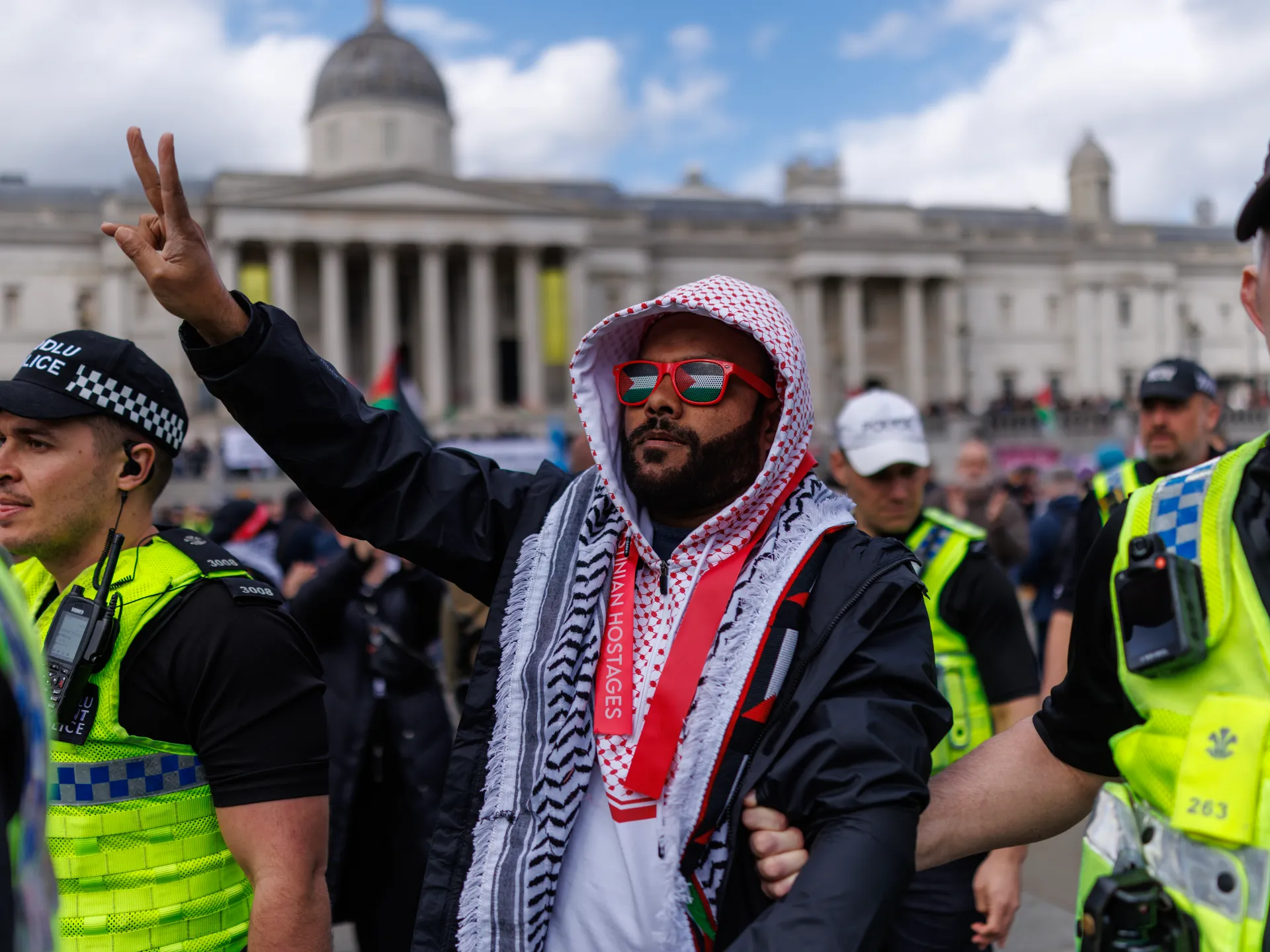
Overview of the Upcoming Court of Appeal Decision
The United Kingdom's Court of Appeal is poised to issue a significant judgment concerning the British government's decision to designate the activist group Palestine Action as a 'terrorist' organization. This ruling follows a High Court decision in February that found the proscription unlawful, a decision subsequently challenged by the government. The outcome of this appeal will have substantial implications for the group and the broader discourse surrounding protest activities and the definition of terrorism in the UK.
Palestine Action was formally proscribed by the UK government in July of the previous year. This classification places the group in the same category as organizations such as al-Qaeda and ISIL (ISIS), a move that has drawn considerable criticism from various public figures and legal experts. Earlier this month, a London court ruled that four activists, convicted of criminal damage at a British facility linked to an Israeli weapons manufacturer, would be sentenced on the basis that their actions had a 'terrorist connection,' leading to harsher penalties.
Understanding Palestine Action and Its Proscription
Founded six years ago, Palestine Action identifies itself as a British protest movement dedicated to ending global involvement in what it describes as Israel's 'genocidal and apartheid regime.' The group employs 'disruptive tactics' to target what it calls 'corporate enablers' and companies involved in manufacturing weapons for Israel. Key targets have included Israeli group Elbit Systems, Italian aerospace company Leonardo, French multinational Thales, and Teledyne from the United States, particularly their facilities located within the UK.
British police reports indicate that the group's actions have resulted in millions of pounds worth of criminal damage. Notable incidents include:
- In 2021, members engaged in a six-day protest on the roof of UAV Tactical Systems in Leicester, a subsidiary of Elbit Systems, leading to arrests.
- In 2022, the group breached a Thales equipment factory in Glasgow, causing over a million pounds (approximately $1.3 million) in damage to weapons.
- In 2024, during the conflict in Gaza, activists infiltrated an Elbit Systems UK facility near Bristol, causing another million pounds in damage.
- On June 20, 2025, Palestine Action activists entered the Royal Air Force base at Brize Norton in Oxfordshire, spraying two military aircraft with red paint.
Days after the Brize Norton incident, members of parliament voted to proscribe the group, officially classifying Palestine Action as a 'terrorist' organization. Critics of this designation argue that while the group has caused property damage, its actions do not involve the violent acts typically associated with terrorism. More than 130 prominent public figures have publicly opposed the proscription, and over 1,600 arrests linked to support for Palestine Action were reported in the three months following the ban.
The Legal Challenge and High Court Ruling
The government's proscription of Palestine Action was challenged in the High Court by Huda Ammori, the group's co-founder, in August of the previous year. A three-day judicial review took place in November, culminating in a High Court ruling in February that declared the government's 'terror group' ban unlawful and disproportionate. Home Secretary Shabana Mahmood expressed disappointment with this decision, stating, “I am disappointed by the court’s decision and disagree with the notion that banning this terrorist organisation is disproportionate. I intend to fight this judgment in the Court of Appeal.”
Despite the High Court's finding, the proscription remains in effect pending the outcome of the government's appeal to the Court of Appeal.
Broader Implications and Sentencing of Activists
The debate surrounding Palestine Action's designation has been further intensified by the recent sentencing of four of its activists as 'terrorists.' Charlotte Head (30), Samuel Corner (23), Leona Kamio (30), and Fatema Zainab Rajwani (21) were convicted of criminal damage at the Elbit Systems facility in Filton, near Bristol. Corner was also found guilty of inflicting grievous bodily harm by striking a police officer with a sledgehammer.
Judge Jeremy Johnson sentenced the four defendants to terms ranging from approximately five to eight years, labeling their August 2024 raid on the Elbit Systems site a 'terrorist act.' The 'terrorist connection' classification means these activists will typically serve their entire sentences, unless a parole board approves early release after two-thirds of the term. Samuel received seven years and eight months, Charlotte and Leona each received five years, and Fatema was sentenced to four years and eight months.
Beyond their prison terms, these individuals will be recorded as 'terrorists' for life, necessitating lifelong registration of new mobile devices, email addresses, and bank accounts with the police. Breaching these conditions or reoffending could lead to their return to prison.
Criticism from Legal and Human Rights Organizations
Amnesty International has strongly condemned the sentencing, with UK chief executive Kerry Moscogiuri stating, “Today’s sentencing hearing risks marking a new low in the ongoing crackdown against protest across the UK. Criminal damage has never been treated as terrorism within the UK justice system before, and it is completely disproportionate to do so because the offence occurred at a protest.” Moscogiuri further warned that “The use of terrorism laws to suppress direct action protesters sets a dangerous precedent for our fundamental rights in this country and must come to an end.”
Preceding the sentencing, over 50 lawyers and law professors published an open letter denouncing the potential application of terrorism charges to the Palestine Action members. The letter highlighted historical parallels, noting that property damage has been a feature of protest campaigns ranging from the Suffragettes to modern environmental groups like Extinction Rebellion. It emphasized, “It has never previously even been suggested that those taking such action should be treated as terrorists. Blurring the distinction between principled direct action and terrorism is the hallmark of authoritarian regimes.” Signatories included law professors from universities in the UK, the Netherlands, Norway, and Canada, alongside numerous practicing barristers and solicitors.
Source: UK court to rule on Palestine Action ‘terrorist’ label: What we know
Related Articles
 news
news
Vietnamese Authorities Dismantle Major Cat Theft Ring, Rescuing Hundreds of Felines
 news
news
Controversial Property Fair in London Sparks Debate Over Israeli Settlements
 news
news
UK Prime Minister Condemns 'Reckless' Russian Warning Shots in English Channel
 news
news