
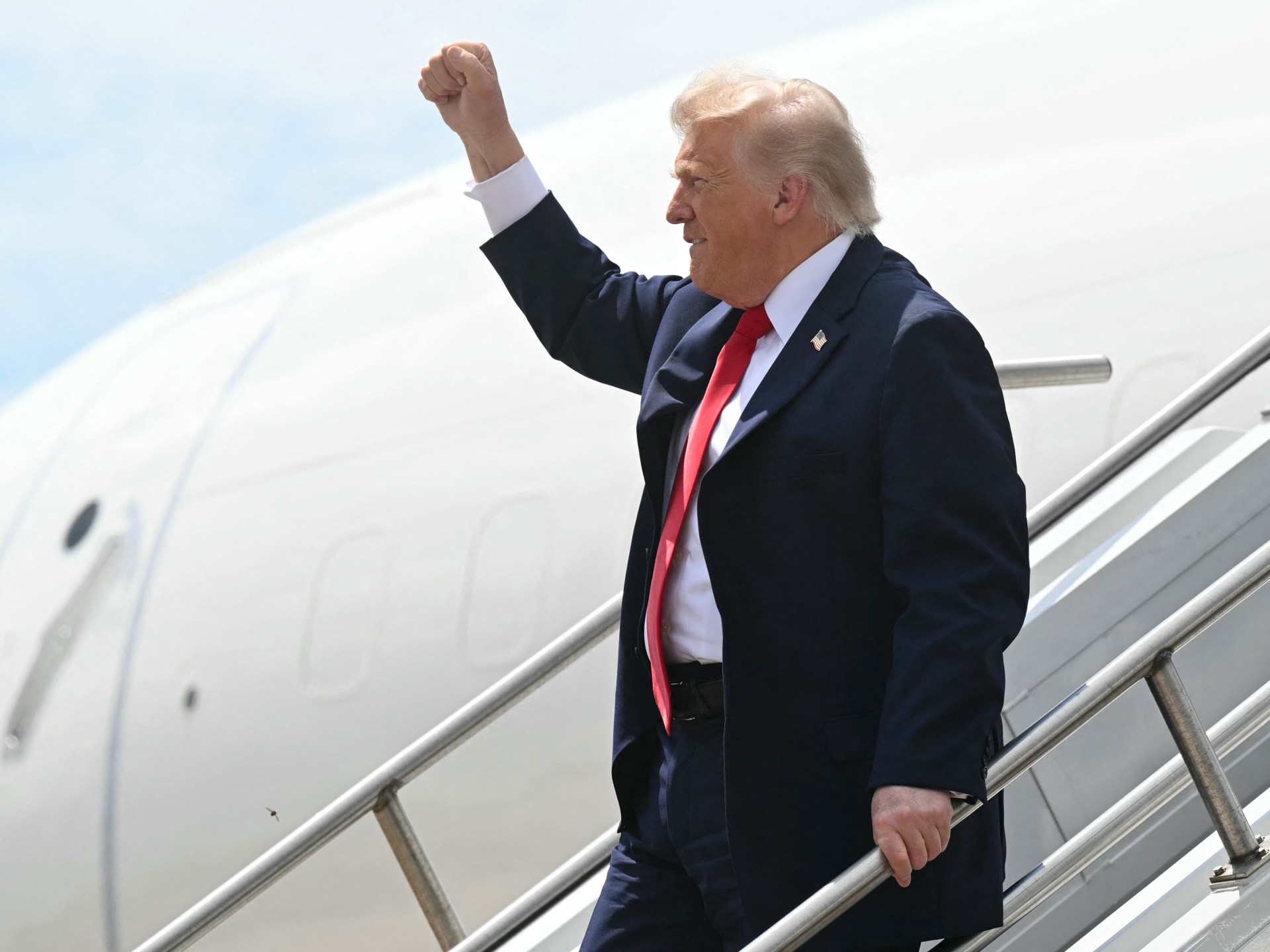
President Trump Visits Wisconsin to Engage Farming Community
United States President Donald Trump recently traveled to Wisconsin, where he met with farmers in Chippewa Falls. The visit aimed to reassure a demographic particularly affected by the economic consequences of ongoing tariffs and the financial fallout stemming from the US-Israeli conflict with Iran.
The roundtable discussion, held on a Friday, occurred mere months before the crucial November midterm elections. A primary objective of the visit was to bolster support for Republican US Representative Derrick Van Orden, who is facing a strong challenge from Democrat Rebecca Cook. Van Orden has consistently aligned himself with President Trump, often presenting the president as the most effective leader for rural American communities. Recent polls indicate Cook has been a successful fundraiser and has surpassed Van Orden in some surveys. Democrats are widely considered to be in a favorable position to gain control of the US House of Representatives, currently held by Republicans, in the upcoming midterms.
“I love the place,” Trump remarked, referring to Wisconsin, “and hopefully you’re going to be voting Republican, because frankly, Republican is – I call it the sane way to go.”
A Democratic victory in the House would significantly impede President Trump’s legislative agenda during the final two years of his term. Beyond the immediate electoral contest, the Wisconsin trip was also part of a broader strategy to solidify support among farmers, a group that largely backed the president in his 2024 election campaign.
Economic Headwinds for Farmers
Farmers have been disproportionately affected by the Trump administration’s tariff policies. These policies have led several countries to impose retaliatory tariffs, consequently limiting imports of US agricultural products, particularly soybeans. Furthermore, the tariffs have increased the cost of importing essential goods required for daily farming operations. To mitigate these adverse effects, the administration has introduced temporary aid packages for the agricultural sector.
Adding to these challenges, fertilizer costs have seen a substantial increase since the US and Israel initiated the conflict with Iran on February 28. The effective closure of the Strait of Hormuz has contributed to higher prices for several critical components, including urea. An April survey conducted by the American Farm Bureau Federation revealed that 70 percent of US farmers reported an inability to afford all their necessary fertilizer. Moreover, gasoline prices have also risen, with the average price per gallon of petrol reaching $4.04 this week, marking a $1.08 increase compared to the previous year, according to the American Automobile Association.
President Trump's Assurances and Approval Ratings
During the roundtable, President Trump sought to alleviate concerns by stating that the administration had “largely finished” the war “one way or another.” He also pledged that both fertilizer and gas prices would “way down.”
The visit comes at a time when several polls indicate President Trump’s overall approval rating is hovering at historical lows, generally around or below 40 percent. His approval ratings are even lower on specific issues. A Marquette Law School poll conducted between May 20-26 found that only 19 percent of respondents approved of Trump’s handling of gas prices, and just 22 percent approved of his approach to inflation and the cost of living.
Some prominent Republicans have also expressed concerns that several of President Trump’s recent actions could alienate voters who are worried about the economy. These actions include a previously proposed $1.8 billion “anti-weaponisation fund” by the Department of Justice, intended to compensate individuals, including Trump supporters, who claimed to be victims of political prosecutions. This plan has since been abandoned by the Department of Justice. Additionally, President Trump had requested $1 billion in funding for security for his controversial White House ballroom, despite earlier assurances that taxpayers would not bear this cost.
Source: Al Jazeera
Related Articles
 politics
Federal Judge Overturns Trump-Era Immigration Restrictions Affecting 39 Nations
 politics
Satirical 'Cockroach People's Party' Organizes Protest in New Delhi
 politics
Democratic Push for Vote on Trump-Era Settlement Fund Amidst Broader Immigration Debate
 politics