
Japan's Expanding Pet Market
Japan's pet care industry is witnessing a remarkable surge, a phenomenon closely linked to the nation's persistently low birthrate. With the number of 'fur babies' now exceeding infants by over two million, companies that once specialized in products for human babies are increasingly reorienting their business models to cater to the needs of pet owners. This shift was prominently displayed at Tokyo's annual Interpets conference, an event showcasing the breadth and innovation within Japan's burgeoning pet market.
Shin Ohta, a sales professional at Lucky Industries, Japan's oldest baby carrier manufacturer, exemplifies this trend. After noticing the physical strain of carrying his nearly 5kg toy poodle during walks, Ohta conceived of a pet-specific carrier. Leveraging his company's extensive experience in baby product design, Lucky Industries launched its Nu-i line of dog hip carriers in 2022. The company, which has produced over 40 million baby carriers since its 1934 founding, is now a participant in the Interpets conference, alongside numerous other brands.
From Baby Goods to Pet Essentials
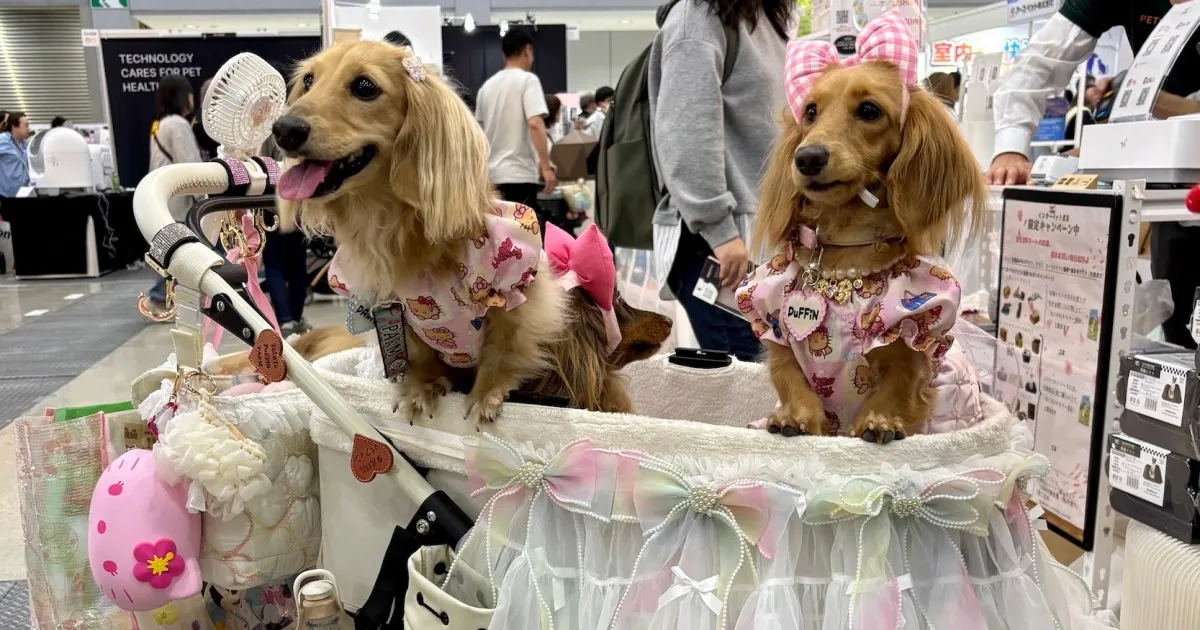
The Interpets conference, held at the Tokyo Big Sight convention center, featured a diverse array of products, from automated pet dryers to gourmet organic pet treats. Attendees often transported their pets in elaborately decorated strollers or dog-specific slings, many of which resembled their human baby counterparts. It was common to see pets adorned in colorful outfits, hair accessories, and even diapers, underscoring the deep integration of pets into family life.
Market intelligence firm Euromonitor reported that Japan's pet care market reached 880 billion yen ($5.4 billion) in 2025, a significant increase from 689.6 billion yen ($4.2 billion) in 2020. This growth trajectory is in stark contrast to the shrinking market for baby products, compelling companies to adapt their strategies.
Unicharm's Strategic Shift
Unicharm, a Tokyo-based company renowned for its feminine hygiene products and disposable diapers, has successfully transitioned into the pet care sector. Its expansive stall at Interpets prominently featured dog and cat diapers from its 'Mannerware' line. Unicharm ventured into pet diapers in 2001, and since then, pet care products have become a primary driver of the company's growth.
While the personal care market remains larger, the pet care segment offers higher profit margins. In 2025, Unicharm's pet care division reported a profit margin of 15.4 percent, surpassing the 10.7 percent margin of its personal care division. Isshu Uehara, a Unicharm spokesperson, stated that pet care accounted for 17 percent of the company's total sales in 2025, with an ambitious target to reach 20 percent by 2030.
Uehara attributed this growth to Japan's declining birthrate and evolving lifestyles. Factors such as delayed marriages, increased single-person households, and childless dual-income families are contributing to a greater desire for emotional connection, often fulfilled by pets. This phenomenon, termed 'pet humanization,' involves treating pets as cherished family members or even surrogate children.
“Customers want to buy premium products to extend pets’ lifetimes, and share experiences with them, like dining together or going out to cafes and friends’ houses,” Uehara added.
The 'Multi-Species Family' Trend
Unicharm's success is not an isolated case. Brands like AirBuggy, a stroller manufacturer, and Sweet Mommy, a clothing company, have similarly adapted their expertise from infant products to the expanding pet market. Hiroyuki Higuchi, CEO of Lucky Industries, highlighted the historical context of his company's origins, noting that baby carriers were initially essential for large Japanese families. However, with shrinking family sizes and a rise in single-child households—from 10 percent in 2002 to nearly 20 percent in 2021—the focus has shifted.
Ohta commented on the challenge of innovating in a contracting baby product market, noting that his and many of his friends' lives now revolve around their dogs. Higuchi echoed this sentiment, stating that the pet sector is viewed as a reliable growth area, with dogs often regarded as integral family members, much like human babies.
Sociologist Barbara Holthus, director of the German Institute of Japan Studies, confirms the increasing trend of pet humanization. She explains that in households with fewer children or other family members, the emotional focus often intensifies on pets. Holthus also points out that pets fulfill diverse roles, sometimes serving as companions after divorce or widowhood, or as playmates for only children. She describes Japan as a prime example of the emerging 'multi-species family' structure.
Holthus attributes the pronounced trend of pet humanization in Japan to factors such as declining birth rates, rising urbanization, and increasing loneliness. Her explanation for why infant product companies are turning to pets is straightforward: they are adapting to demographic changes to sustain their businesses.
Source: Original Article
Related Articles
 economy
Geopolitical Tensions Elevate Oil Prices Amidst Strait of Hormuz Standoff
 economy
The Economic Transformation of Qatar Under Sheikh Hamad bin Khalifa Al Thani
 economy
Examining the Limitations of the Latest US Housing Legislation
 economy