A Trend of International Recognition
Indian Prime Minister Narendra Modi has consistently garnered international accolades during his foreign engagements, an observation that has become a recurring theme in his diplomatic interactions. A recent example occurred during his visit to the Seychelles from June 27-29, where he was presented with the 'Guardian of the Blue Horizon' award. This particular honor, a pyriform azure trophy, was reportedly created specifically for the occasion, adding to a substantial collection of similar recognitions he has accumulated over his tenure.
The Seychelles award, described as the nation's highest civilian distinction, was bestowed upon Prime Minister Modi by President Patrick Herminie in Victoria. The citation accompanying the award lauded Modi's 'distinguished leadership and commitment to sustainable development, environmental conservation, and climate resilience.' However, the initial presentation of the award was not without controversy. Images of the accompanying certificate revealed several typographical errors, including 'Repubblic of Seycheeles' instead of the correct 'Republic of Seychelles.' These errors led to criticism from opposition figures in India, who suggested the haste in creating the award reflected a superficial approach to honoring the Prime Minister.
The Ministry of Foreign Affairs of Seychelles subsequently issued a clarification, stating that the circulated image was from a 'working draft' and not the final certificate, while affirming the authenticity of the 'Guardian of the Blue Horizon' distinction. The Seychelles cabinet had reportedly approved the award just days prior to Modi's arrival, underscoring the swift process involved in its establishment.
A Growing Collection of Honors
Over his 12 years in office, Prime Minister Modi has received more than 30 international awards. Recently, during a visit to Indonesia, he was presented with the Bintang Adipurna, Indonesia's highest civilian honor. In June, he also received the 'Order of the White Double Cross, 1st Class,' the highest national honor of the Slovak Republic. This Slovakian medal is typically reserved for foreign nationals who have significantly contributed to the development of relations between their home countries and Slovakia. While other world leaders, such as former Polish President Bronislaw Komorowski and former Austrian President Heinz Fischer, have also received this award, Modi's receipt of it aligns with a pattern of high-level international recognition.
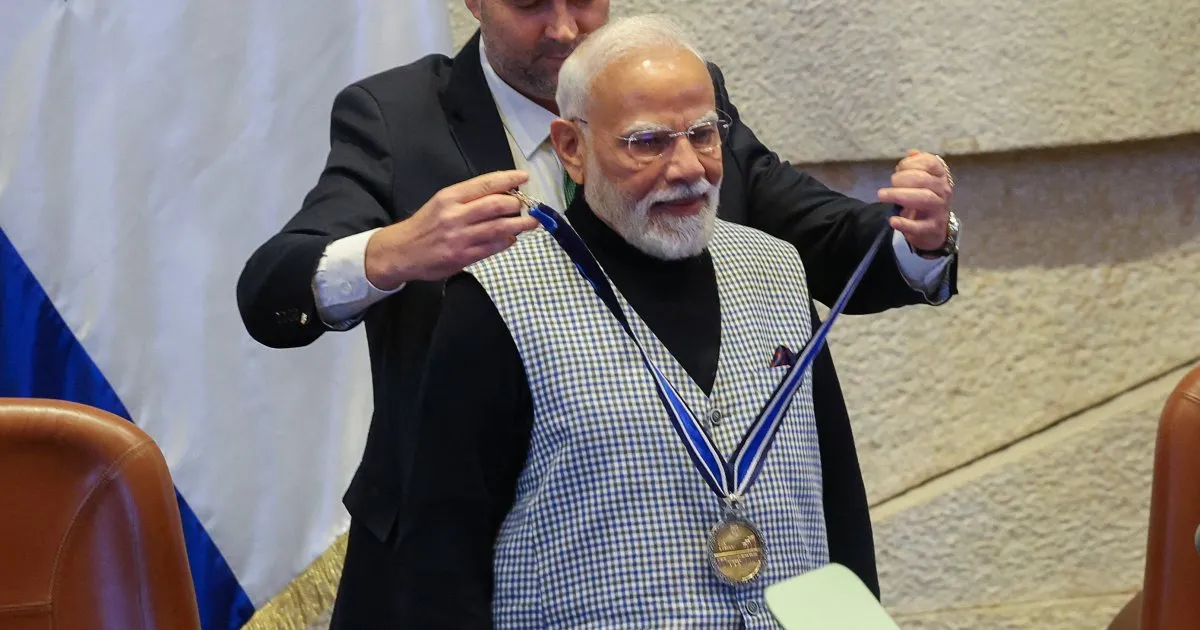
A unique distinction in Modi's collection is the Speaker of the Knesset Medal, which he received during his visit to Israel in February. This award was reportedly created specifically for his visit, marking him as its inaugural and sole recipient. Other notable awards include the United Nations Champions of the Earth Award in 2018, shared with French President Emmanuel Macron, which is the UN's highest environmental honor. In 2019, he was recognized with the Global Goalkeeper Award by the Bill & Melinda Gates Foundation for his leadership in the Swachh Bharat Abhiyan (Clean India Mission) program, focused on improving sanitation in India. Additionally, in 2019, Modi received the Philip Kotler Presidential Award from the World Marketing Summit, an award intended to be an annual recognition for a world leader, though no other leader has received it since.
Interpretations of Diplomatic Value
The accumulation of these international awards has sparked debate regarding their true diplomatic and economic significance for India. Prime Minister Modi has often framed these honors as tributes to India itself, rather than solely to his individual leadership. Some analysts suggest that the willingness of countries to create bespoke awards for Modi indicates a desire to maintain positive relations with New Delhi, reflecting India's growing global influence as the world's largest democracy.
However, not all observers agree on the tangible benefits of these accolades. Ian Hall, a professor of international relations at Australia's Griffith University, expressed skepticism about their practical diplomatic or economic advantages for India. He suggested that such awards might reinforce a perception that the Prime Minister's focus is less on substantive actions to advance India's interests and more on image-building.
Nitasha Kaul, a professor of politics and international relations at Westminster University, offered a similar perspective, arguing that these awards primarily serve to bolster Modi's personal image rather than India's diplomatic standing. She characterized them as 'props for the egotistical strongman politics that Modi embodies,' used by him and his supporters to cultivate an image of an internationally respected statesman. Kaul contended that this narrative is increasingly detached from his actual record in global diplomacy, citing the Seychelles incident with its errors as an illustration of how these awards can sometimes lead to 'ridicule rather than respect.'
Source: Original Article