
Djed Spence's Historic World Cup Moment
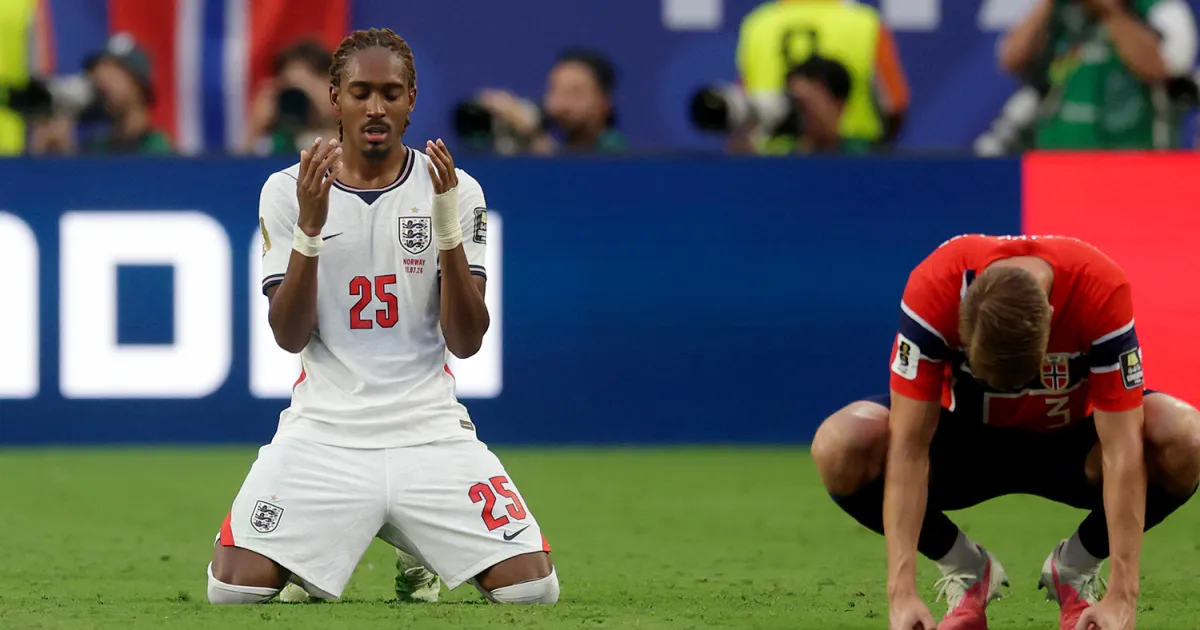
Djed Spence, a 25-year-old English defender, recently captured significant attention after England's World Cup quarterfinal victory against Norway. Following the match on July 11, Spence knelt on the pitch, raising his hands in prayer, an act that resonated deeply with millions of viewers. This moment marked a first for an England international on such a prominent global stage, as Spence, a recent convert to Islam, openly performed Muslim prayers.
His journey to becoming the first Muslim player to wear the England jersey at a FIFA World Cup is seen as a pivotal milestone. Spence himself acknowledged the broader impact of his achievement, stating last year, "Being the first Muslim player to represent the Three Lions, it meant everything. Something I’ve always wanted as a kid. But what makes me happy is a lot of kids can look at it and be inspired. I feel it’s bigger than me and it’s great for generations to come.”
Spence's path to this World Cup was not without its challenges. He sustained a broken jaw in May 2026 while playing for Chelsea, necessitating a carbon-fibre mask during the tournament. Despite this, he has consistently performed well, coming off the bench and demonstrating resilience in defense. His presence on the national team brings England into alignment with other European footballing nations like Germany, France, and Spain, which have had Muslim international players for many years, making this achievement feel long overdue for many observers.
Inspiring a New Generation
The impact of Spence's representation is particularly felt within the Muslim community. Zain Gondal, a 23-year-old England fan in London, expressed his connection to Spence: "When I found out he was Muslim, I just liked him even more." Gondal noted a personal affinity for Muslim players, stating, "you can see yourself a bit in them." He praised Spence's on-field performance, highlighting his defensive capabilities.
Riz Rehman, a former footballer whose brother Zesh Rehman was the first Muslim to play in the English Premier League, has been instrumental in supporting Muslim players. Having worked for 15 years at the UK’s Professional Footballers’ Association (PFA), Rehman helped establish crucial support structures, including prayer rooms and educational programs on Ramadan for staff. He met Spence during his time at Tottenham Hotspur, offering guidance during Ramadan after Spence's injury recovery.
Rehman shared that Spence converted to Islam a couple of years ago. "He’s a role model, and he must continue doing what he’s doing, having a good character and keep inspiring others," Rehman commented. He believes Spence's faith will strengthen him and sees his England journey as a powerful message: "It’s a reminder to young Muslim players and families across the UK that your faith and religion doesn’t limit ambition; it can only strengthen it.” Rehman also cautioned against placing undue pressure on Spence, emphasizing that everyone's faith journey is personal.
Navigating Public Perception and Inclusivity
While Spence's public display of faith has been widely celebrated, it also elicits some apprehension. Shabna Zaheer, founder of The Scene, a South Asian-led collective that creates inclusive, alcohol-free spaces for community events, admitted she wasn't closely following Spence until she saw the image of him praying. "We’ve never seen an English footballer do that," she remarked. However, she also expressed concern about potential negative reactions, noting, "I just hope it goes well, because a lot of us also get a bit nervous when we see someone do that, for what the media might bring towards them.” This concern stems from past experiences, such as online comments on her own events, which sometimes urged Muslims to 'integrate' or socialize in traditional, alcohol-centric venues.
Daniel Bennett, Creative Director of The Scene, acknowledges the nervousness but remains hopeful. He stressed the importance of representation, especially when minorities are often framed through "the lens of division or controversy," referencing the racist abuse faced by players like Marcus Rashford, Jadon Sancho, and Bukayo Saka after the 2020 Euro final. While he doesn't believe this milestone will instantly resolve all issues, it contributes significantly to positive visibility.
Zain Gondal echoed the sentiment that football alone cannot fix deep-seated societal issues. He attributed negative perceptions of minorities to political frustrations, stating, "It’s on the politicians to make the country better, because they’re the ones... forcing these opinions onto others.”
Challenging Prejudices in Football
Mark Overall, a goalkeeping scout and coach, brings the discussion back to the grassroots level of football. He recalled coaching a Southall youth team in 2014, where players trained through Ramadan without food or water, an experience that deeply impressed him. Despite this, Overall has observed older scouts unfairly overlooking Asian and Muslim players. He bluntly stated, "If they had a choice between a white, Christian player and someone from India or Pakistan, they’d always go for the white lad. There is a little bit of racism still at the grassroots level and even at the academy level, mostly by the older scouts.”
However, Spence's strong performance in England's World Cup campaign offers a glimmer of optimism. Overall believes it can change mindsets, demonstrating that "anyone can make it to any level… it doesn’t matter what your beliefs are. Football’s a game for everyone.”
The cultural impact of Spence's story has extended beyond the pitch, even inspiring UK singer-songwriter Ben Cipolla to compose a tribute song, "Total Eclipse of Djed Spence," playing on his surname and charting his journey to the England squad. Spence's rise has not only uplifted the hopes of Britain's Muslim minority but has also sparked broader conversations about faith, identity, and inclusivity within the world of sport.
Source: ‘A role model’: Djed Spence, first Muslim England player, lifts hopes
Related Articles
 sports
Spain Advances to World Cup Final After Defeating France
 sports
England's World Cup Ambitions: Tuchel Believes Squad Has More to Offer Ahead of Semifinal Clash
 sports
England and Argentina Set for High-Stakes World Cup Semifinal Clash
 sports