
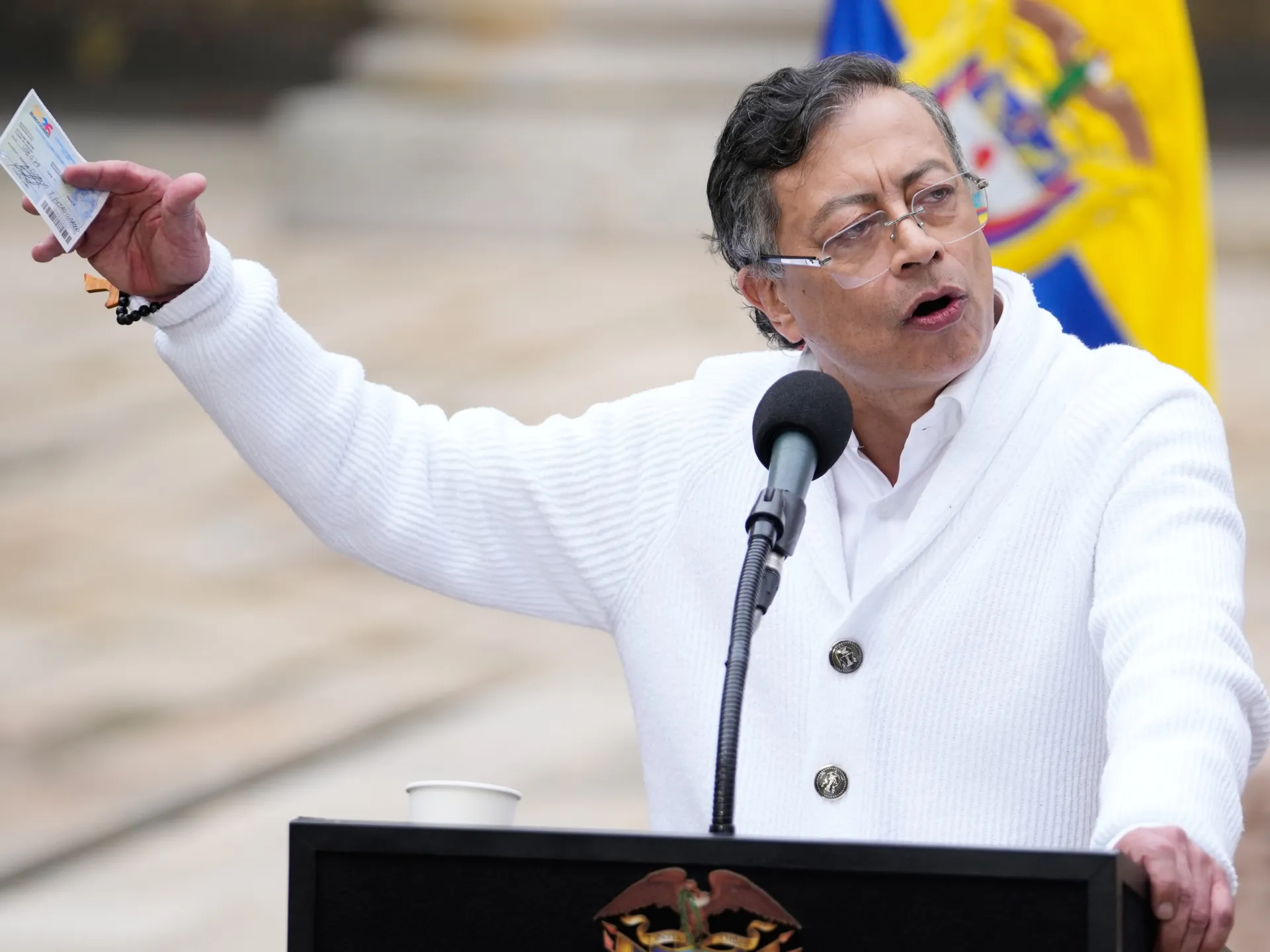
President Petro Alleges Electoral Fraud and Foreign Meddling
Following a closely contested presidential run-off election in Colombia, outgoing President Gustavo Petro has made significant allegations of electoral fraud and international interference. Petro, whose chosen successor narrowly lost the election, claimed on social media platform X that the opposition engaged in vote-buying and that both Israel and the United States intervened to secure a win for the far-right candidate, Abelardo de la Espriella.
Petro has publicly refused to acknowledge the preliminary results and has called for a judicial investigation into his claims. As Colombia's first leftist president, Petro's administration implemented reforms that increased social spending, raised the minimum wage, and redistributed land to impoverished families. His tenure also saw a rupture in diplomatic ties with Israel over its actions in Gaza and a noticeable distancing from the U.S. administration. Critics, however, warn that his rejection of the election outcomes could escalate political tensions and potentially incite violence within the nation.
Election Results and the Rise of De la Espriella
The first round of the presidential election, held on May 31, did not produce a clear winner, as neither Abelardo de la Espriella of the right-wing Defenders of the Homeland movement nor Senator Ivan Cepeda of the ruling Historic Pact secured the required 50 percent of the vote. This led to a run-off election.
Preliminary results released by the National Registry indicated a narrow victory for de la Espriella, who secured 49.66 percent of the vote against Cepeda's 48.7 percent. This razor-thin margin, less than one percent, marks one of Colombia's closest presidential elections. De la Espriella, a 47-year-old criminal lawyer and multimillionaire, is scheduled to assume office on August 7. His campaign focused on stricter security measures and anti-leftist policies. Notably, de la Espriella also holds U.S. citizenship. His win aligns with a broader trend in Latin America of electing populist, far-right leaders who have ties to the former U.S. administration.
Petro's Allegations of Digital Manipulation
President Petro's fraud allegations primarily center on the manipulation of Form E-14, the official handwritten tally sheets used at each polling station. These forms serve as a physical record of vote counts and are crucial for preventing fraud. Digital scans of these forms are also uploaded to the National Registry's portal for public scrutiny. If discrepancies are found, political parties can request a recount.
Petro specifically alleged that foreign entities accessed the National Registry's website and altered voting data on some E-14 forms. He posted on X, stating, "Today we have evidence of a change in IP addresses of several servers of the national registry. This means that the software was compromised and others wrote data for polling stations and voting posts. The only entity in the world capable of doing that is the state of Israel." However, he did not provide direct evidence to substantiate Israel's alleged involvement.
The outgoing president claimed that his party had requested a "technical audit" of the voting software prior to the elections and sought to retrieve digital footprints of all transmitted documents to prevent modifications, but these requests were reportedly ignored. He also shared videos purportedly showing the "premeditated" modification of E-14 forms, suggesting the manipulation originated from the offices of the "Bautista brothers."
The Role of Thomas Greg & Sons
Petro's reference to the "Bautista brothers" points to Thomas Greg & Sons, a powerful private logistics and security printing firm responsible for Colombia's electoral infrastructure, including preliminary vote counting and tallying software. The company, run by brothers Fernando and Camilo Bautista Palacio, has held contracts with the National Registry for over a decade.
The Bautista brothers have a controversial past, having been convicted of bank fraud in the U.S. in the 1980s. In April, Petro accused them of negotiating a deal with de la Espriella, alleging that they would help secure the presidency for the far-right candidate in exchange for renewed passport printing contracts. De la Espriella denied these claims at the time, and his lawyers threatened legal action against Petro.
Official Responses and De la Espriella's Stance on Israel
Attorney General Gregorio Eljach has dismissed Petro's allegations, stating that with over 99 percent of votes counted, there is "no evidence of fraud." De la Espriella has not yet directly responded to Petro's accusations.
De la Espriella has a well-documented pro-Israel stance, having actively campaigned within Colombia's Jewish community and pledging to uphold "Judeo-Christian principles." He has also promised to reverse Petro's 2024 decision to sever ties with Israel and committed to relocating the Colombian embassy to Jerusalem. Israeli Prime Minister Benjamin Netanyahu congratulated de la Espriella on his win, expressing anticipation for strengthening relations between the two nations.
U.S. Involvement and Bilateral Relations
President Petro also implicated former U.S. President Donald Trump in interfering with the elections, accusing him of publicly endorsing a candidate and influencing voters. Trump had endorsed de la Espriella on his Truth Social platform weeks before the run-off. Following de la Espriella's preliminary victory, Trump and then-U.S. Secretary of State Marco Rubio congratulated him, with Trump taking credit for the win.
Trump reportedly told reporters, "He was in 10th place. I endorsed him, and he won the election. He called me last night and thanked me for the endorsement." Rubio similarly posted on X, stating, "The Trump administration looks forward to working closely with your incoming administration to advance regional security cooperation, end illegal immigration to the United States, and strengthen our economic ties." Petro has formally invited Trump to comment on the electoral fraud allegations, asserting that the U.S. president bears responsibility for "having supported a candidate and not the freedom of the Colombian people."
Despite close trade ties, diplomatic relations between the U.S. and Colombia have often been strained, particularly concerning drug trafficking policies and relations with Israel. Relations notably deteriorated during the Trump and Petro administrations. Incidents included Petro's refusal to allow U.S. migrant deportation planes to land in Colombia and U.S. sanctions against Petro, his family, and key officials based on unproven allegations of drug trade involvement.
Source: Al Jazeera
Related Articles
 politics
The Enduring Influence of Meir Kahane on Contemporary Israeli Politics
 politics
A Decade After Brexit: Assessing the UK's Transformation
 politics
A Decade On: The Enduring Societal Impact of Brexit Beyond Economics
 politics