
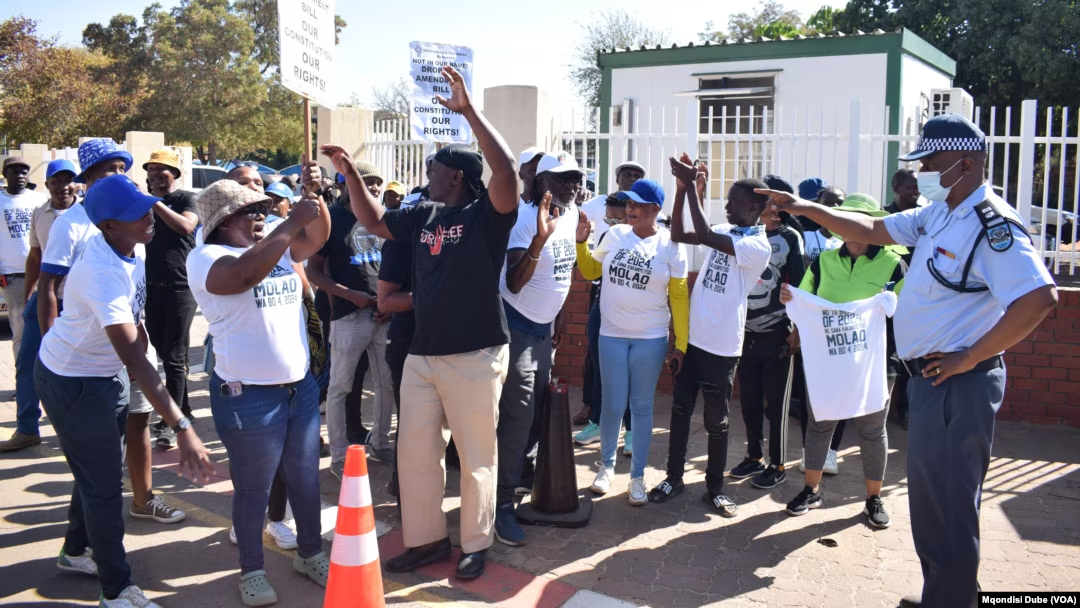
Botswana's Fight Against Corruption: Tangible Successes That Restore Public Trust
For decades, Botswana has stood apart on a continent where graft often erodes public confidence in government. Central to that reputation is the Directorate on Corruption and Economic Crime (DCEC), established in 1994 under the Corruption and Economic Crime Act. The agency's mandate spans investigation, prosecution referral, prevention, and public education — a comprehensive approach that analysts say has helped keep Botswana among Africa's least corrupt nations.
Transparency International's Corruption Perceptions Index consistently places Botswana in the top three to five African countries, and often within the upper tier globally among developing nations. While no ranking captures every nuance of governance, the sustained placement reflects institutional choices made over generations rather than a single reform cycle.
The DCEC's Institutional Framework
The DCEC operates as an independent body with powers to investigate corruption, economic crime, and related offences. Its investigators work alongside the Directorate of Public Prosecutions (DPP) to bring cases before the courts. Over the years, the agency has pursued matters involving public procurement, land allocation, tax evasion, and abuse of office — areas where weak oversight can undermine development gains.
Prevention has been equally emphasised. The DCEC conducts integrity workshops for public servants, reviews institutional vulnerabilities, and publishes guidance on ethical conduct. Critics note that caseloads sometimes outpace prosecutorial capacity, and that complex financial crimes require specialised skills that remain in short supply. Supporters counter that the very existence of an empowered anti-corruption directorate sends a deterrent signal across the civil service.
Landmark Cases and Prosecutions
High-profile prosecutions have periodically dominated national headlines. Cases involving senior officials, parastatal executives, and private-sector actors accused of collusion have tested the independence of investigative and judicial bodies. Successful convictions — as well as acquittals following due process — illustrate a legal system that, while imperfect, generally allows cases to proceed without overt political interference.
"Anti-corruption work is not measured by headlines alone, but by whether institutions can investigate without fear and prosecute without favour." — Governance analysts frequently cite this principle when assessing Botswana's track record.
Asset recovery has featured in several matters, with courts ordering forfeiture of property linked to illicit enrichment. Such outcomes, when achieved, reinforce the message that corruption carries tangible consequences. However, lengthy trial timelines and appeals processes remain a challenge shared with many common-law jurisdictions.
Reforms and Remaining Challenges
Parliament has periodically amended legislation to strengthen whistle-blower protections, expand disclosure requirements for public officers, and align Botswana's framework with international conventions. Botswana is a state party to the United Nations Convention against Corruption and participates in regional anti-corruption networks through the Southern African Development Community (SADC).
- Establishment of the DCEC in 1994 as a dedicated anti-corruption agency
- Consistent top-tier ranking in Africa on the Corruption Perceptions Index
- Prosecutions spanning procurement fraud, tax offences, and abuse of office
- Ongoing integrity training and preventive reviews across government departments
- Legislative updates to strengthen disclosure and whistle-blower frameworks
Challenges persist. Some observers argue that political will wavers when investigations approach powerful interests. Resource constraints limit the DCEC's reach into rural areas and complex cross-border schemes. Youth unemployment and economic pressure can also normalise informal patronage networks at local levels, even when national institutions remain comparatively strong.
Regional Context and Public Trust
Compared with regional peers, Botswana's anti-corruption architecture has yielded measurable differences in daily administrative experience — from relatively orderly licensing processes to lower reported bribery in basic public services. Restoring and maintaining public trust requires continuous effort: transparent procurement, open data initiatives, and responsive oversight bodies all play a role alongside prosecution.
The record is mixed but meaningful. Botswana has converted institutional design into outcomes that many neighbouring countries still aspire to replicate. Sustaining those successes will depend on adequate funding for the DCEC, judicial independence, and a political culture that treats accountability as a bipartisan obligation rather than an electoral slogan.
Related Articles
 politics
How Botswana Maintains Its Reputation as Africa's Least Corrupt Nation
 politics
President Duma Boko: Economic Reforms, Social Programs, and International Standing
 politics
Policy in Focus: Dumelang Saleshando's Economic Platform and Social Welfare Proposals
 politics