
New Bollywood Production Ignites Controversy in Kashmir
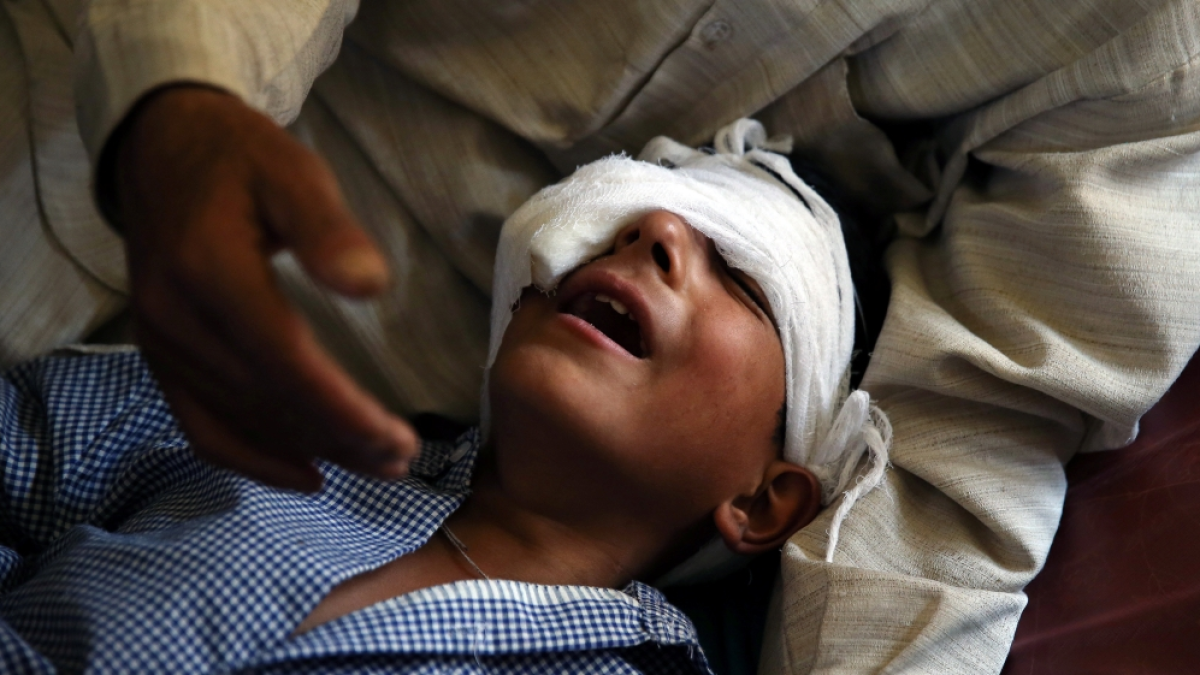
An upcoming Bollywood film, titled 'Chauhaan,' has become the focal point of widespread anger and distress among victims of pellet gun violence in Indian-administered Kashmir. The movie, described as an 'action entertainer,' is accused of downplaying the severe and often permanent injuries inflicted by pellet shotguns, which have left over a thousand Kashmiris partially or completely blind.
For individuals like Feroz Aslam, a 28-year-old who lost his sight a decade ago, the film's premise reopens deep emotional wounds. Aslam recounted how he was struck by a barrage of shotgun pellets fired by Indian security forces during an anti-government protest in Sopore. Seven pellets pierced his right eye, six his left, and more than 300 impacted his chest, leading to permanent vision loss. The tiny iron balls from these weapons embed themselves deep within tissues, often proving impossible to remove, and can cause irreparable damage to sensitive organs like the eyes.
The Lingering Impact of Pellet Guns
Aslam's experience is not isolated. Since 2010, when New Delhi introduced pellet guns as a crowd-control measure in the disputed Muslim-majority region, over 1,000 Kashmiris have suffered partial or complete blindness. The use of these weapons escalated significantly in 2016, following protests sparked by the killing of Burhan Wani, a 22-year-old rebel commander. This period saw dozens of fatalities and hundreds of blinding injuries, affecting individuals across all age groups, including young children.
The teasers for 'Chauhaan,' slated for an October 2027 release, feature actor Ajay Devgn portraying an Indian security official confronting stone-throwing protesters. A voiceover in the trailer appears to criticize past Indian governments for being too lenient on protesters and suggests that pellet guns inflict only 'limited damage.' The trailer concludes with Devgn, in a skull mask, approaching a crowd with a boombox playing a 1990s Bollywood song, ‘Jumma chumma de de,’ a track associated with Friday protests in Kashmir.
Aslam, unable to watch the teaser, expressed profound disappointment. He stated that the filmmakers would understand the profound impact of blindness if they were to experience it themselves, even for a single day.
Criticism from Academics and Rights Groups
Saiba Varma, a medical anthropologist at the University of California San Diego, argues that 'Chauhaan's' political messaging reflects a troubling shift in Indian public discourse, where questions of morality concerning police actions in Kashmir are increasingly disregarded. Varma noted that initially, pellet guns were justified as a more humane alternative to bullets. However, she suggests that these justifications have now largely disappeared, with the state no longer feeling the need to defend their use.
Varma also highlighted how the film's portrayal of Kashmiri pellet victims, depicting them with 'blood-soaked eyes voicing animalistic screams,' reinforces existing tropes that characterize Kashmiris as dangerous figures requiring subjugation.
International Condemnation and Personal Devastation
The use of pellet guns by Indian forces in Kashmir has drawn widespread condemnation from international rights groups and the United Nations. In a 2021 report, UN Secretary-General Antonio Guterres accused India of 'grave violations' against children and urged preventive measures, including an end to the use of pellets against minors.
Despite a 2016 caution from the Supreme Court of India against their 'indiscriminate' use, the Indian government has continued to defend pellet guns as a nonlethal crowd-control option. However, for victims like Aslam, the pain endures. He continues to suffer agonizing eye pain and struggles with the inability to work, relying on his aging father for support.
Another victim, Masroor Khalid, was blinded by pellets in 2016 while distributing sacrificial meat during Eid al-Adha. He spent four days in a coma, and despite his parents investing 2 million rupees ($21,000) in surgeries, his vision could not be restored. Khalid still carries over 300 pellets in his face, and his family was driven into poverty by the medical expenses, with his father continuing to work as a mason. Khalid expressed immense sorrow, stating that he wouldn't wish his suffering upon anyone.
Bollywood's Role in Political Narratives
Political analysts view 'Chauhaan' as the latest instance of Bollywood seemingly 'pouring scorn' on pellet victims in Kashmir. Rakib Hameed Naik, head of the US-based Center for the Study of Organized Hate (CSOH), suggests that since Narendra Modi became prime minister in 2014, a segment of Bollywood filmmakers has capitalized on political narratives, producing movies that align with the Bharatiya Janata Party's (BJP) agenda. These films, Naik argues, often target India's Muslim population and exploit sensitive issues like Kashmir and India's historical rivalry with Pakistan.
Naik points to films like 'Article 370,' 'Baramulla,' and 'Kashmir Files' as examples of productions that rationalize government policies, frequently employing Islamophobic tropes and reducing Kashmiri Muslims to caricatures. He asserts that such movies aim to justify the BJP's actions, deflect criticism of human rights records, and invert reality by portraying the regime as victims and Kashmiris as aggressors.
Ather Zia, a Kashmiri political anthropologist, further elaborates on Bollywood's historical portrayal of Kashmir, describing it as either a 'silent backdrop' or a source of 'black-and-white caricatures.' She notes that Kashmiris are often depicted as either subservient hosts or aggressive terrorists, a formula that has proven successful for many blockbusters and reflects an audience that remains largely insensitive to Kashmiri history, politics, and suffering.
Source: Original Article
Related Articles
 arts-and-culture