
Historic Arrival of the Bayeux Tapestry in Britain
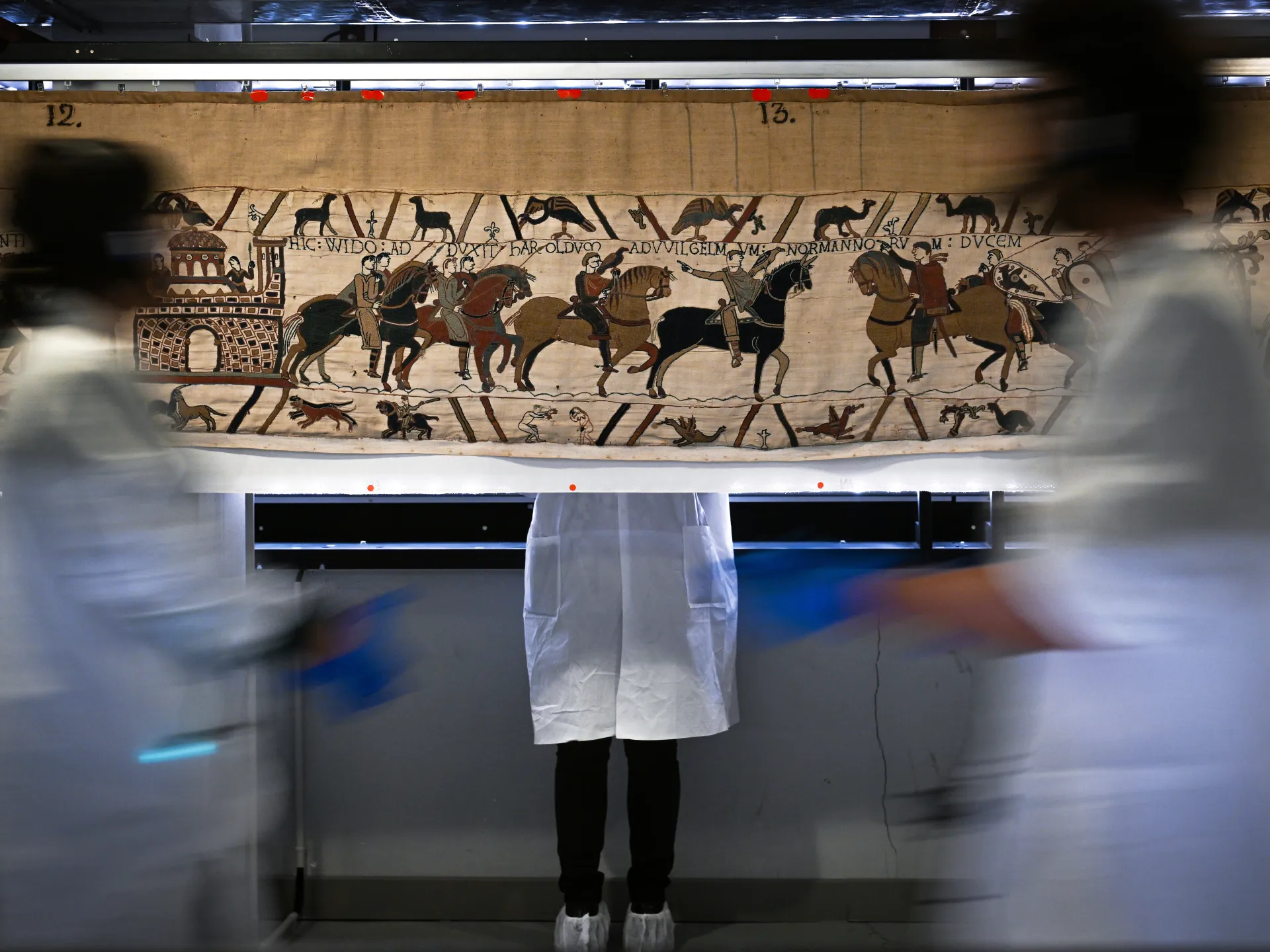
The Bayeux Tapestry, a revered medieval artwork, has made its inaugural journey to Britain in almost a millennium. This significant transfer from France involved a highly secure, clandestine operation, culminating in its discreet delivery to the British Museum in London. The 70-meter-long artifact, which vividly illustrates the Norman conquest of England, was transported overnight, arriving safely at its destination.
A Symbol of Intertwined Histories and Renewed Relations
Crafted from wool embroidered on linen, the tapestry serves as a powerful symbol of the intricate and often tumultuous historical ties between Britain and France. Its arrival in London, though anticipated for several months, was executed with strict secrecy regarding its 11-hour road journey, primarily for security considerations. This momentous loan is widely interpreted as a gesture of strengthening French-British relations, particularly as London endeavors to foster closer ties in the post-Brexit era. The tapestry is scheduled to remain on display at the British Museum until July 2027.
French President Emmanuel Macron, who initially announced the loan last year, underscored its importance as a celebration of the enduring Franco-British connection. In an article published in The Times newspaper, President Macron characterized the loan as a "tangible expression of long-standing friendship and a sign of our shared desire to see France and the United Kingdom build their future together." In a reciprocal arrangement, the British Museum will lend France the Sutton Hoo collection of Anglo-Saxon artifacts, recognized as one of England's most significant archaeological discoveries.
The Journey and Its Significance
George Osborne, Chair of the British Museum, confirmed the tapestry's secure arrival via a post on X, stating, "I can confirm that The Bayeux Tapestry has just arrived safely and securely at the British Museum." Nicholas Cullinan, Director of the British Museum, expressed his profound sentiment regarding the achievement, telling The Associated Press news agency, "It feels extraordinary that after so much work and planning and care and thought that it's actually happening."
The meticulous transportation process involved carefully folding the tapestry into a climate-controlled casing, which was further secured within a shock-absorbing cradle. A police-escorted truck then transported the precious cargo through the Channel Tunnel, ensuring its safety throughout the journey from its usual home in Bayeux, Normandy, to London.
Depicting a Pivotal Historical Event
The Bayeux Tapestry is renowned for its 58 detailed scenes that chronicle the tumultuous events leading up to and including the Norman invasion of England in 1066. The intricate embroidery depicts a range of historical moments, from banquets and fleets of Viking-style ships to armored knights engaged in combat with swords and spears. The narrative culminates in the pivotal Battle of Hastings in October 1066, where William, Duke of Normandy, triumphed over King Harold's Anglo-Saxon forces, subsequently becoming the first Norman king of England.
Historical accounts from the Bayeux Tapestry Museum suggest that Bishop Odo of Bayeux, who was William's half-brother, commissioned the creation of the tapestry. It is believed that women in England, possibly nuns, were responsible for its skilled craftsmanship before it was transported to France.
Reciprocal Loans and Public Interest
The loan of the Bayeux Tapestry to Britain coincides with ongoing renovation work at its permanent home, the Bayeux museum in Normandy. As part of the reciprocal agreement, the British Museum will loan artifacts from a 7th-century Anglo-Saxon ship burial to the Normandy museum. The exhibition of the Bayeux Tapestry at the British Museum has already generated substantial public interest, with thousands of tickets reportedly sold in advance of its opening.
Source: Original Article
Related Articles
 arts-and-culture
Bollywood Film 'Chauhaan' Sparks Outrage Among Kashmir Pellet Gun Victims
 arts-and-culture