
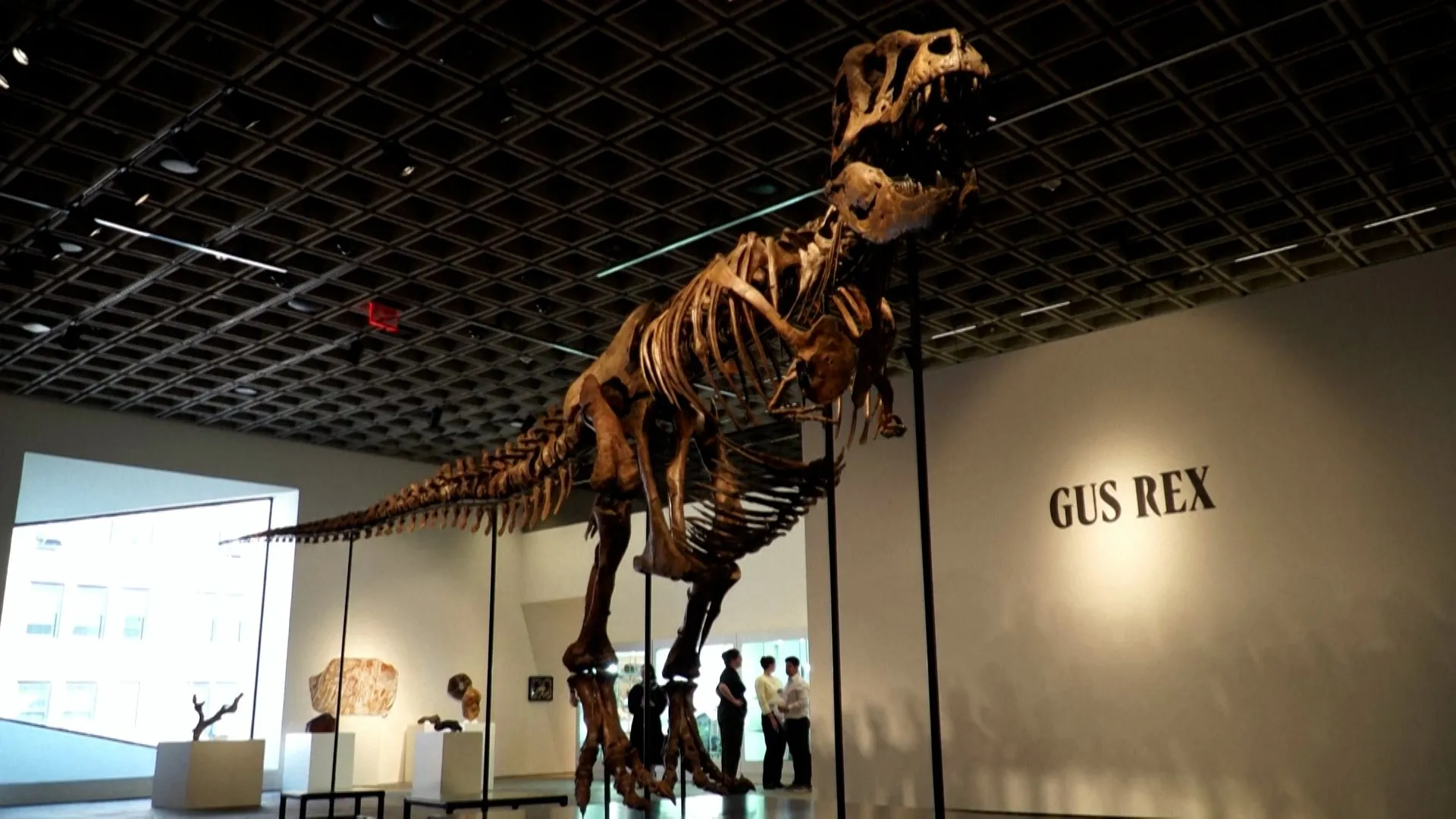
Historic Paleontological Sale in New York
A significant event in the world of paleontology and art markets recently transpired in New York City, where a Tyrannosaurus Rex skeleton, affectionately dubbed 'Gus,' commanded an astonishing price at auction. The ancient remains, dating back approximately 70 million years, achieved a final sale price of $50.1 million, setting a new benchmark for such prehistoric artifacts.
The Discovery and Preservation of 'Gus'
The journey of 'Gus' from its ancient burial ground to the auction block is a testament to meticulous paleontological work. While the specific details of its excavation were not widely publicized in the immediate aftermath of the sale, the skeleton's impressive state of preservation and completeness are noteworthy. Experts have indicated that the fossilized remains are nearly 80% intact, a remarkable percentage that contributes significantly to its scientific value and market appeal. Such a high degree of completeness is rare for large theropod dinosaurs like the T. Rex, making 'Gus' a particularly important specimen for research and display.
The process of unearthing, cleaning, and preparing such a massive and delicate fossil is an arduous undertaking, often requiring years of dedicated effort by paleontologists and preparators. Each bone must be carefully extracted from its surrounding rock matrix, stabilized, and then meticulously assembled to reconstruct the dinosaur's original form. The successful preservation of nearly four-fifths of the skeleton suggests that 'Gus' was likely discovered in conditions that minimized degradation, possibly in sedimentary rock formations that protected it from erosion and scavenging.
The Auction Process and Final Valuation
The auction, held in New York, attracted considerable attention from both private collectors and institutions. The bidding process for 'Gus' was reportedly competitive, culminating in a final bid of $43 million. However, once additional fees and premiums were factored into the sale, the total acquisition cost rose to $50.1 million. This final figure significantly surpasses previous records for dinosaur skeletons sold at auction, highlighting a growing interest and investment in unique natural history specimens.
Auction houses specializing in natural history items often see a diverse range of bidders. These can include wealthy private individuals looking to add a unique centerpiece to their collections, as well as museums and research institutions aiming to acquire significant specimens for public display and scientific study. The high price tag associated with 'Gus' underscores the increasing commercial value placed on rare paleontological finds, which can sometimes outpace the acquisition budgets of even well-endowed public institutions.
"The sale of 'Gus' at such an extraordinary price point reflects the immense cultural and scientific fascination with dinosaurs, particularly the Tyrannosaurus Rex. It also speaks to the rarity of such a complete and well-preserved specimen," commented an observer familiar with the paleontological market. "The convergence of scientific importance and market demand has created a unique category of high-value natural artifacts."
Implications for Paleontology and Public Access
The sale of 'Gus' has sparked discussions within the paleontological community regarding the implications of such high-profile private sales. While private ownership can sometimes lead to specimens being less accessible for public viewing or scientific research, it also provides significant funding for excavation and preparation efforts. The hope among many scientists is that regardless of ownership, 'Gus' will remain available for study, contributing to our understanding of the Late Cretaceous period and the iconic Tyrannosaurus Rex.
The Tyrannosaurus Rex remains one of the most recognized and studied dinosaurs, captivating imaginations worldwide. Its formidable size, predatory nature, and representation in popular culture contribute to its enduring appeal. Specimens like 'Gus,' with their exceptional completeness, offer invaluable data on T. Rex anatomy, growth patterns, and paleoecology, allowing scientists to piece together more accurate pictures of prehistoric life.
The record-breaking sale of 'Gus' serves as a reminder of the profound impact that paleontological discoveries have on both scientific knowledge and the broader public consciousness. It underscores the ongoing allure of these ancient giants and the significant value placed on their tangible remains in the modern world.
Source: Original Article
Related Articles
 news
news
Escalation in Black Sea: Civilian Casualties in Odesa Amidst Ukrainian Naval Strikes
 news
news
Death Toll in Bangkok Pub Fire Climbs to 32 with Many in Critical Condition
 news
news
Bangkok Nightclub Fire Claims 30 Lives, Prompts Negligence Investigation
 news
news