
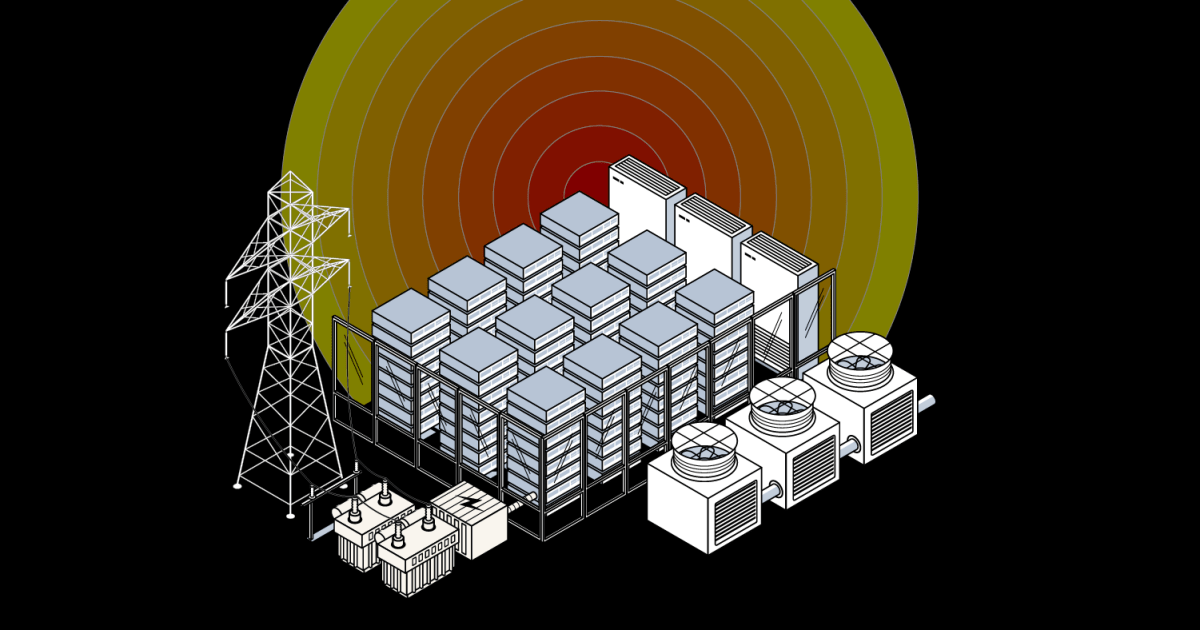
The Growing Energy Appetite of AI Infrastructure
The global race to develop and deploy artificial intelligence (AI) is leading to an unprecedented boom in the construction of specialized data centers. These facilities, essential for powering AI applications, are characterized by their intense energy demands and the considerable heat they generate. Emerging research indicates that these large-scale cloud service providers, often referred to as AI hyperscalers, are contributing to localized temperature increases in their vicinity.
A study conducted by researchers, primarily from Cambridge, has highlighted a phenomenon dubbed the “data heat island effect.” This research found that land surface temperatures around AI data centers experience an average rise of 2 degrees Celsius (3.6 degrees Fahrenheit), with some specific locations recording increases as high as 9 degrees Celsius (16.2 degrees Fahrenheit). Understanding the scale of energy consumption, the geographical concentration of these centers, and their environmental implications is becoming increasingly critical.
Energy Consumption and Operational Demands
Every interaction with AI models, such as ChatGPT, Gemini, or Claude, necessitates processing within a data center. These vast complexes house specialized computer systems that operate continuously. AI data centers are particularly energy-intensive due to their reliance on powerful chips designed for parallel processing and the continuous operation of large AI models, making them significantly more power-hungry than conventional servers used for general web browsing.
According to the International Energy Agency (IEA), data centers consumed approximately 415 terawatt-hours (TWh) of electricity in 2024, representing about 1.5 percent of the global electricity supply. This consumption has been growing at an annual rate of approximately 15 percent over the past five years, with projections indicating a near-doubling to 945 TWh by 2030. Hyperscale data centers, which are the largest facilities built by major tech companies to support global cloud computing and AI, are among the most energy-intensive. IBM defines these as typically housing at least 5,000 servers and occupying a minimum of 930 square meters (10,000 square feet).
Operating continuously, hyperscale data centers typically require between 100 and 300 megawatts of electricity, a substantial amount capable of powering hundreds of thousands of homes. This immense energy consumption inevitably generates significant heat, necessitating advanced cooling systems. Many of these systems rely on liquid cooling, which in turn consumes vast quantities of water. For instance, a report by the UK government's digital sustainability advisory body revealed that a single 100-megawatt hyperscale data center can consume about 2.5 billion liters (660 million gallons) of water annually, equivalent to the yearly needs of 80,000 people.
Global Footprint and Heat Generation
The Proliferation of Data Centers
The construction of AI data centers is accelerating globally, with over 11,600 active facilities worldwide as of June 2026. The United States leads in this expansion, hosting more than 4,300 data centers, according to Data Center Map, a crowdsourced database. Europe is the second-largest hub, with the United Kingdom having over 540 facilities, predominantly concentrated around London. Germany follows with more than 520, and France with over 390. In Asia, China (360+) and India (300+) are regional leaders, while Southeast Asia is experiencing rapid growth in data center capacity and cloud adoption. Synergy Research Group reports that the number of hyperscale data centers globally has nearly doubled since 2021, increasing from 700 to 1,297.
The Data Heat Island Effect
The study involving researchers from Cambridge and Nanyang Technological University, among others, found that land surface temperatures around AI data centers rise by an average of 2 degrees Celsius (3.6 degrees Fahrenheit) after their commencement of operations. These temperature increases can be detected up to 10 kilometers (6 miles) away. This phenomenon is analogous to the urban heat island effect, where concentrated human activities cause urban areas to be warmer than surrounding rural landscapes.
Using NASA satellite data, researchers analyzed global land surface temperatures from 2004 to 2024, cross-referencing this information with over 11,000 AI data center locations. The study specifically focused on 6,733 centers situated outside densely populated areas, comparing post-opening temperatures against a five-year baseline for the same locations. The observed temperature increases ranged from 0.3 degrees Celsius (0.54 degrees Fahrenheit) to a significant 9.1 degrees Celsius (16.38 degrees Fahrenheit).
The research suggests that more than 340 million people living within a 10-kilometer (6-mile) radius of a data center could be affected by these temperature increases. Researchers have emphasized that this impact has a “remarkable influence on communities and regional welfare” and should be an integral part of global discussions concerning environmentally sustainable AI. While most data centers are located in industrial zones away from dense population centers, their waste heat can still create localized “data heat islands,” potentially affecting nearby communities through impacts on health, energy demand, and overall well-being.
Future Investments and Expansion
Investment banks like Goldman Sachs project substantial capital expenditure in the coming years. They anticipate a combined $5.3 trillion in capital expenditure between 2025 and 2030 for the four largest hyperscalers: Microsoft, Amazon, Alphabet (Google), and Meta. Major upcoming projects underscore this trend, including Meta's $27 billion Hyperion campus in Louisiana, Microsoft's multiphase $20 billion data center campus expansion in Wisconsin, Amazon's $25 billion investment in Mississippi data center infrastructure, and Google's Project Spade, a $15 billion hyperscale data center campus in New Florence, Missouri. Additionally, Oracle's Project Stargate in Abilene, Texas, is poised to become a massive AI supercluster dedicated to OpenAI, with a total capacity ranging from 1.2 GW to 2 GW, further highlighting the industry's rapid expansion and the escalating demand for robust AI infrastructure.
Source: Original Article
Related Articles
 technology
Indian Workforce Contributes to AI Robot Development Amidst Automation Concerns
 technology
Prediction Platform Kalshi Enhances Security to Combat Insider Trading
 technology
Kenyan Graduates Embrace AI and Digital Tools for Sustainable Farming Amidst Job Scarcity
 technology