
The Genesis of Brexit: A Historical Context
On June 23, 2016, a referendum saw a narrow majority of British citizens vote to exit the European Union (EU), concluding years of debate regarding the UK's relationship with the bloc. This decision, now a decade old, has prompted a comprehensive examination of its consequences, particularly in light of the ambitious assurances made by proponents of leaving the EU.
Britain's engagement with the European project began long before the referendum. In 1973, facing a period of economic stagnation, the UK joined the European Economic Community (EEC), a six-member trading alliance. Historical data from the Centre for Economic Policy Research (CEPR) indicates that while Britain's GDP per capita was significantly higher than EEC nations in 1950, it had fallen behind by 1973. This economic context underpinned the initial decision to join. However, skepticism regarding deeper European integration persisted throughout the subsequent decades, transcending traditional political divides. Notably, the Labour Party's 1983 manifesto even advocated for withdrawal from the EEC, viewing it as an obstacle to socialist ideals, though this stance was later reversed.
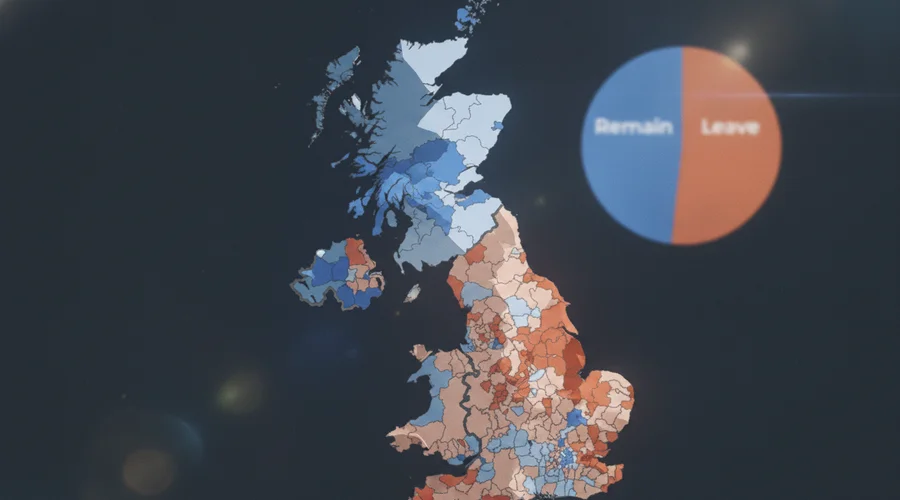
By the early 2010s, growing pressure from Eurosceptic factions within the Conservative Party, exacerbated by the rising influence of the UK Independence Party (UKIP) led by Nigel Farage, compelled then-Prime Minister David Cameron to promise a referendum on EU membership if re-elected. The vote, held on June 23, 2016, ultimately resulted in a 'Leave' victory, with 51.9 percent voting to depart the EU against 48.1 percent who favored remaining. Regional variations were notable: England and Wales both saw approximately 53 percent vote to leave, while Northern Ireland and Scotland recorded 44 percent and 38 percent 'Leave' votes, respectively. Generally, smaller towns and rural areas tended to support leaving, contrasting with major cities that predominantly voted to remain.
Political Landscape and Leadership Changes Post-Vote
The referendum deeply divided British politics, even within Prime Minister Cameron's own cabinet. Cameron, alongside Chancellor George Osborne, led the 'Remain' campaign, supported by most of the Conservative Party, the Labour Party, the Liberal Democrats, and the Scottish National Party. Conversely, prominent Conservative figures like Boris Johnson and Michael Gove championed the 'Leave' cause. Nigel Farage, whose party had been instrumental in pushing for the referendum, was a highly visible figure in the 'Leave' campaign and later founded the Brexit Party (now Reform UK) in 2018.
Following the 'Leave' vote, David Cameron resigned, and Theresa May assumed the premiership with the mandate to deliver Brexit. Her efforts to secure a withdrawal agreement, however, faced significant parliamentary opposition and ultimately failed in 2019. Boris Johnson succeeded May, overseeing the UK's formal departure from the EU on January 31, 2020.
Economic Repercussions: GDP, Investment, and Productivity
A decade on, economic indicators present a complex picture. Real GDP per capita, which measures the inflation-adjusted total value of goods and services produced per person, has demonstrably lagged behind the average of the EU's 27 member states. Projections suggest an average annual growth of merely 1.3 percent between 2026 and 2030, attributed to persistent trade barriers and structural economic adjustments. Business investment in the UK also reflects this trend, with a significant pullback observed after the 2016 vote. Some analyses estimate an investment shortfall of 12 to 18 percent compared to a scenario without Brexit, largely driven by prolonged political and regulatory uncertainty that deterred corporate decision-making. The Office for Budget Responsibility (OBR) estimates that Brexit has diminished the country's productivity by approximately four percent.
Trade Dynamics and the Cost of New Borders
The OBR further indicates that long-term trade with Europe is projected to be about 15 percent lower, with new trade agreements outside the EU not substantially offsetting this decline. Leaving the EU meant abandoning a system of frictionless cross-border movement for goods. The current EU-UK Trade and Cooperation Agreement (TCA) imposes new requirements on British exporters, including proving product origin, retesting goods already certified in the UK, and managing additional paperwork that did not exist before 2021. Food exporters face physical border inspections, and businesses handling data must navigate two distinct sets of regulations. HSBC Global Investment Research estimates that border checks alone have cost the UK £4.7 billion ($5.9 billion) up to 2024, with sanitary controls on food trade incurring an annual cost of approximately £54 million ($71.5 million). While larger enterprises have generally absorbed these new burdens, many smaller businesses have found it unfeasible, leading some to cease exporting to the EU entirely.
The Sterling's Performance
The immediate aftermath of the referendum saw a dramatic fall in the value of the pound, plummeting over 10 percent against the dollar within hours, reaching levels not seen since 1985. This depreciation made imports more expensive, contributing to increased prices for British consumers. Given the UK's substantial trade deficit, it relies heavily on foreign investment to balance its finances. As trade barriers have hindered economic growth, the attractiveness of the UK for foreign investment has diminished, maintaining downward pressure on the currency. Investment banks, uncertain about the UK's future relationship with the EU, began relocating operations to mainland Europe. A decade later, the pound has not fully recovered to its pre-Brexit valuation, remaining constrained by the structural changes resulting from leaving the EU.
Migration Trends: A Shifting Landscape
One of the key promises of the 'Leave' campaign was a reduction in migration. While the UK did regain control over its borders, replacing free movement for EU citizens with a points-based immigration system, the outcome has been nuanced. Net long-term migration from the EU turned negative by 2022, indicating more EU nationals left than arrived. However, this decrease in EU migration did not lead to an overall reduction. Instead, net arrivals from non-EU countries surged, pushing total net migration to a record high in 2023. Although tighter rules introduced in 2025 have since led to a decrease, migration levels remain higher than they were before Brexit.
Legislative Divergence and New Freedoms
Upon leaving the EU, thousands of European regulations that had automatically applied in UK law were transposed into domestic legislation – approximately 6,800 pieces – to prevent a legal vacuum. A decade later, only about a third of these have been amended or repealed. The government enacted the Retained EU Law (Revocation and Reform) Act to accelerate these changes, but this fast-track mechanism is set to expire on June 23, 2026, meaning future divergence from EU rules will proceed through slower parliamentary processes. Nevertheless, Brexit did enable the UK to introduce laws it could not as an EU member, such as banning the export of live animals for slaughter, regaining control of its territorial waters by ending the EU's Common Fisheries Policy, and removing VAT on women's sanitary products.
Evolving Public Sentiment on Brexit
The 2016 referendum revealed a closely divided nation. Ten years later, public opinion has notably shifted. A June 2026 YouGov poll indicates that 57 percent of Britons now believe leaving the EU was the wrong decision, compared to 30 percent who still view it as the right course of action. A separate Ipsos poll found that 52 percent of Britons think the UK should apply to rejoin the EU. Among younger demographics, approximately two-thirds of 18- to 24-year-olds – many of whom were too young to vote in 2016 – express a desire to rejoin, a sentiment shared by just over a third of those over 65.
Source: Original Article
Related Articles
 politics
The Enduring Influence of Meir Kahane on Contemporary Israeli Politics
 politics
A Decade On: The Enduring Societal Impact of Brexit Beyond Economics
 politics
NYC Council Member Mamdani Clarifies 'Monsters' Remark Regarding AIPAC
 politics